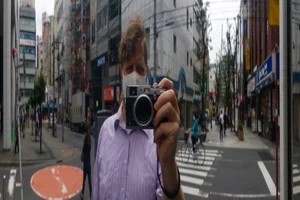
Vintage brass and glass from Nikkor
A camera bag is a list of everything its owner is afraid of missing. Mine holds one lens. The other is already on the camera.
On 19 October, Japan Camera Hunter ran my bag as In Your Bag No. 1788. Bellamy laid it all out: the Z9, the vintage Nikkors, the green canvas bag that was never meant for cameras. A gear feature has room for the list. It doesn't have room for the reasons. This post is the reasons.
The rule
Two lenses. One on the Z9, one in the bag.
The body stays in my hand nearly all day. So the bag only has to carry what isn't on the camera, and the rule keeps that to almost nothing. Twenty-five years in Tokyo have left me with more glass than any one walk needs. The rule is what stops it all coming along.
There are no fixed pairs. The place decides, or the light does, usually on the train that morning. A flat grey afternoon in Nakano and a weekday platform at Shinagawa don't want the same glass, and no pairing I could name in advance would suit both.
The second lens isn't a spare. It's the one other question I'm allowed to ask the street that day. Every lens beyond that is a decision about equipment, and every decision about equipment is a moment I'm not looking.
The bag itself is the oldest thing in the feature that isn't glass. It was my first camera bag in Japan, and it isn't really a camera bag at all.
"It is old, trustworthy, hand-stitched, and it's not even a real camera bag."
It's close to retirement now. The rule will outlive it.
Five lenses, five streets
The feature lists four lenses. There are five candidates now: the Nikkor-S Auto 35mm f/2.8 has joined the rotation. Here is why each one earned its place, and the street where it does its best work. (For the longer argument about lengths in general, see the best focal length for street photography.)
Nikkor Auto NC 24mm f/2.8 · Togoshi-Ginza
The 24 earned its place by refusing to let me hide. At one or two metres there is no neutral position. Either you are inside the scene, or you have made an inventory of it. This was Nikon's first lens with close-range correction, a floating element that keeps the edges disciplined at short distances. That is exactly the range a 24 wants to work in. The NC version adds multi-coating.
Togoshi-Ginza suits it. The shōtengai runs long and narrow, and the signage hangs low enough to touch. The 24 holds the shopkeeper and the shop in one frame without either one turning into the background. Turn it toward a lit facade at dusk, and the highlights bloom a little at the edges. I leave that in. It records the light that evening.
Nikkor-S Auto 35mm f/2.8 · Yūrakuchō
The S stands for seven elements. This is the 1962 redesign of one of Nikon's oldest working lenses, revised for decades and never made famous. It earned its place by being forgettable. The colour is warm but neutral. It's sharp where you focus, and small enough that nobody on the street reads it as serious equipment.
Under the brick arches at Yūrakuchō, the light is dim, directional and full of gaps. Point older glass toward the mouth of an arch, and you learn its manners at once. The 35 gives a little flare, the controllable kind, and keeps the shadows from going to mud. I wrote up a whole day with it in the field test. The verdict still stands: unremarkable, which is the point.
Nikkor 50mm f/1.4 AI-S · Nakano
This is the youngest lens in the bag, from the early eighties, and it works at conversation distance: close enough to matter, not so close that I change what I'm watching.
The 50 is also where zone focusing runs out. At f/8, focused at two metres, the zone that stays in focus is under eighty centimetres deep on full frame (using a 0.03 mm circle of confusion). The same settings on the 35 give you roughly 1.4 to 3.3 metres. So the 50 asks you to actually focus, and that slows you down. (The arithmetic is in zone focusing for street photography.)
On flat grey afternoons in Nakano, the old shopfronts don't need dramatic light, and the 50 doesn't invent any. Wide open, it softens the overhead fluorescents into atmosphere. Stopped down to f/4, it turns graphic. The aperture ring sets the mood as much as the exposure.
Nikkor-H Auto 85mm f/1.8 · Kōenji
The H stands for six elements. The lens is mid-1960s and single-coated. It earned its place through distance: the 85 works from where you'd stand if someone had let you look. Against the light, the contrast rolls off, and the frame turns interior. Highlights keep their colour and shadows open up. Wide open, the edges swirl a little. That's the lens's signature, not a fault. (More in the H-Auto 85 review.)
In the Kōenji record shops, collectors stand at the racks in silence, and the way they pay attention is the subject. The 85 keeps that at a polite distance without flattening the shop behind them into nothing.
Nikkor-Q Auto 135mm f/3.5 · Shinagawa
The Q stands for four elements. It is the simplest formula Nikon made at this length, and the most graphic lens I own. It earned its place by making layers legible. Overhead wire, signage and commuters stacked at different depths read as a composition instead of a crowd.
On a weekday morning at Shinagawa, with the Keikyu express loading, the 135 works from thirty metres. No one knows I'm there. That is exactly why it brings a question with it, one I ask before I raise the camera: does this scene call for an eavesdropper? Some do. Many don't. The lens makes me decide.
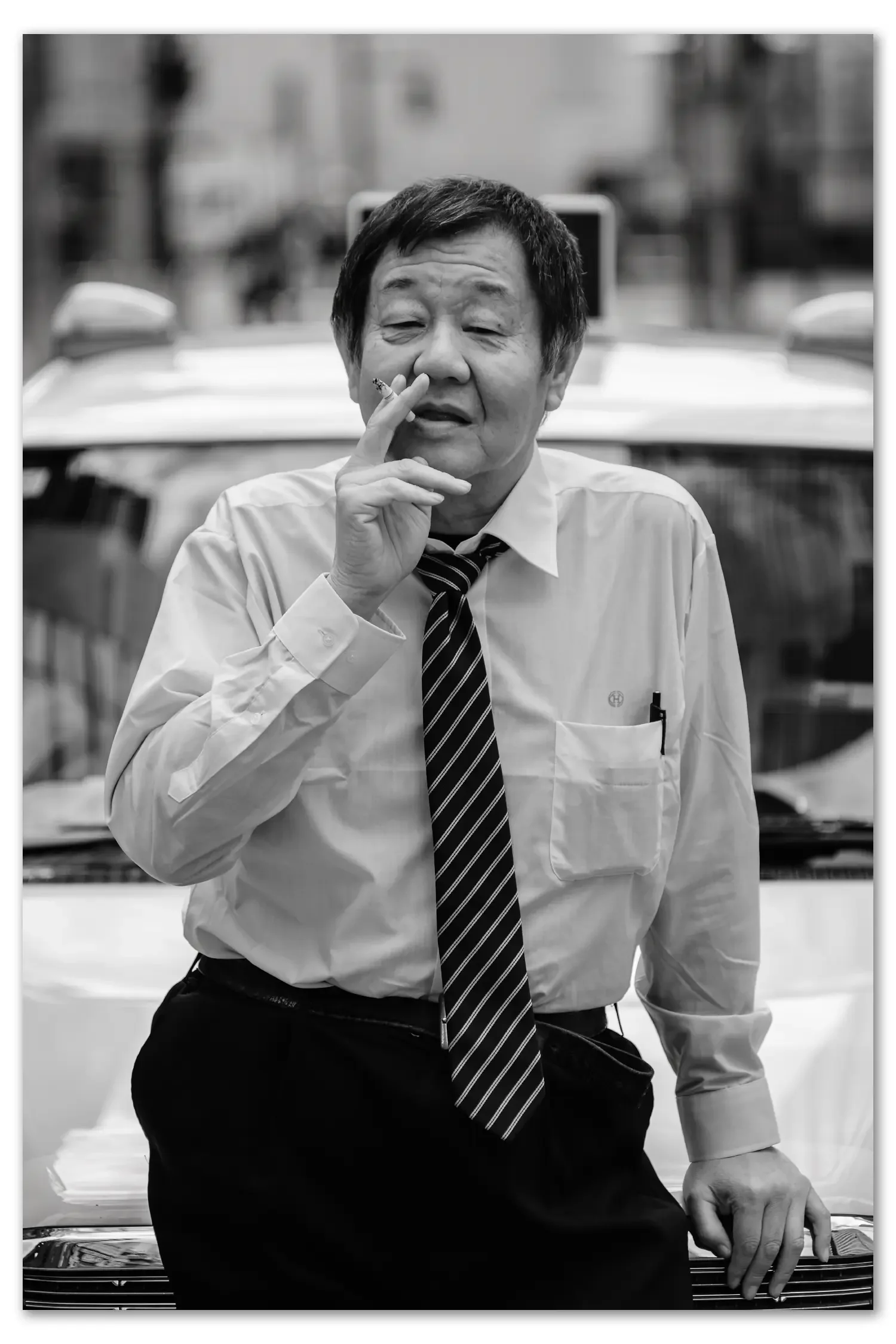
Nikkor-Q Auto 135mm f/3.5 Shinagawa Portrait
What the rule protects
None of these lenses is new, fast to focus, or rare. All are manual, and none is what I'd take on a paid job. In the feature, I put what they share in one line: sharp where you want it, gorgeous fall-off everywhere else. I keep that from turning into a collection by doing two at a time.
The bag is ready to retire. The rule isn't.
Read the full feature at Japan Camera Hunter: In Your Bag No. 1788 – Tokyo Forgeries – Jeff Austin
What's the one lens you'd keep in the bag? Drop a comment below.
I live on flat whites and shutter clicks. If you've found value in these shots, toss a coffee my way.
If you want to skip the tourist traps and shoot the real Tokyo, my calendar is open for workshops. Explore the Masterclass here, or email me at jeff@tokyoforgeries.com.
The streets never look the same way twice. I’m curious—how does this side of Tokyo hit you? Drop a comment below.
I live on flat whites and shutter clicks. If you’ve found value in these shots, toss a coffee my way to keep the sensor humming.
For those who want to skip the tourist traps and shoot the real Tokyo, my calendar is open for workshops. Explore the Masterclass here or email me at jeff@tokyoforgeries.com.
See you in the shadows.
Tokyo Forgeries is an evolving archive of Tokyo street photography and vintage-lens deep dives. We spend 30 days in every ward, using mid-century brass and glass to capture the city’s soul. This is a roadmap for the active pursuit of craft—documented through the geography of Tokyo and the character of its light.