The best photograph in a market is rarely the first one you see. It's the one you come back around for. I find that attempt number two is when you get the best pictures, and on a long day through Ueno, Asakusa and Shinjuku, the second pass earned almost every frame I kept.
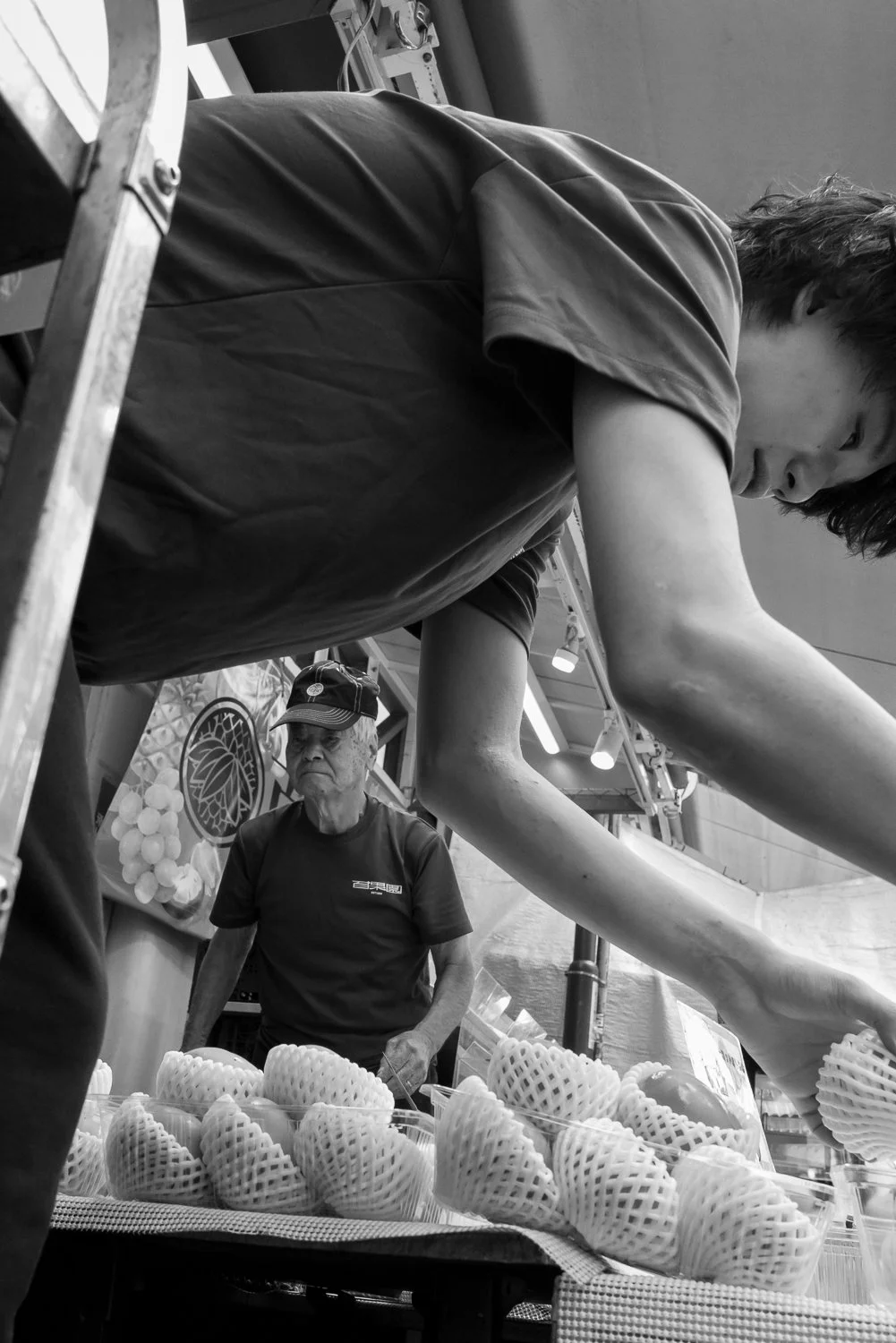
Ueno Market fruit vendor
Walking Ameyoko in figure-eights
Whenever I help another street photographer's workshop with logistics, the Ameyoko market in Ueno is high on the list. More often than not, the light is very good. Visit early in the morning, and there are only a few people. Within an hour, it's bustling and overwhelming. Both make for strong image opportunities.
I know this ground well, so I can make sure the participants and the teacher all find good images. If they're all finding good images, they're happy. It also gives me time to shoot alongside them, which creates a wonderful atmosphere.
For me, the best part of the Ueno market is that it's part of old Tokyo. With old Tokyo, you get a lot of character, and even more so, you get a lot of characters who have a lot of character. They make the most fascinating subjects for street photography, and that's what I look for every time I'm in Ueno.
Ameya-Yokocho grew out of a post-war black market, and it still runs along and under the elevated tracks between Ueno and Okachimachi stations.
Because the market follows the tracks, there are several loops you can walk in a figure-eight. I ask people to go through one loop, turn around and go back through the other, then do the first loop again, so you see everything from both directions. If there was something you wanted to photograph but were a little scared, or too busy, or it wasn't quite the moment, you get another chance as you come back around.
This is good for the subject, too. They don't feel like somebody is hovering over them, trying to steal a photo. You went with the flow of the crowd, and now you've come back around for attempt number two.
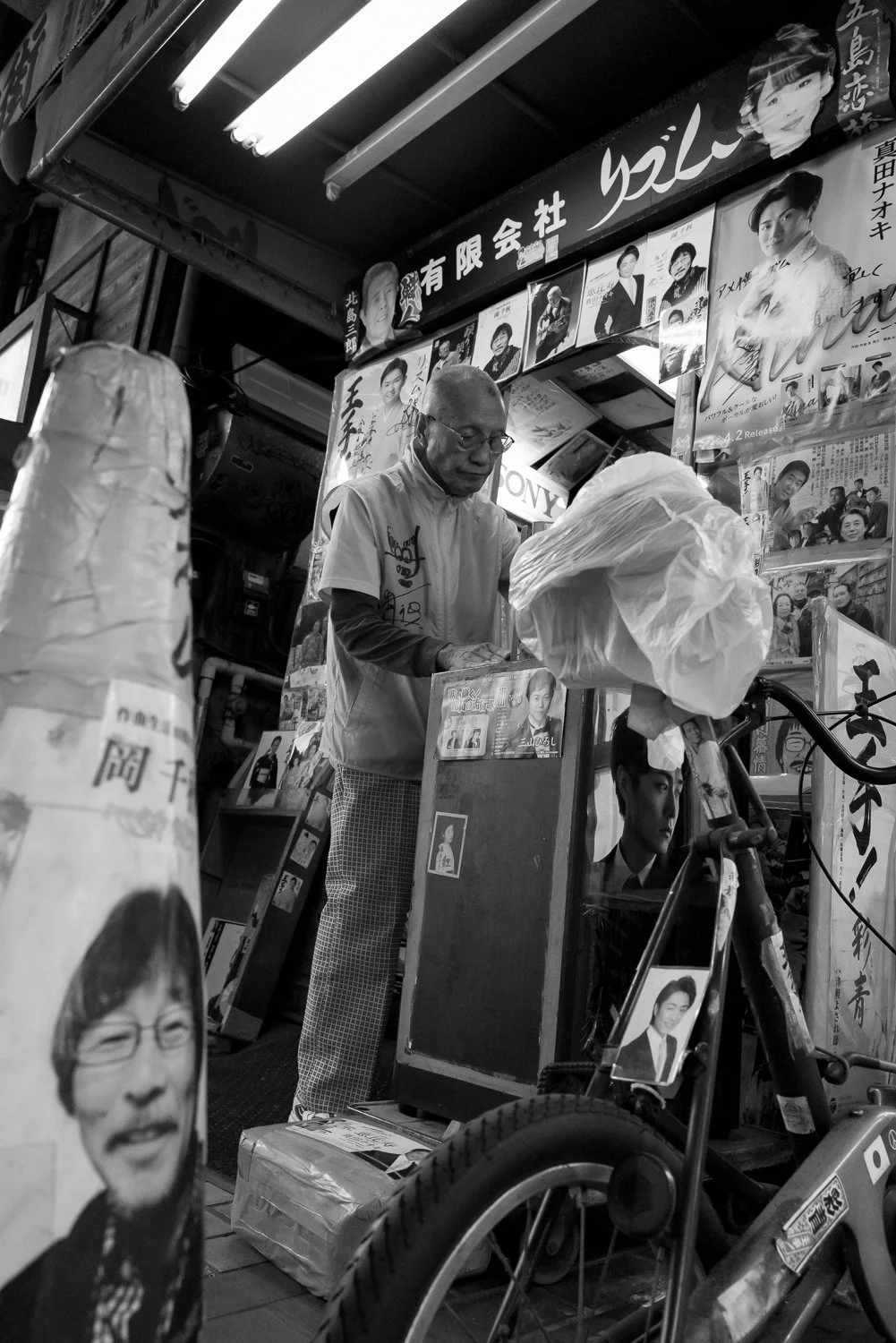
The many faces of Ueno Market’s character
Walking from Ueno to Senso-ji
Most groups would hop on the subway for two or three stops from Ueno to Asakusa. I prefer to walk the narrow streets and get a good feeling for old Tokyo.
This area is dotted with dozens, if not hundreds, of small shrines and temples and generations-old family shops. To the casual observer it has a kind of built-in nostalgia, except it's not nostalgia. It's everyday life.
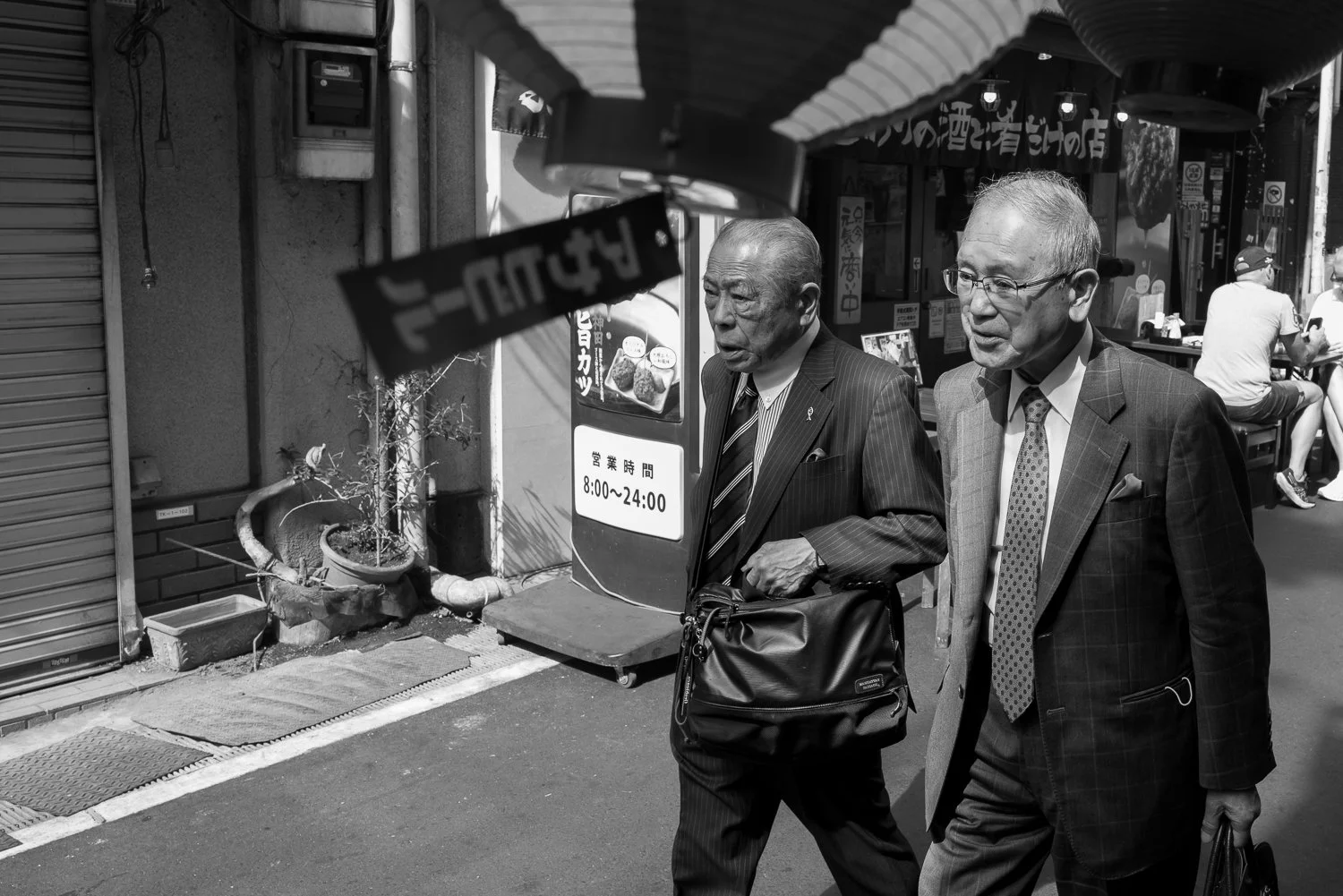
Ueno Market at lunchtime
Plan your route right and you'll find yourself in the middle of Kappabashi, which is loaded with texture and colour and is quite lively. It also lets you enter the Asakusa shopping streets on the outskirts of Senso-ji, away from the massive crowds at the main gates.
As you move towards the main temple, the crowds slowly grow. That gives everybody a moment to acclimatise. Even on my own, it gives me space and time to shoot. I don't always like to jump straight into the massive crowd. There's plenty of chance to do that every day in Tokyo, so when I can avoid it, I often do. This stretch is much larger than the market in Ueno, and the steps add up. It's easy to put in 10,000 in a couple of hours. That's a good chunk of the 25,000, and they're well worth it.
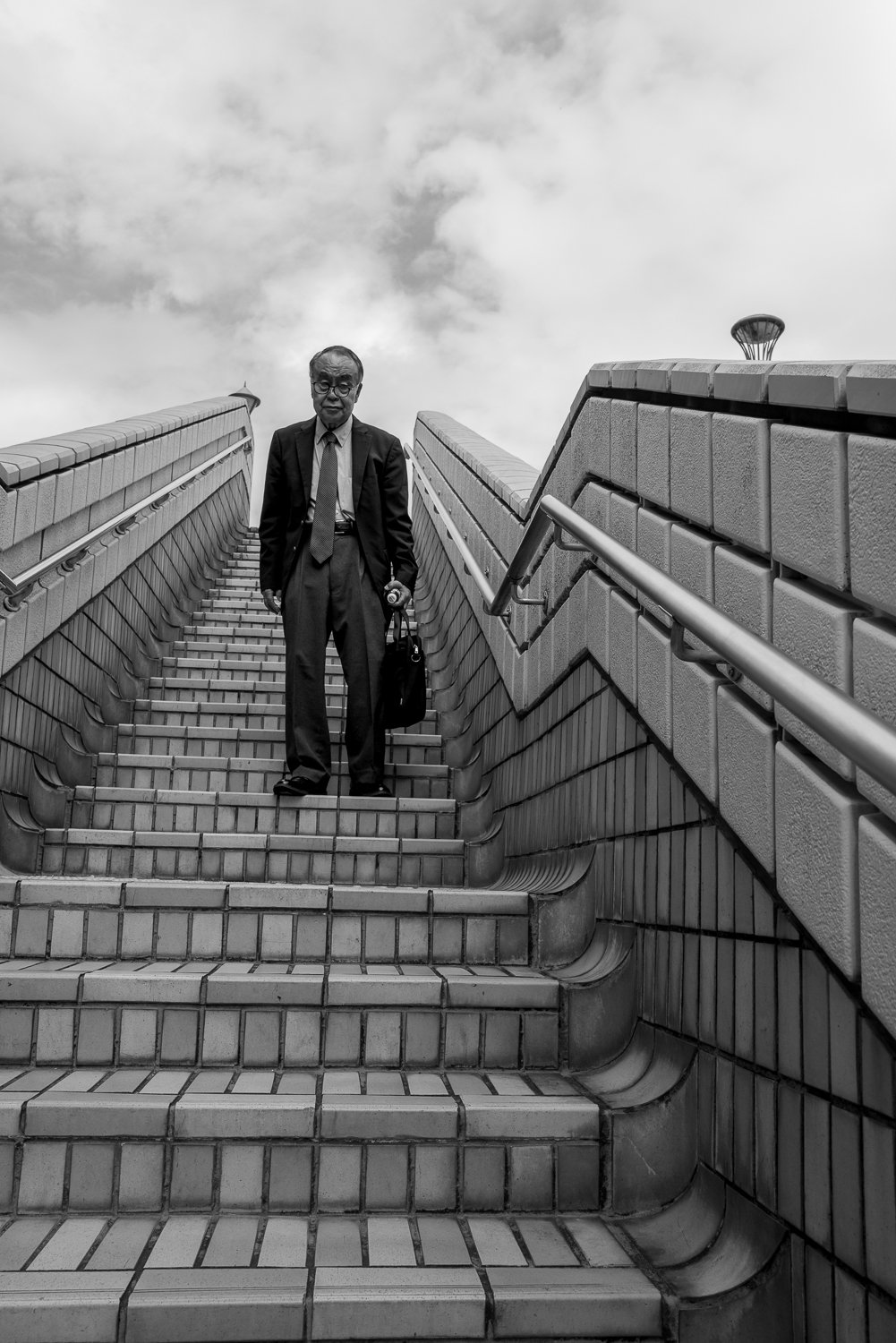
Pedestrian walking bridge near Ueno Station
The Jokoro at Senso-ji
The real draw at Senso-ji is the Jokoro (常香炉), the great cauldron in front of the main hall where people burn incense and draw the smoke over their bodies. It's a ritual purification. For me, it's fascinating because people of every culture, religion, age, shape and size come through those gates to that cauldron. They all do it a little differently, yet they all do it the same.
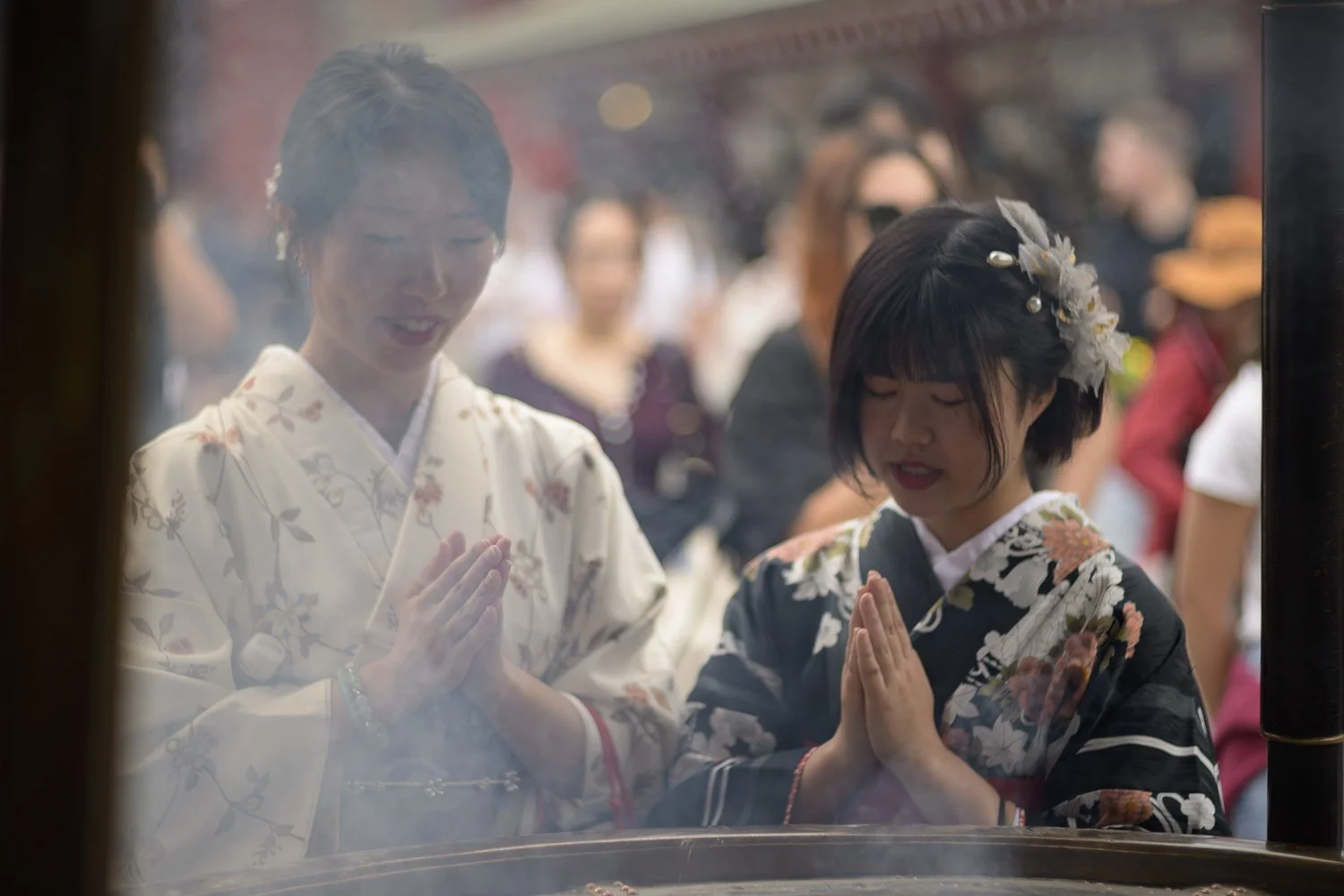
Two women at prayer: Senso-Ji Jokoro
If you're a street photographer and you only visit one temple or shrine in Japan, I'd say this is the one. Yes, there are massive crowds. Yes, there are lots of tourists. But many of those visitors are on a pilgrimage, and many are curious and fascinated by what they're seeing. It's not Disneyland. It's a holy site, and that fact makes for compelling images.
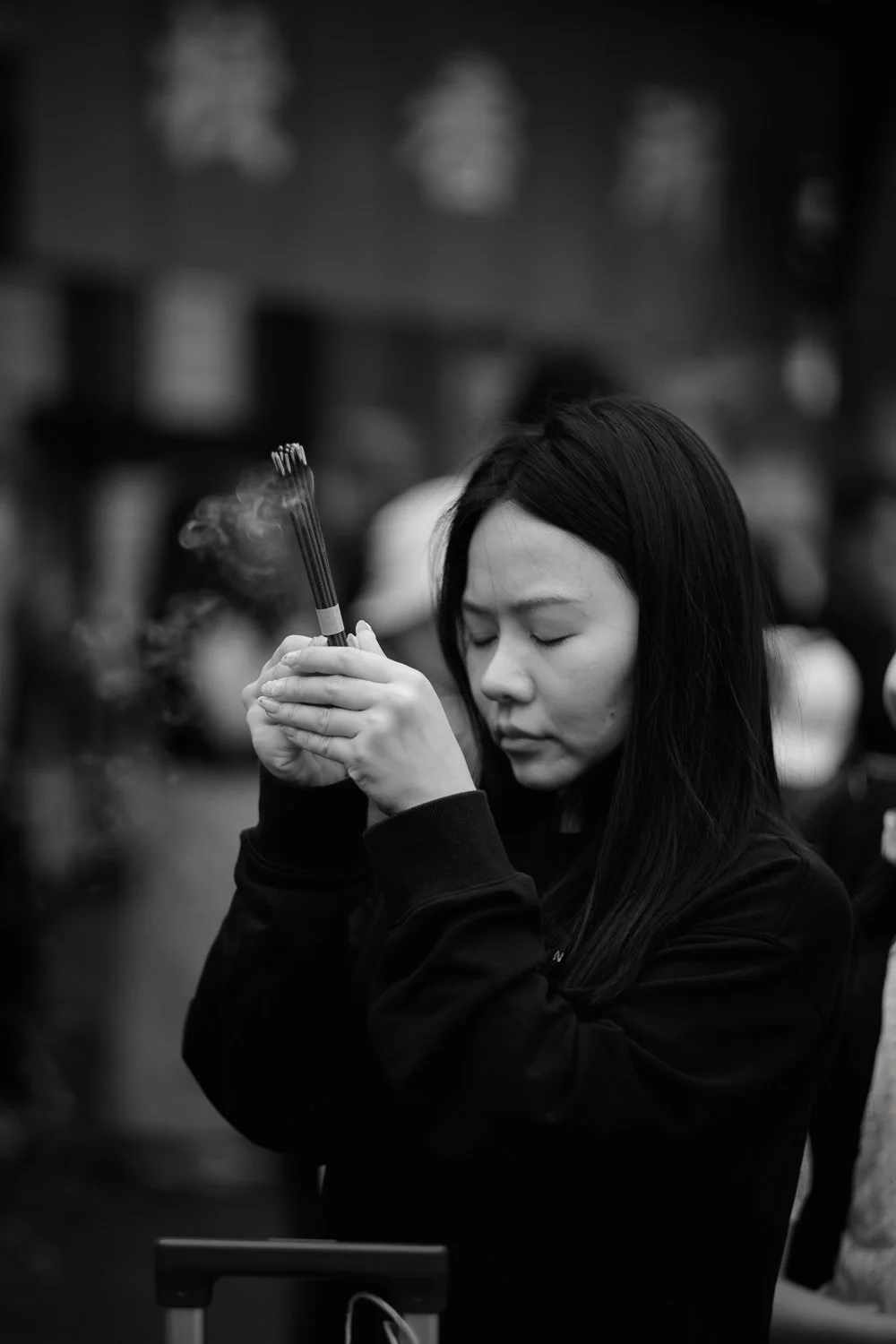
Senso-Ji, deep in prayer. Black and white street photography.
![An elderly man with a white crew cut smiles as he wafts incense smoke from the Jokoro towards his face, Senso-ji, Asakusa]](https://images.squarespace-cdn.com/content/v1/5edf1b5a80a94a6733cf75f3/f5afff45-798d-4fa3-af71-3ab4b873c0c8/20261013-_DSC596220.jpg)
Catching incense at Senso-ji's Jokoro
Panning the Asakusa rickshaw
Next to people praying, the rickshaw is by far my favourite thing to shoot around Senso-ji and Asakusa Station. In particular, I love to shoot the rickshaw in motion, ideally with a pan.
Some days, in some places, you don't see as many as you'd like. So it's a waiting game, a patience game. You need your A-game. You have to know what you're doing with panning, and your settings- focus and exposure all have to be dialled in before the rickshaw goes by. The only adjustment you make is matching your pan speed to the driver's.
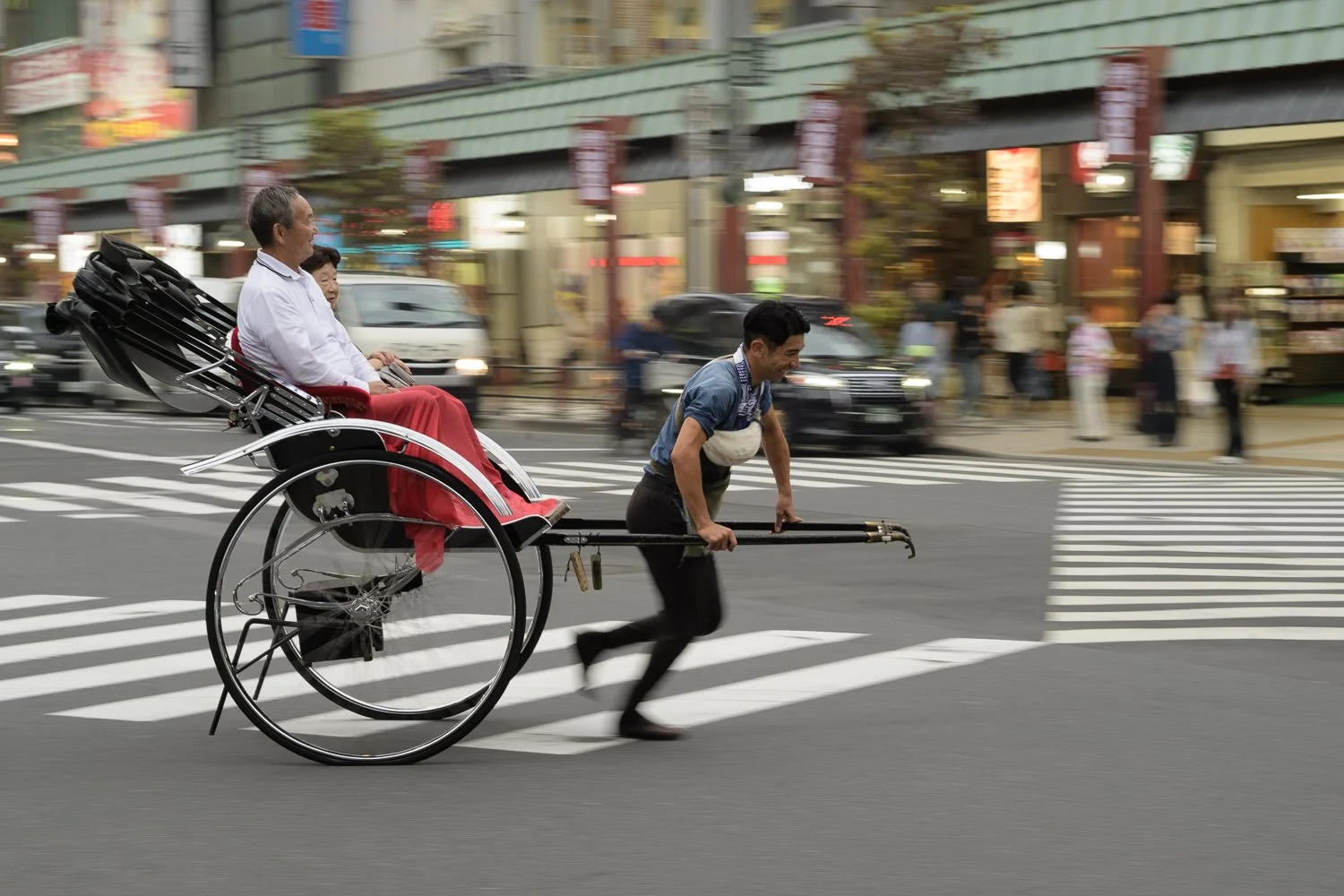
A speedy rickshaw at Senso-Ji Temple
I often stand near the main gate because a lot of rickshaw drivers tend to gather there. But moving a few blocks left or right can give you very interesting results. It's a matter of finding a safe place to stand with an interesting background. Expect a 99% failure rate. When one or two do work, they usually work well. It makes me really happy.
Both frames here are at 1/50 of a second.
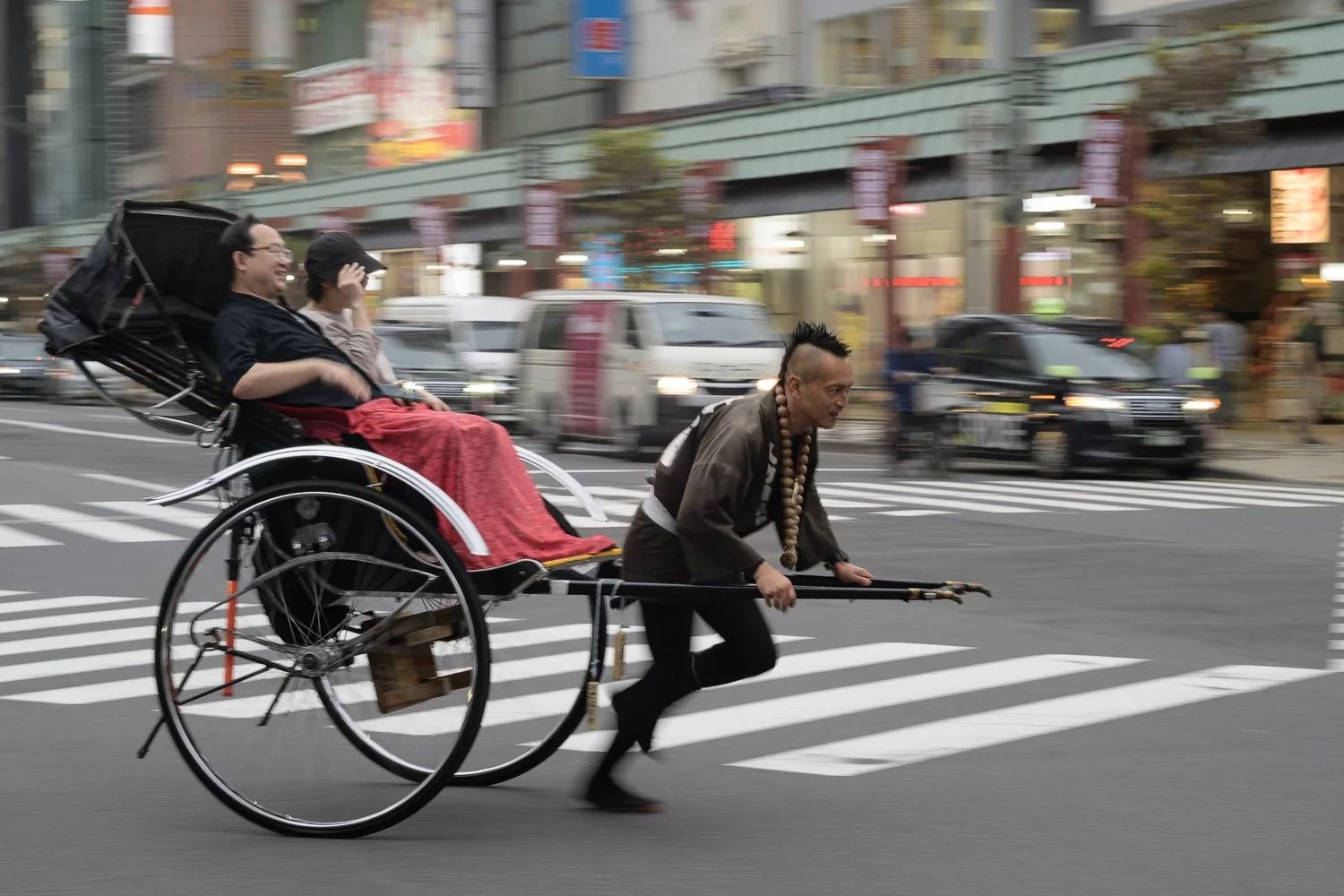
Exceptionally fast rickshaw driver with a mohawk at Senso-Ji Temple
Shutter drag on the Shinjuku Station platform
After a long day on the market streets of Ueno and Asakusa, there's no better nightcap than Shinjuku Station. Many people race out of the station and into Kabukicho, Omoide Yokocho, or out of the East, West, or New South exits to get their fill of neon and the nightlife Shinjuku has to offer. But for those of us with a little more patience, the train platform offers something special.
Slow your shutter down just a little. On this evening, that meant a tenth to a fifteenth of a second. Use your camera strap for extra steadiness, and wait for the train to reach full speed as it passes or pulls out. You get a beautiful blur while your subjects stay sharp.
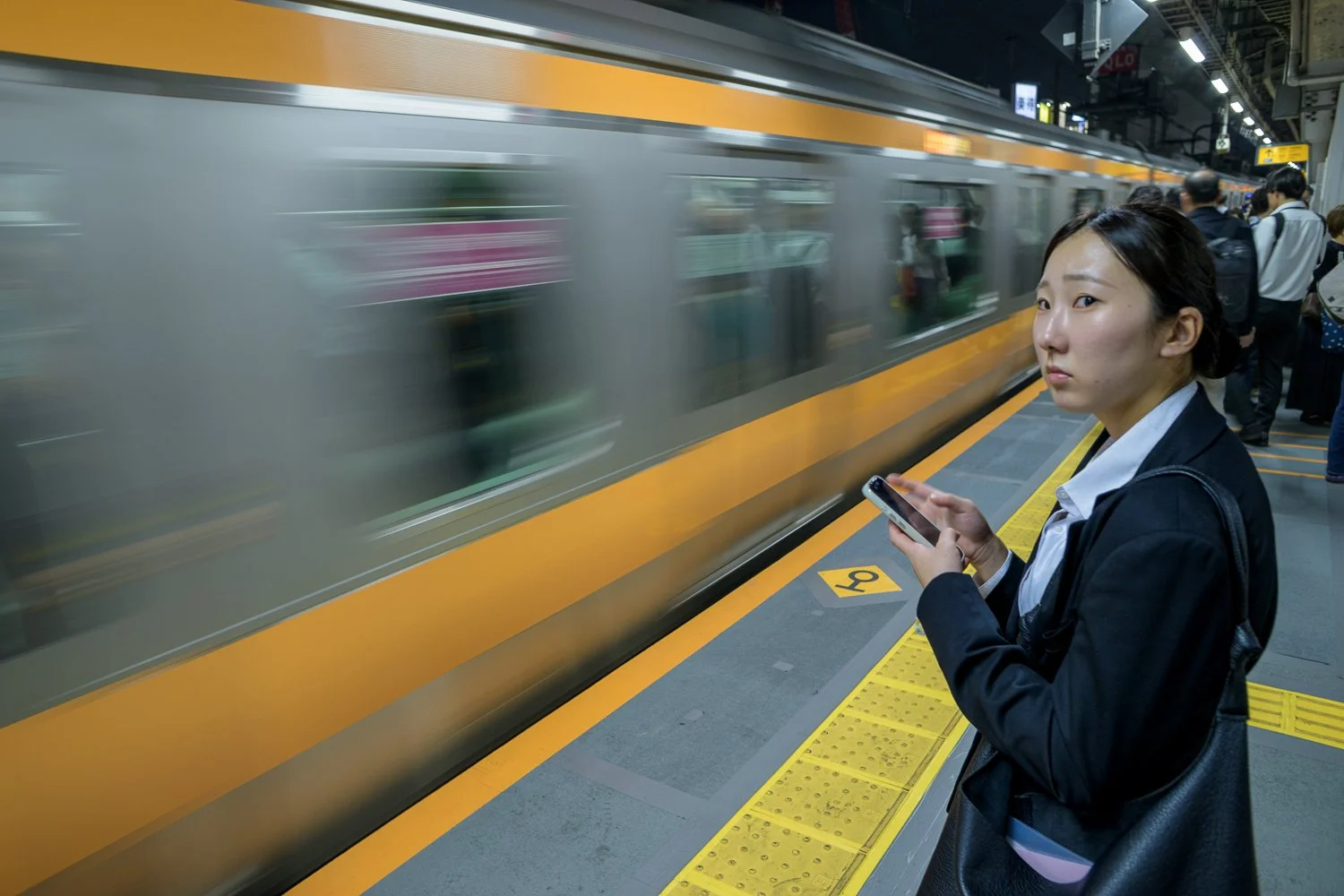
Street Photography Masterclass at Shinjuku Station
The station is brightly lit and full of colour. ✎ More than three and a half million people pass through it every day. I never tire of shooting there, and I always come home with something a little different from the last time.
Occasionally, luck plays a role. The group I was working with was very much into flash, and they were panning with it. In several of my frames, the train is lit by someone else's flash, because I was shooting at a very slow shutter speed. Sometimes that ruins a shot. More often it made for something interesting and dynamic. In one frame you can see the photographer, and the pop of his flash off to the left.
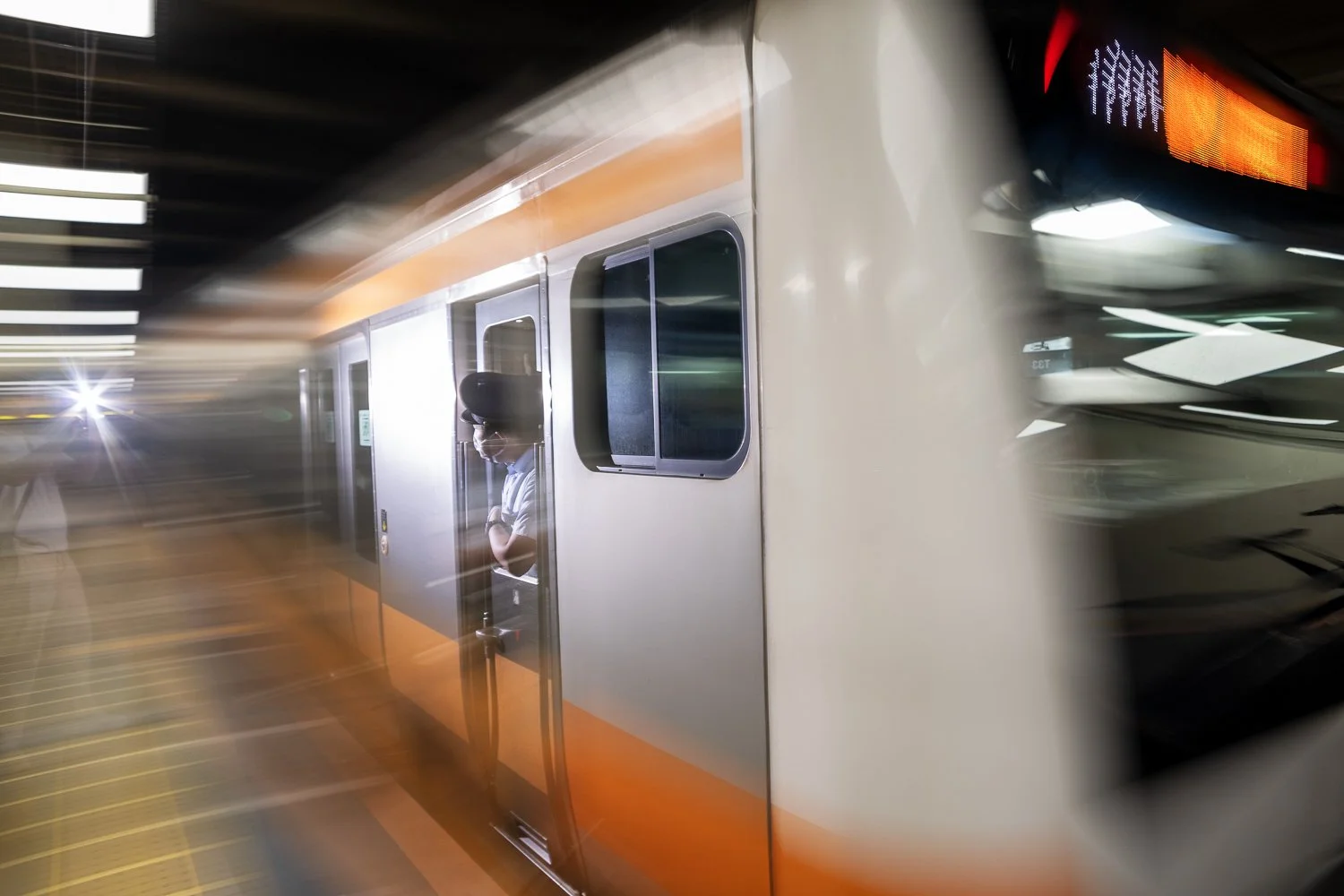
Tokyo Street Photography Masterclass at Shinjuku Station with Flash
Street photography workshop logistics in Tokyo
There's nothing I love more than sharing the street with someone like-minded. In my own masterclass, I like to work one-on-one, or occasionally with a small group of two or three people, usually friends or family. I find this creates a deep connection and a great chance to capture many strong images.
I also do a lot of logistics work for visiting street photographers who run their own workshops and masterclasses in Tokyo. These groups are usually larger, five to ten people, running for five days to a week. I share some of my favourite locations and the best times of day, so each participant comes away with something special.
I'm lucky to work with some very talented street photographers who have large social media followings. Most of the time, though, I work with people like me, who have smaller followings and want to share their knowledge and their love of street photography with the people who follow them.
A long day, well spent
By 25,000 steps, my feet are usually done. Even if I want more street photography, I don't need to feel bad about calling it a day, because I know I've got a number of solid images. That makes anyone happy.
The route: figure-eights through Ameyoko, photographing the characters of old Tokyo. A walk from Ueno to Asakusa through Kappabashi, past old neighbourhoods, shrines and temples, and a lot of local flavour. Senso-ji, and its visitors taking a moment to purify and pray at the Jokoro. Then the light show of Shinjuku Station. It's a simple thing, walking from place to place to contrast the old with the ultra-modern, documenting the people along the way. It's also one of the most fulfilling ways I know to spend a day.
The first pass shows you where the picture is. The second pass is where you make it.
If you're running a workshop in Tokyo and need a local hand with routes, timing and logistics, or you'd like to walk with me one-on-one, the details are under Masterclass in the main menu. Email me, and we'll talk about what your group needs.
— Jeff Austin, Tokyo
The streets never look the same way twice. I’m curious—how does this side of Tokyo hit you? Drop a comment below.
I live on flat whites and shutter clicks. If you’ve found value in these shots, toss a coffee my way to keep the sensor humming.
For those who want to skip the tourist traps and shoot the real Tokyo, my calendar is open for workshops. Explore the Masterclass here or email me at jeff@tokyoforgeries.com.
See you in the shadows.
Tokyo Forgeries is an evolving archive of Tokyo street photography and vintage-lens deep dives. We spend 30 days in every ward, using mid-century brass and glass to capture the city’s soul. This is a roadmap for the active pursuit of craft—documented through the geography of Tokyo and the character of its light.