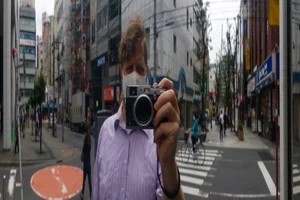
Zone focusing means setting your aperture and focus distance in advance so that everything within a known band is acceptably sharp — and then not touching focus again. I work at f/8, or f/11, focused at about two metres: on a 35mm lens that keeps roughly 1.4 to 3.3 metres sharp at f/8, and 1.3 to 4.25 metres at f/11. It works best with wide lenses in daylight, and it breaks down at 50mm, at night, and if you crop hard.
Autofocus is better than you at finding a face. It has no idea which face matters.
That sentence is the whole argument. Zone focusing is not a speed trick, and it is not nostalgia. It is the decision to stop asking the camera what the photograph is about — made in advance, at the curb, so that when the moment arrives you are watching instead of aiming.
Here is what I actually do.
Aperture: f/8 or f/11. Distance: about two meters. Auto ISO, with exposure compensation under my thumb. Shutter fast enough for a walking stride. Then I stop touching the camera.
That is it. The rest is understanding why those numbers, and where they stop working.
What the zone actually is
Set your focus to two metres on a full-frame body, and this is the band that comes back acceptably sharp:
- 28mm: f/8 1.25 – 5.05 m; f/11 1.09 – 11.8 m
- 35mm: f/8 1.44 – 3.25 m; f/11 1.31 – 4.25 m
- 50mm: f/8 1.68 – 2.46 m; f/11 1.59 – 2.69 m
Read the table properly, because it contains the entire technique.
A 28mm at f/11, focused at two metres, is sharp from just over a metre to nearly twelve. You can walk an alley all afternoon and never think about focus again. A 35mm at f/8 gives you about a metre and eighty of working room, which is enough for one person arriving where you decided they would. And a 50mm at f/8 gives you seventy-eight centimetres — less than an arm's length of usable zone. At that point zone focusing has stopped being a technique and become a bet.
So: the wider the lens, the more forgiving this gets, and the longer the lens, the faster it falls apart. Nobody tells beginners that, and it is why their first attempt fails.
Why two metres
Because that is how close I work. Two metres is where a person occupies the frame the way I want them to, and it puts the near edge of the zone tight in front of me where somebody might cross unexpectedly. Set it at three, and everything shifts outward — at 35mm and f/8 you would be sharp from 1.9 to 7.2 metres, which is a fine choice if you stand further back than I do. The number is not holy. It is a statement about the distance you are willing to be from a stranger.
Why auto ISO
Because the light in these alleys changes by a full stop in three paces, and I refuse to spend the moment doing arithmetic. Aperture and shutter are decisions about how the photograph looks. ISO is just the tax you pay for the light you were given.
Exposure compensation is the one dial I keep a thumb on, and it is not a formality. Under the tracks, with a person in a shaft of light and a black market behind them, the meter will try to rescue the shadows and blow the only thing you came for. Compensation is how you tell the camera the scene really is that dark. It is the fastest correction available and the only one worth making while something is happening.
The drill nobody does
Learn what two metres looks like. This technique does not fail on the mathematics; it fails on distance estimation — the photographer is sure the man is two metres away, and he is at three and a half. Pace it out on a quiet street. Learn it as the width of a stall, as your own stride, as the gap between two paving slabs. Ten minutes of this is worth more than any calculator.
On a vintage manual lens you get a second gift: the depth-of-field scale engraved on the barrel. You can see the zone with your eyes, turn the ring by feel, and never look down. That is not romance. On old glass it is the entire working method, and it is one of the reasons the old lenses suit this way of shooting.
Where it breaks — honestly
Those numbers assume the traditional standard for acceptable sharpness, the one built for looking at a print. Examine the same file at a hundred percent on a modern sensor and the edges of that zone will not look critically sharp, because "acceptable" was never a promise of "tack." If you crop hard, your real zone is narrower than the table says. Plan for that or stop pixel-peeping; either is a valid choice, pretending is not.
Stopping down further does buy zone — a 35mm at f/16 focused at two metres runs from about 1.1 metres out to nearly nine. It also costs you some bite across the whole frame. That is a straight trade, and on most days missed focus costs more than diffraction does. Make the trade knowingly, not by superstition, in either direction.
And this is a daylight technique. To hold f/11 in a dark alley, you are pushing ISO hard; when the light finally goes, you open up, the zone collapses to almost nothing, and the honest move is to stop pretending and change methods.
Set it once. Then spend the rest of the afternoon looking at people instead of at a focus point.

Vintage Nikkor Lens Set
The common counterpoint
This is film-era technique kept alive by sentiment. Modern autofocus finds an eye across a crowded street in the dark and stays on it while the subject runs; subject detection and tracking are faster and more accurate than any human thumb, and they work at apertures where your zone would be a few centimetres deep. Zone focusing throws away a genuine advance so you can feel like a craftsman — you are choosing f/11 and a guess over a system that simply does not miss. Handicapping yourself is not discipline. It is cosplay.
My answer
Most of that is true, and I use modern autofocus. On professional work, I shoot modern glass and let the camera track, without apology and without contempt — those systems are a real achievement and anyone pretending otherwise has not used one properly.
But the two things are not answering the same question.
Autofocus answers is this sharp. Zone focusing answers where I have decided the photograph will happen. The second is a compositional decision, made before anybody walked into the frame, and the value of making it early is not speed — it is attention. Once the distance is set, there is no acquisition, no confirmation, no small negotiation with the machine about which face it thinks is important. There is just the street, and you, watching.
There is also a plain mechanical reason in my case. Vintage lenses have no autofocus. If you want what old glass does to light, this technique is not a preference; it is the price of entry.
And I will mark the limits clearly, because the objection deserves it. If your subject is erratic — children, cyclists, anything that changes direction — autofocus wins. If you are working long, or wide open, or at night, autofocus wins. If you crop hard, autofocus wins. I would use it in all four, and do.
What it cannot do is decide. The camera can find the face. It cannot know which face was the photograph.
Part of Street Photography: Twenty Questions, Answered- a series answering the questions people most often ask about street photography.
Frequently asked questions
What is the best zone focus distance for street photography?
It depends on how close you work. I use about two metres, which suits a 35mm lens and puts the near edge of the sharp zone just in front of me. Setting three metres shifts the zone outward and suits photographers who stand further back.
What aperture should I use for zone focusing?
f/8 or f/11 in daylight. At f/8, a 35mm lens focused at two metres is sharp from about 1.4 to 3.3 metres; at f/11, from about 1.3 to 4.25 metres. Stopping down further buys more depth at a small cost in overall sharpness.
Does zone focusing work with a 50mm lens?
Poorly. At f/8 focused at two metres, a 50mm lens is acceptably sharp only from about 1.7 to 2.5 metres — less than eighty centimetres. At that point, zone focusing becomes a gamble, and autofocus is usually the better tool.
Notes and sources
Depth-of-field figures are calculated for a full-frame (36×24mm) sensor using the standard formulas and a 0.03mm circle of confusion — the traditional standard for acceptable sharpness in a print — at a focus distance of 2.0m (3.0m where noted). Judged at 100% on a high-resolution sensor, the sharp band will look narrower.