The Decisive Moment Isn't Luck. It's a Habit.
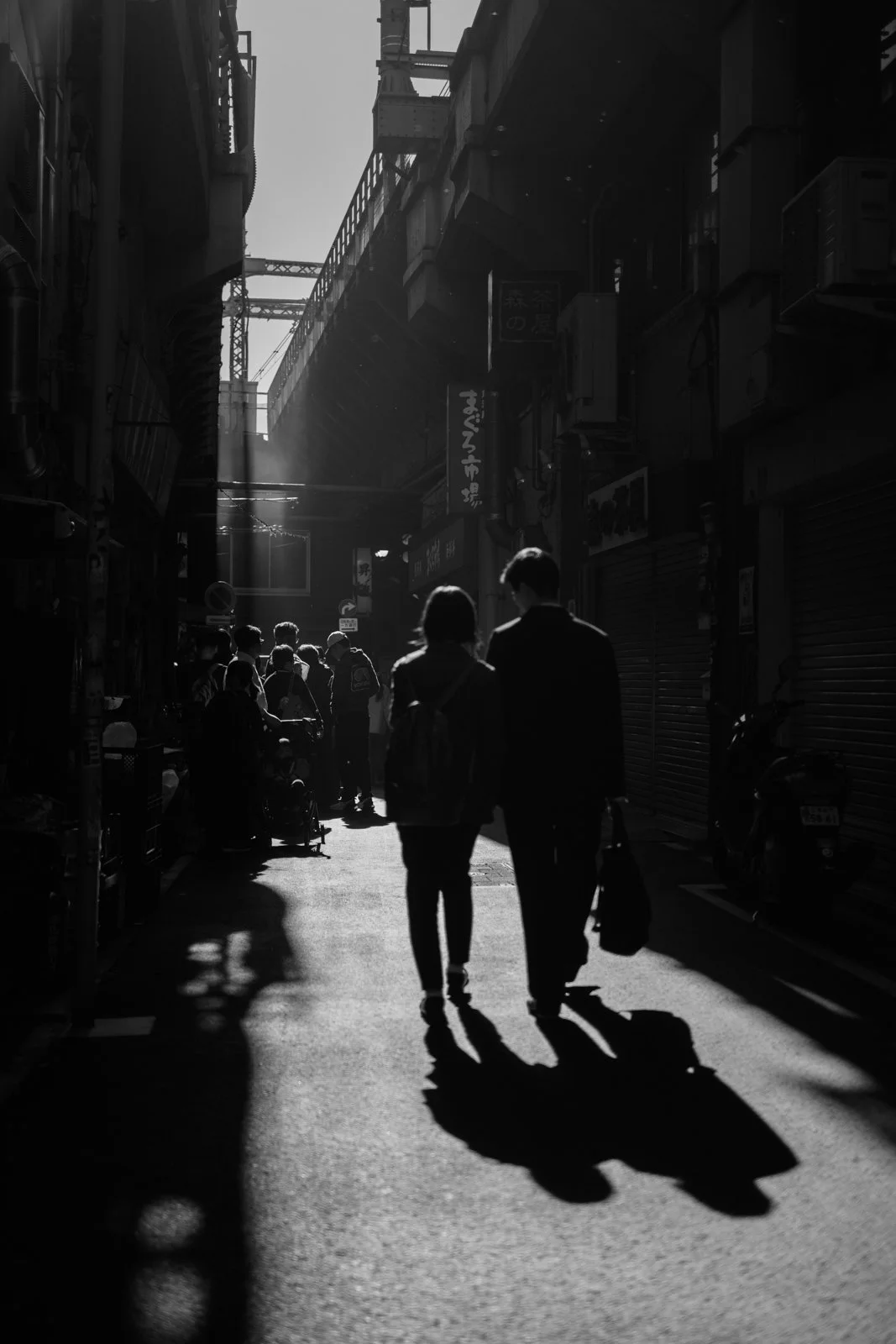
Early morning light in-between the Ueno Market and Yamanote Line
The Decisive Moment Habit
Henri Cartier-Bresson gave street photography its most famous idea, and a generation has been misreading it ever since.
"The decisive moment" gets quoted like a lottery ticket. Wander long enough, stay loose, and the universe will eventually hand you the frame — geometry and grace aligning in front of your lens while you stand there, blessed. It's a romantic idea. It's also the reason so much street photography looks like it was taken by someone who happened to be walking past. Because that is exactly what happened.
Here's what nobody wants to say plainly: luck is real. Serendipity isn't a flaw you can train out of street photography — it is street photography. You do not arrange the commuter, the market-goer, and the straggler still out from the night before all crossing the same light at the same second. Anyone who tells you they do is selling something.
But luck is not random, nor is it a single event. That's where the lottery-ticket crowd gets it wrong twice over: they think the prize is one frame, and they think it falls from the sky. It isn't, and it doesn't. The prize is a hit rate — and a hit rate is something you can raise.
The Habit In Practice
Picture the strip in Ueno where the JR tracks run up hard against the market. On the right mornings the light pours down into that narrow gap between the rails and the stalls, and the whole cast of the neighbourhood walks through it at once: commuters cutting to the platforms, market-goers working the first deals of the day, a few stragglers still out from the night before and blinking at a sun they hadn't planned on seeing. I summoned none of them. But I was standing in that gap, at that hour, with the right lens on the camera — because I had learned that this is where, and when, Ueno gives. Most mornings it gives a little. Some mornings it gives a dozen.
Let me show you the real math, because it's uglier and more honest than the myth. A productive morning yields about a thousand frames, but only a dozen are worth saving. I would publish just half of those. The rest dissolve into the binary ether of a storage drive and are never thought of again. That ratio is not a confession of failure — it is the job. The craft isn't avoiding the misses. The craft is making sure the dozen keep coming, morning after morning, and that they keep getting better.
And this is where knowing a place stops being sentiment and becomes leverage. The first several times you shoot Ueno, you photograph its reputation — the obvious grit, the postcard the neighbourhood sells of itself. Then, slowly, you start to see past the veneer. Frames you missed the first time become possible a second time, because now you know they exist and where to wait for them. New openings appear that you were too green to notice before. And old shots — the ones you'd been circling for a year — finally come to fruition, because you were there again, ready, on the morning the last piece fell into place. None of that is luck arriving. It's luck compounding. The better you know the corner, the more often it pays, and the higher the ceiling on what it pays out.
So I make my odds on purpose. I walk the same routes until they're memorized, then I change one variable at a time — swap the lens, shift the hour, hand myself a constraint like only the colour red today — so a street I've shot a hundred times keeps surrendering something new. Repetition isn't the enemy of serendipity. Repetition is the trap you build for it.
The glass is part of the trap. I shoot a 50mm that renders in standard definition, not 4K — soft where a modern lens would be clinical, and that softness sits closer to how the moment actually felt than any pin-sharp record of it ever could. It's how I'd hang the frame in a gallery or hand it to a client. The lens doesn't make me luckier. It makes the luck, when it lands, worth keeping.
This is what I mean by forged, not captured. I don't manufacture the moment — I can't, and I wouldn't want to. I manufacture the conditions: the known ground, the rehearsed routes, the right glass, the patience to be there on the empty mornings so I'm still there on the full ones. Do that long enough and your luck stops looking like luck. It's starting to look like a body of work.
That's the thing I can actually teach. I can't hand anyone a frame. But I can teach a photographer how to read a place beyond its reputation, how to build the routes and constraints that boost hit rate, and what to carry so the keepers are worth keeping. That's what a one-on-one Tokyo Forgeries masterclass is — not a hunt for one lucky shot, but learning to make your own luck, consistently.
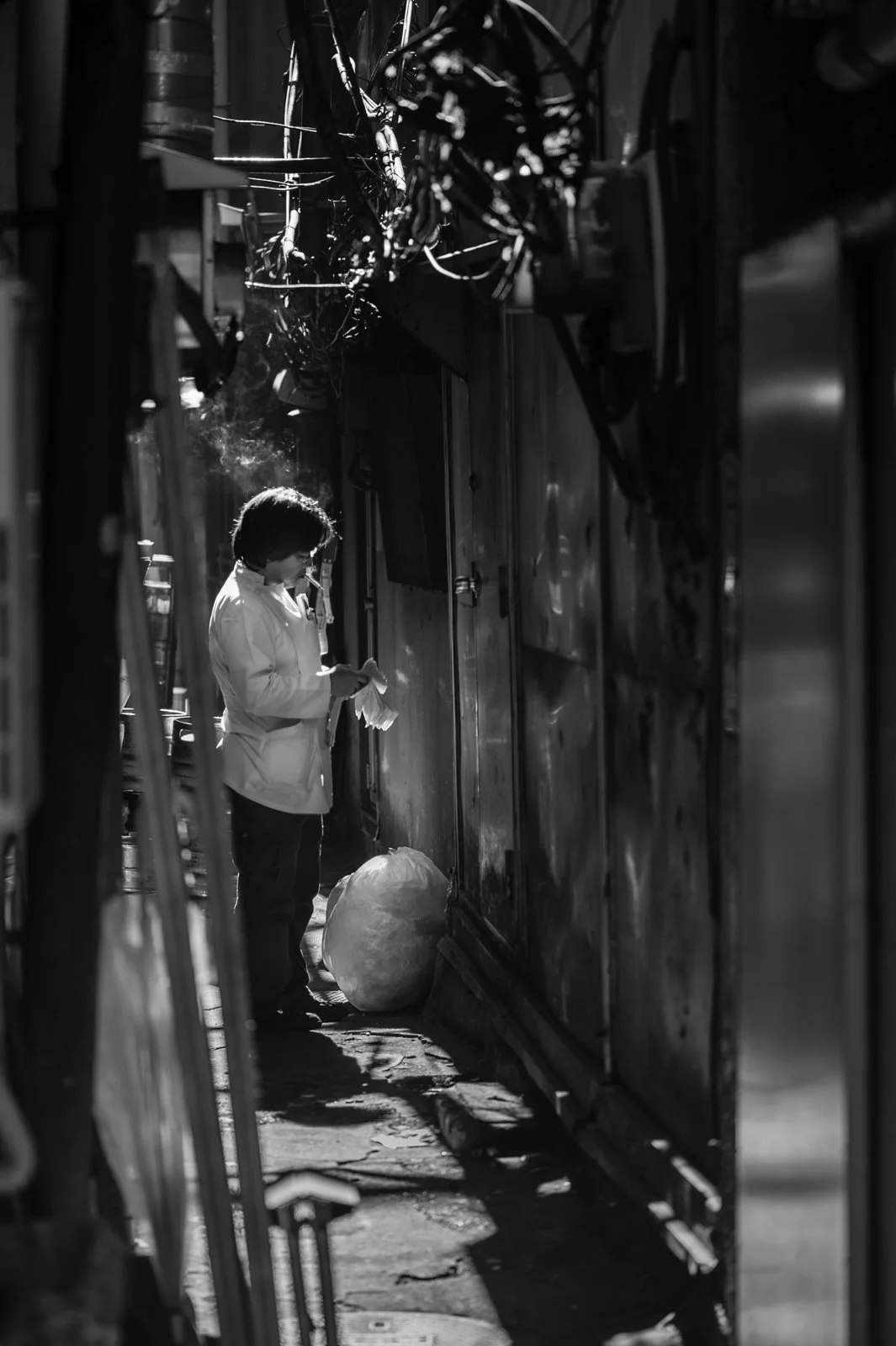
Back alley smoke break in Ueno Market
The streets never look the same way twice. I’m curious—how does this side of Tokyo hit you? Drop a comment below.
I live on flat whites and shutter clicks. If you’ve found value in these shots, toss a coffee my way to keep the sensor humming.
For those who want to skip the tourist traps and shoot the real Tokyo, my calendar is open for workshops. Explore the Masterclass here or email me at jeff@tokyoforgeries.com.
See you in the shadows."
Tokyo Forgeries is an evolving archive of Tokyo street photography and vintage-lens deep dives. We spend 30 days in every ward, using mid-century brass and glass to capture the city’s soul. This is a roadmap for the active pursuit of craft—documented through the geography of Tokyo and the character of its light.