Tokyo in Black and White: Why the City Is Most Honest

Tokyo in Black and White: Why the City Is Most Honest: WHOLE9's mural at Nakano Station north plaza, in the rain
Tokyo in Monochrome
Black and white is not a filter you apply to a photograph that didn't work. It's a language you commit to before you leave the house.
Most of the monochrome in street photography is a rescue operation. A colour frame that failed, desaturated at the desk, and called a decision.
For the last few weeks I've been carrying a camera that doesn't offer me that option.
Street photography is an art of now. It isn't about forging moments alone — it's about immediacy. It's a relentless practice toward a perfection that will never arrive. The pursuit of anticipation, of an against-all-odds image that will very likely find a close-to-zero audience in the world.
There is no time off. No stepping away to reevaluate.
The only thesis is vision. Mine is in monochrome.
Tokyo is at its honest best in monochrome
These last few weeks I put down the Nikon and gave the vintage glass a rest, in favour of a Leica Q2 Monochrom and its Summilux 28mm. The focal length is an argument for another day. There was a more immediate question to answer.
Tokyo is a big, beautiful, colourful city, and there is no argument to be had about colour street photography — superb work is made here in colour, constantly. The same is true of black and white.
The question isn't which one is better. The question is whether Tokyo is most honestly recorded without colour.
Short answer: yes. One hundred percent, yes.
The long answer takes a little more.
A camera that cannot change its mind
The Q2 Monochrom has no colour file. There is no raw hiding underneath with the reds still in it, waiting to be recovered if I lose my nerve at the desk. The sensor records light and the absence of light. That's the entire vocabulary.
This sounds like a limitation. It's the opposite. It's the removal of an escape route.
When you shoot colour, black and white stays available as a second opinion. The frame doesn't work — so you pull the saturation, push the contrast, and call the failure a choice. I've done it. Most photographers shooting digital colour have done it, and the genre is full of the results. Grey, mid-contrast, nothing images that were never seen in monochrome. Only converted into it.
That isn't a photograph in black and white. That's a photograph with its colour taken away.
Committing before the shutter closes changes where the decision lives. It puts it on the street, in the second, with the subject still standing in front of you.
Which is the only place a street photograph was ever made.
We forge the moment. We do not rescue it afterward.
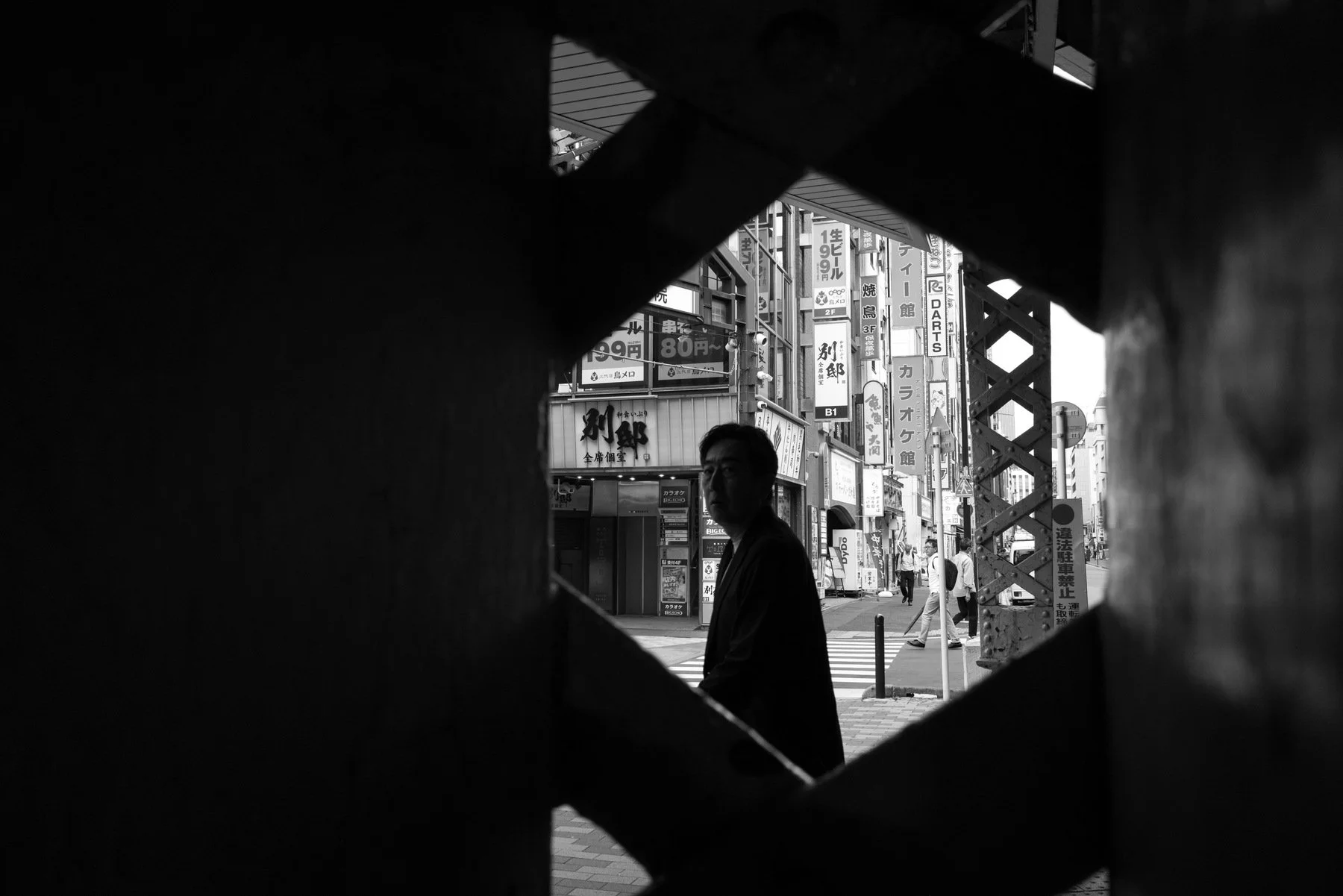
The monochrome wonder of the 神田駅高架下 鉄骨 (Kanda Station Under-Viaduct Steelwork)
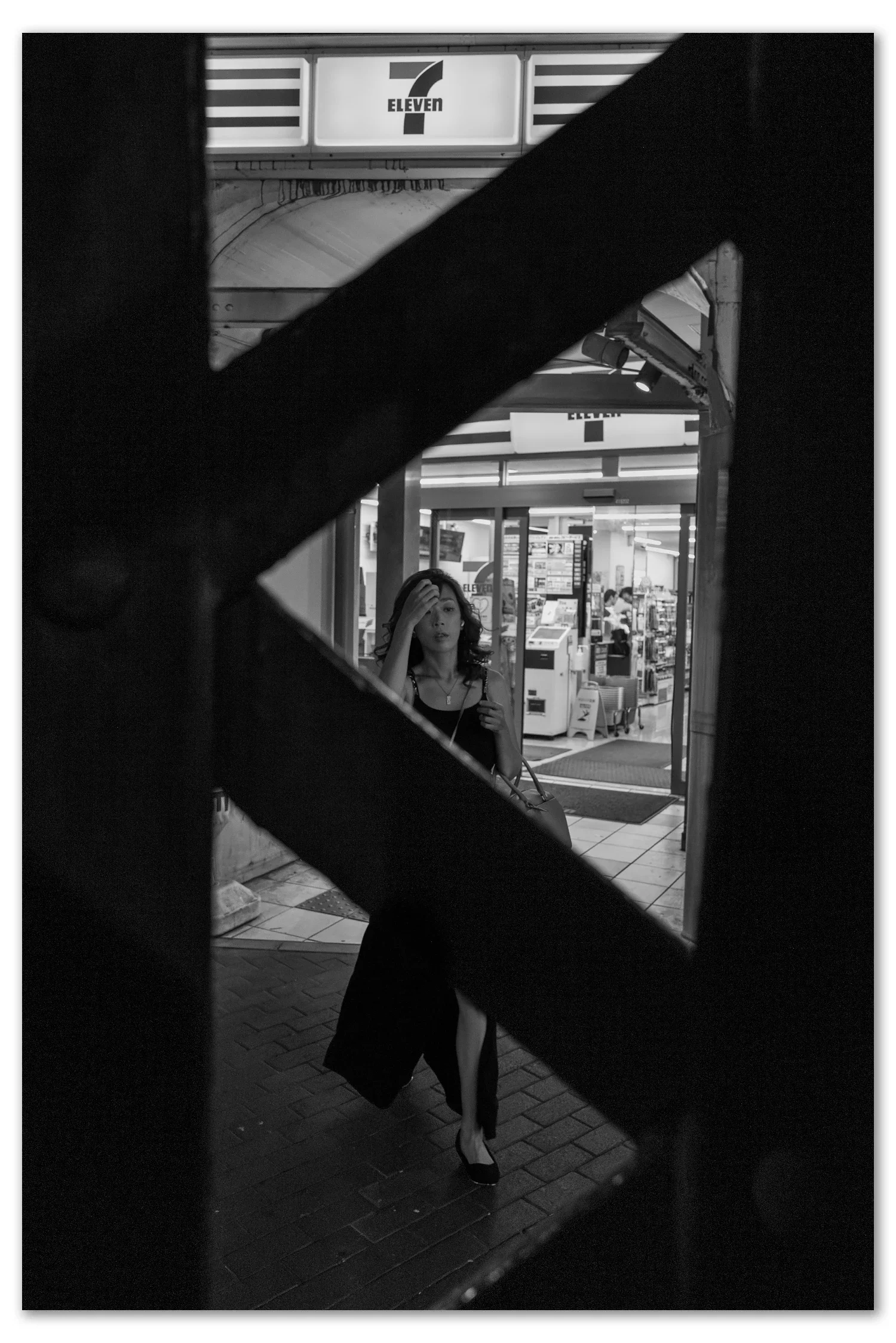
Black and white street photograph, Shinbashi, Tokyo — Leica Q2 Monochrom 28mm
The wall on the eighth, and the wall on the tenth
There is a wall beside Nakano Station with an enormous painted woman on it. Photorealistic, three storeys of her, in profile, looking up and out over the road, a raised hand and foliage around her.
I have never once walked past that wall and thought there's the mural. What I think is: I'm going to stop and photograph her. I wonder how she looks in this light today.
I'd be lying if I said that was a deliberate way of seeing. It's just what my head does. But I've been doing it for long enough that when I finally sat down to work out why the monochrome frames of that wall land and the colour ones never did, the answer was already sitting there in the way I talk to myself about her.
Then I looked her up, which I should have done years ago, and it reorganized the whole thing.
She was painted in November 2021 by WHOLE9 — the duo Hitch and Simo — on the north plaza at Nakano Station. She isn't a decorative face. She's a local university student in a candid morning moment, and what's around her belongs to the ward: the chinquapin, the azalea. Over her shoulder, the silhouette of Nakano Sunplaza, which shut in July 2023 after fifty years and whose replacement has been argued about ever since. The ward's stated theme for the commission was the inheritance of local memory.
So she is a wall that remembers a building. Painted before the building went, standing there now that it has, in a plaza full of people who queue for trains in front of a picture of the thing that used to be behind them.
I have been photographing her for years and knew none of that. I just liked how she took the light.
I shot her on the eighth. Twice. A man in a white shirt walking under the painted arm, another going the other way. Both frames are fine. Fine is the polite word.
I went back on the tenth, in the rain, and stood there.
A woman came along the pavement under a black and white umbrella, looking down at her phone, and for about a second she was directly beneath the painted face. The giant is looking up and away at nothing. The woman is looking down at something. Both of them in profile. Both of them, and this is the whole point, made of exactly the same grey.
That frame does not exist in colour. In colour, paint is paint and skin is skin — the palette does the sorting for you before you've even looked. Strip the colour out and the sorting stops. The painted face and the living one are suddenly the same material, competing on equal terms, and the living one wins on the only thing left to win on: she is the one in the frame who is looking at something.
Which is to say the camera finally caught up with how I'd been thinking about that wall all along. Two women in a photograph. One of them has been standing there for years. The other, for a moment. The rain is falling on both of them the same way.
I found that thread running through half the shoot once I got the frames up — a man walking past a billboard eye, a woman on a bicycle in front of a wall of election posters, faces painted and printed and photographed, all of them reduced to the same tone as the people walking past them. I didn't plan it. I couldn't have. It only became visible when the colour stopped doing the work.
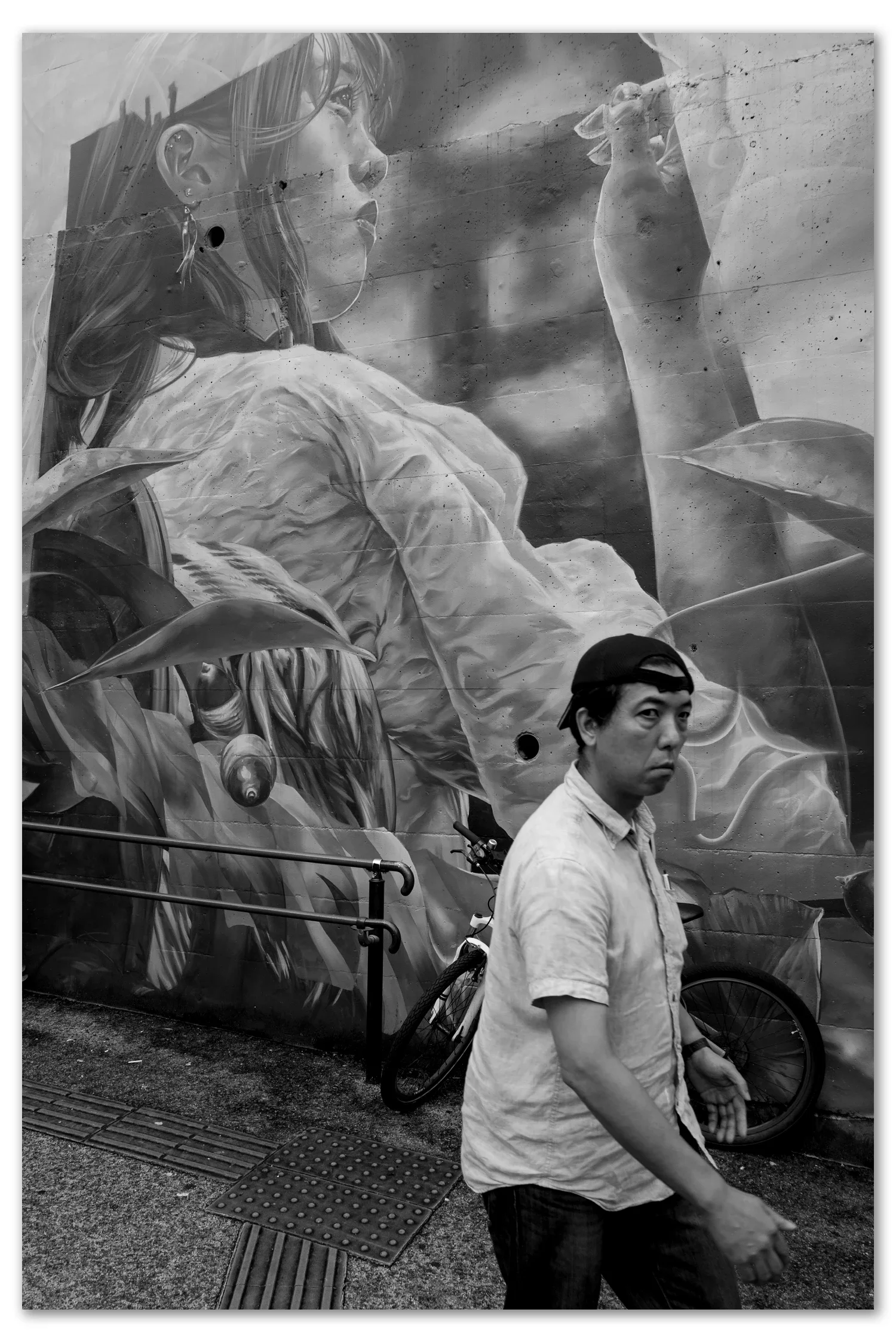
The Nakano Mural-pass number one
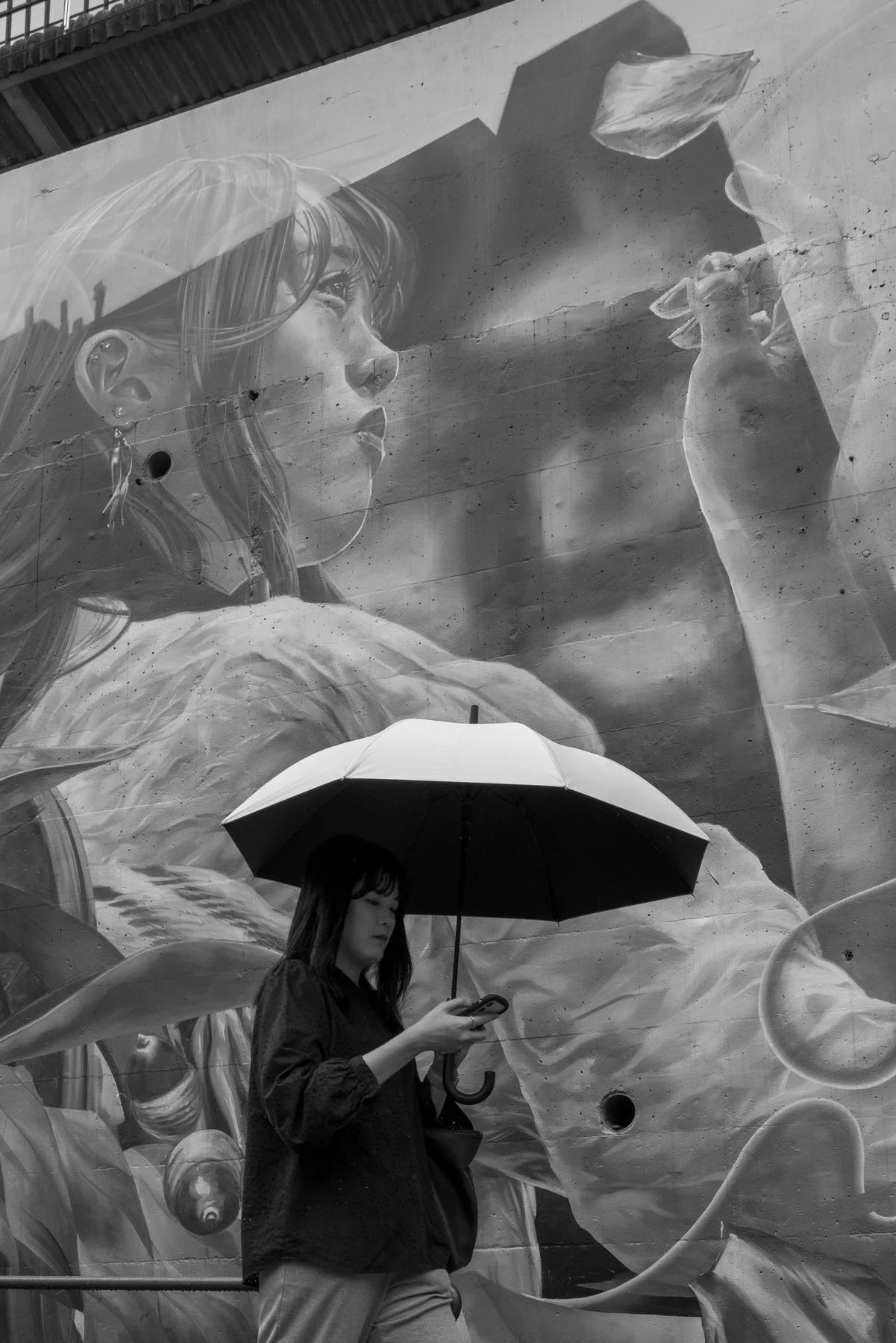
Nakano mural- pass number two
Not being afraid to press it again
There's a second folder from these weeks, and it changed what I think this post is about.
Twenty-two frames in six short runs. Not six versions of one habit — six different reasons to keep shooting.
On the third, a fixed composition: a worker sitting on a step behind stacked pallets. I held the frame and let three different people walk through it. The stage doesn't move. The cast does.
On the fourth, the opposite: one man in a flat cap, seen through a gap in a girder in Kanda, and me working him inside a frame I hadn't built. Two and a half hours later I was in Shinbashi doing the same thing through a different girder — a woman outside a convenience store, the light harder, the gap the same shape.
Two wards, two bridges, one afternoon. That isn't a coincidence. When I'm in either of those places, the girders are the first thing I go to.
On the tenth, a man unloading fish boxes at a mirrored edge that doubled him. I didn't build that. I found it, and then I stayed with it for three frames while a third figure wandered into the reflection.
On the eighth in Nakano, twice within the hour. A man in white coming down a そば alley with his umbrella used as a cane — seven frames, finger down the whole way in. And an hour later, another man crossing an arcade mouth over a puddle deep enough to hold the whole ceiling, three frames, one second apart.
The one I kept from the alley is the seventh.
The seventh. Not the second, not the fourth — the last one, the one I'd have never taken if I'd trusted the frame I already had.
Sometimes you're early. Sometimes you're late. Sometimes the framing is off. And sometimes something happens that you could not have anticipated or pre-visualised, and the only reason you have it is that you were still shooting.
Being ready isn't physical. It's not the finger. It's being ready intellectually, and in the heart, for more frames than you think you need.
Which sounds like the opposite of everything I said above about committing before the shutter. It isn't. The commitment is what earns you the right to spend the frames. You've already decided how you see. What's left is to stay long enough for the city to show you something inside that decision.
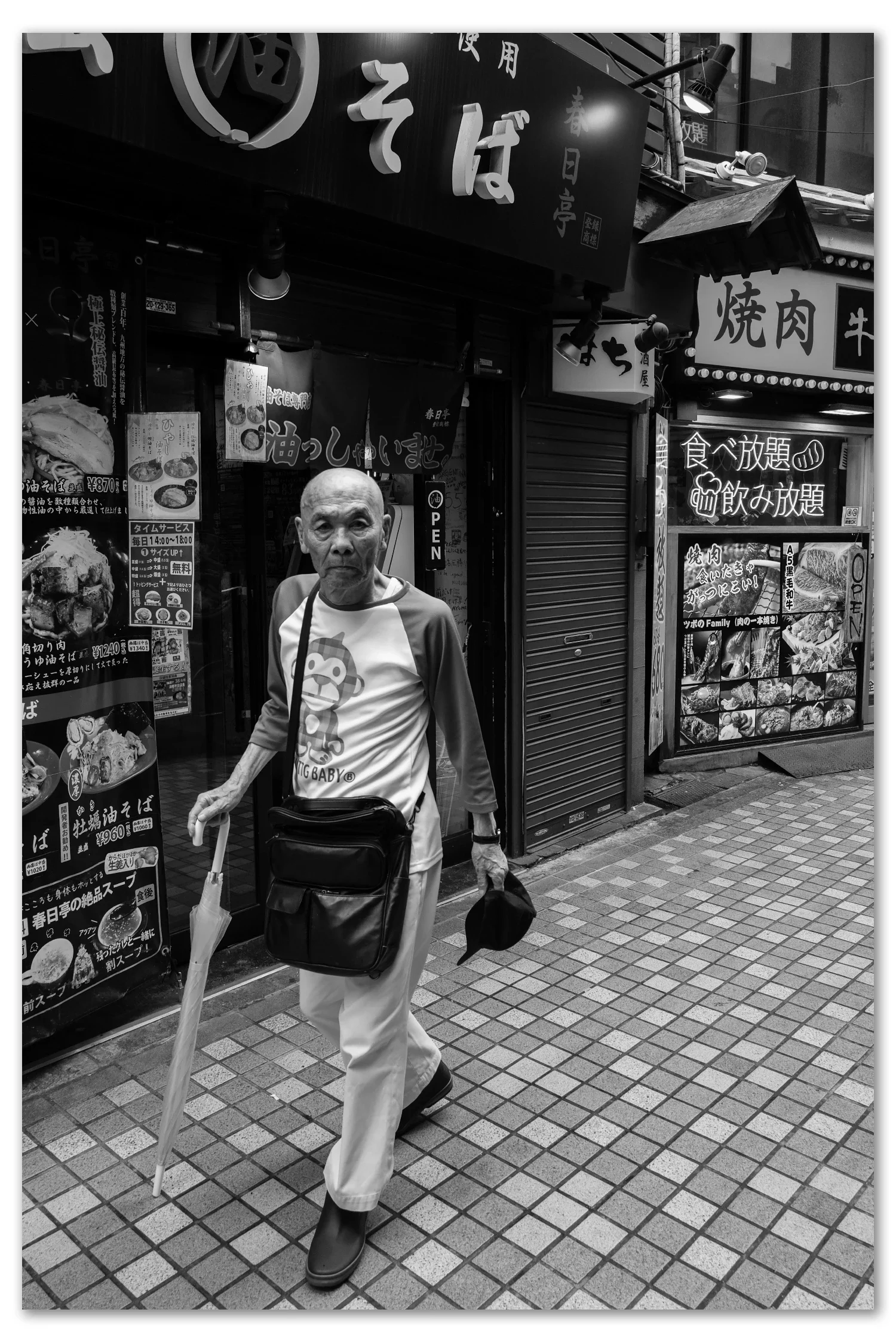
Nakano backstreet portrait
Light and simple
I wanted to be light. One camera, one focal length, one way of seeing. Nothing in a bag. No second body waiting in case the first one was the wrong choice.
Every decision you cannot defer is a decision you have to make now. Standing there. In front of it. Under time, with no way back.
That is not a side effect of the practice. That is the practice.
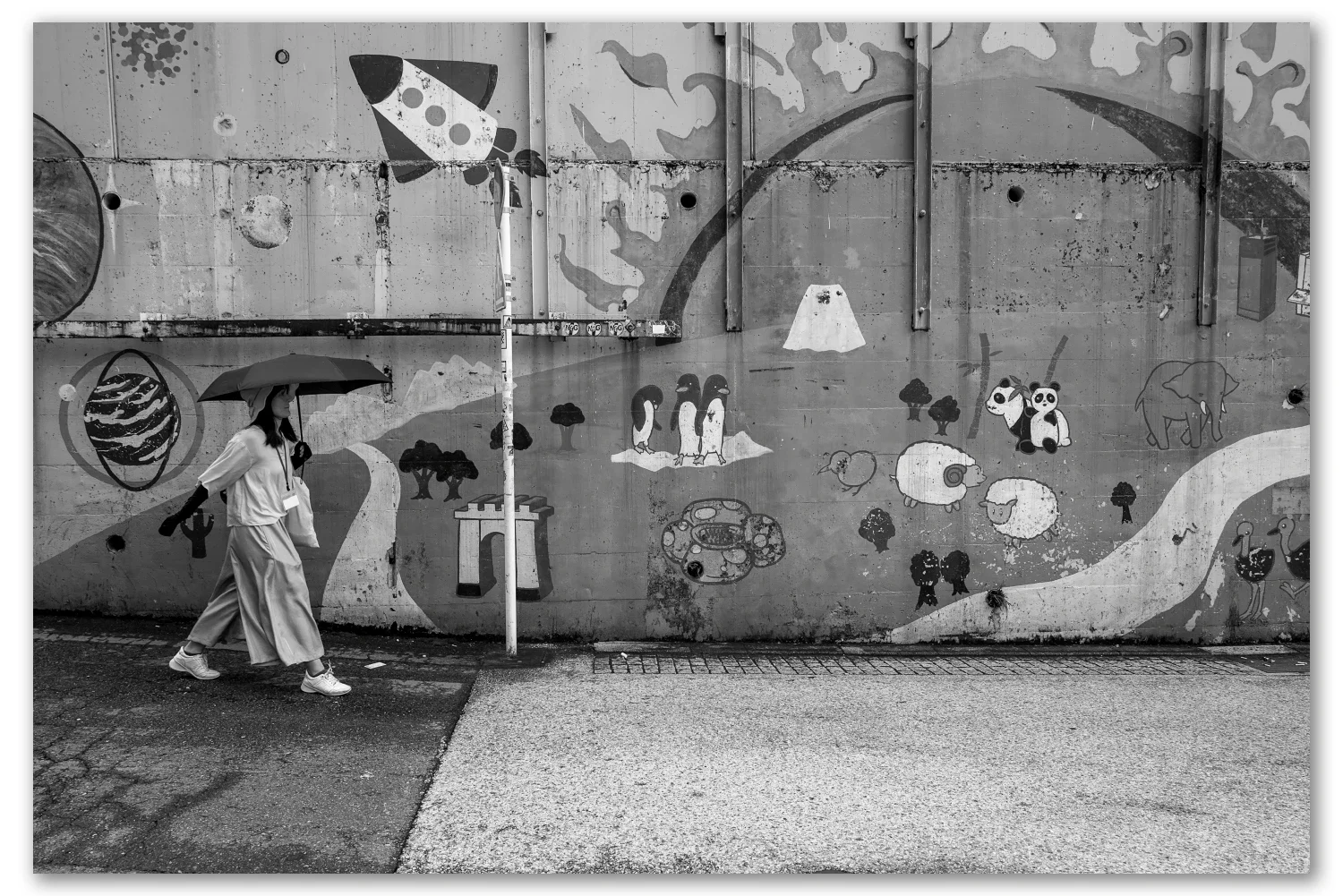
The Nakano Mural Project (中野ミューラルプロジェクト)-a woman walks past with sun umbrella and sleeves-Leica Q2 Monochrom
The ground
Ten places, four days, and less plan than it looks like.
Akabane, which I started and finished the third in, because it's mine and I come back to it the way you come back to a kitchen. Ueno Koen in the late morning, then Ueno Market an hour later — the park and the market are four minutes apart and belong to different centuries. Akihabara, which everybody photographs and almost nobody looks at. Kanda and Shinbashi, which I go to for the same reason, and I'll come to that. Nakano and Koenji, which are the same walk if you're stubborn about it. Gotanda, briefly, standing under a station. And Togoshi Ginza — the longest shotengai in the city, and the one that still behaves like a street rather than an attraction.
Ten is not a survey of Tokyo. It's barely a slice. But it was enough to notice that the argument holds in all of them. The park and the arcade and the residential backstreet all give up the same thing when you take the colour out, and all keep the same thing.
The one setting I didn't change
A word on how these were made, since it's short.
One thousandth of a second is a number people reach for. I sat at 1/500 and left it there for four days, and let the ISO go wherever it had to go — three thousand in the market, twelve thousand in a covered arcade at two in the afternoon. On a sensor with no colour filter over it, that number doesn't frighten me the way it should. The grain it gives back is the good kind.
Twice I broke it on purpose. A taxi at 1/30, because I wanted the street to smear and the cab to stay. A cyclist at 1/15 for the same reason and a worse result.
That's the whole technique. One shutter speed, one focal length, one way of seeing, and everything else left alone.
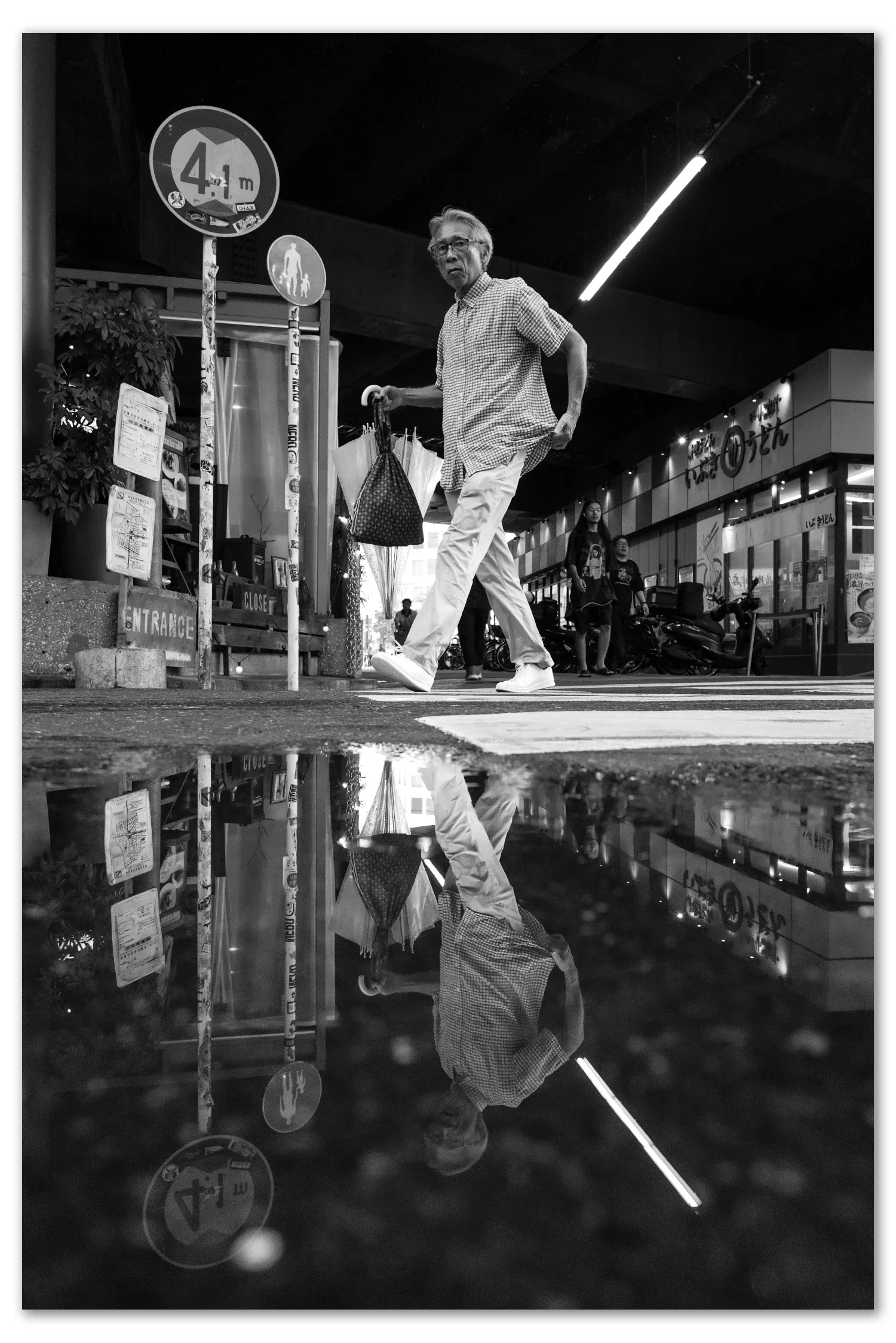
Koenji, under the tracks after a long hard rain- Leica Q2 Monochrom
A word about the glass
Twenty-eight millimetres, fixed, and no say in the matter.
I've spent twenty-five years and counting mostly behind vintage Nikkors, and I hold no contempt for a modern lens — I shoot modern glass professionally, and I'll keep doing it. But this one asks something specific. At twenty-eight, you are either close enough, or you are not in the photograph at all. There's no negotiating from the back of the room.
That's an argument in itself, and it isn't this one.
Going back
I started the third in Akabane, and I finished it in Akabane. Between those two, I went to a park, a market and Akihabara, and then came home and photographed my own neighbourhood again.
On the fourth, I went to the girders in Kanda, and then to the girders in Shinbashi. Both of those are first on the list whenever I'm in either place. I don't arrive and look around. I know exactly where I'm going.
And the wall by Nakano Station — the eighth, then the tenth, in the rain. I walk past that one often enough that photographing it twice in a day isn't unusual either. It's on the way. That's half of what makes a place yours: it stops being a destination and becomes something you have to walk past.
None of that is patience in the way the genre means it, which is a kind of stillness you're meant to admire from a distance. It's simpler and more stubborn than that. The last time was good. I'm trying to find great. I know there's great in there, and I'm going to keep digging until I get it.
That's the whole method. Everything else on this page is a footnote to it.
What it costs
I'd be lying if I said nothing is lost.
There are frames in this city that are about colour, and monochrome can't make them. The sakura. A single red umbrella in a grey crossing. The particular sodium-and-neon fever of a side street at midnight, which isn't a scene that happens to have colour in it—it is colour, happening.
Give up colour, and you give up those. Genuinely.
But that's the trade, and I'd make it again. In colour, the city describes itself to you. In monochrome, it has to be read.
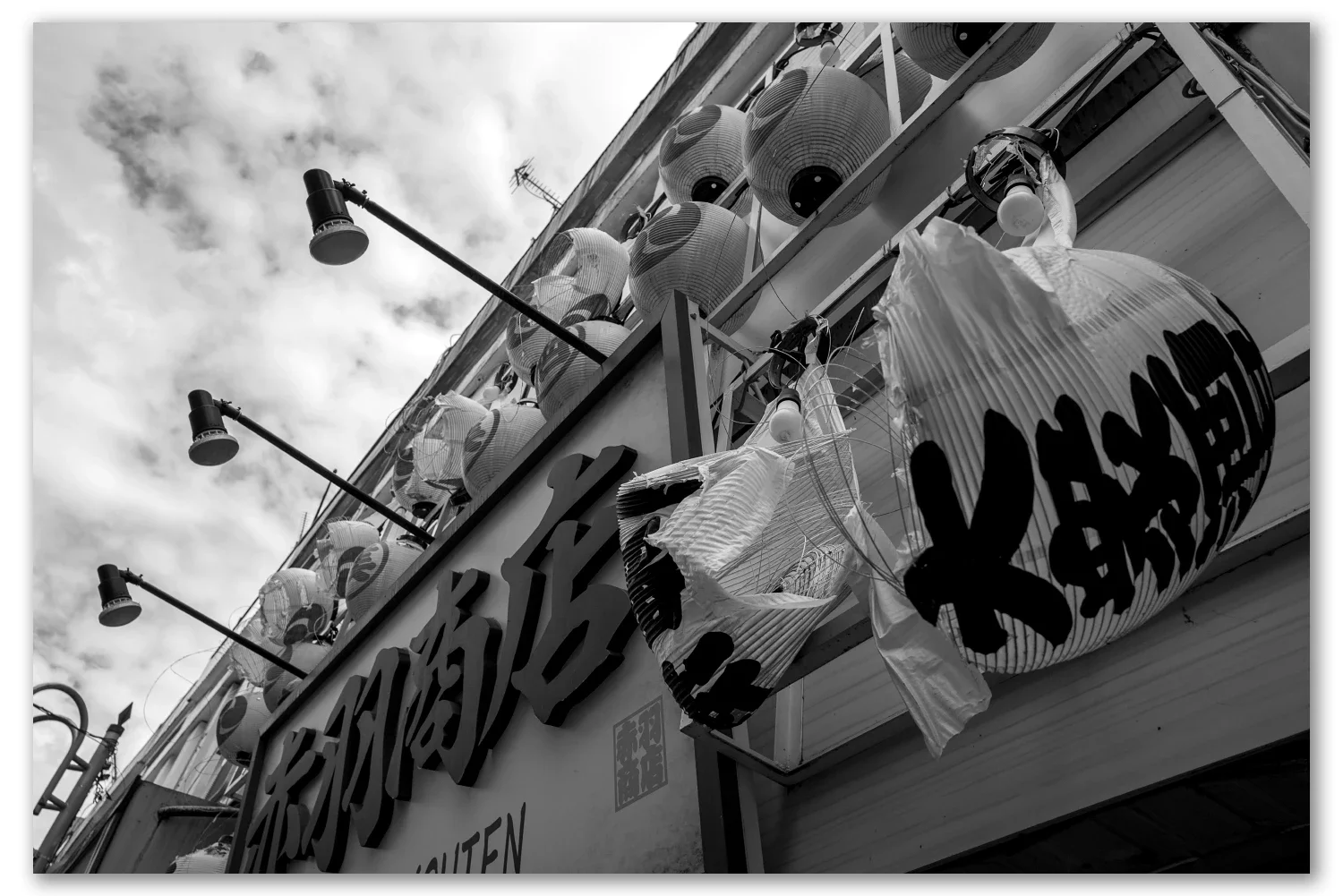
Akabane Ichibangai Shopping Street (赤羽一番街商店街) Paper Lanterns
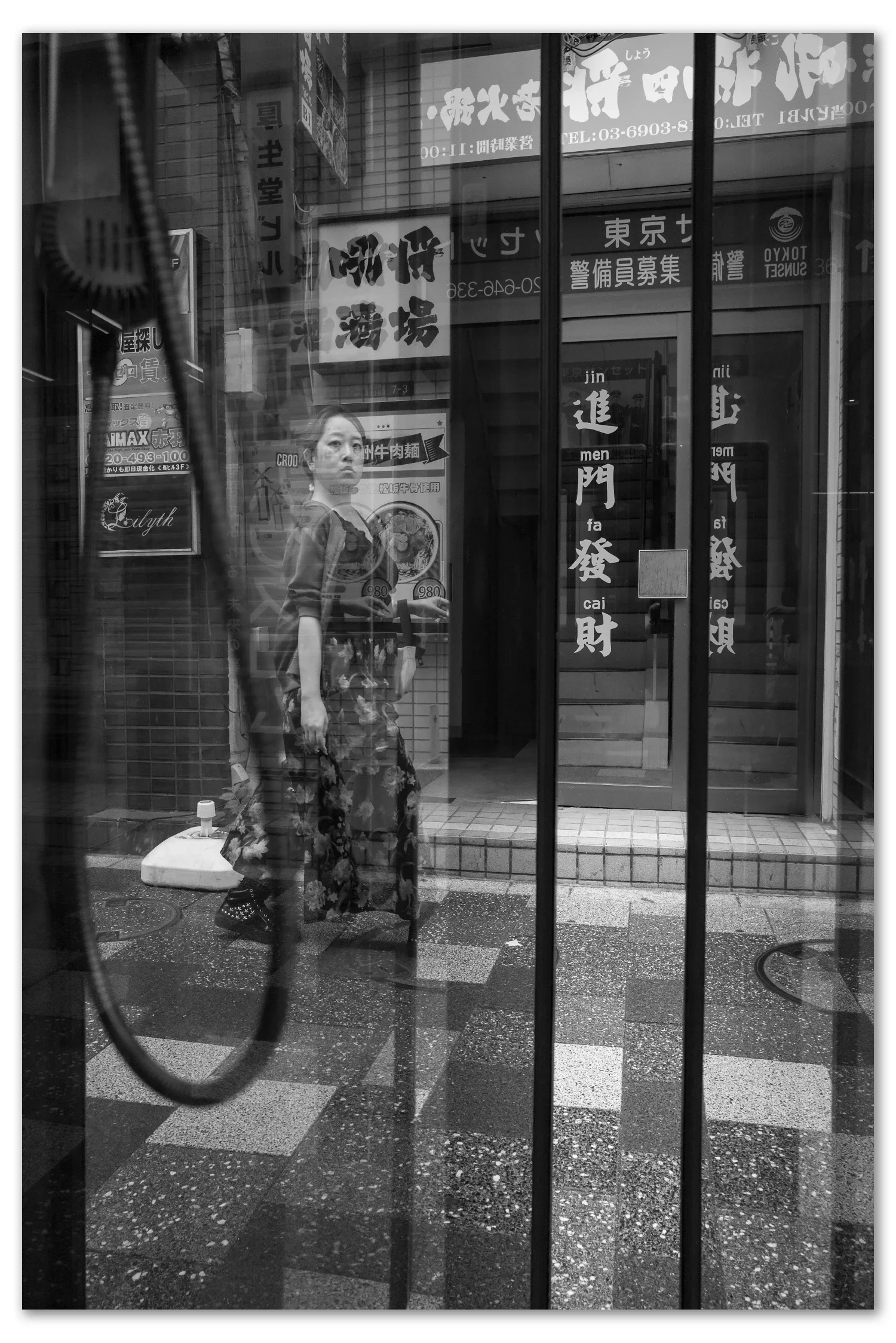
Leica Q2 Monochrom double-phonebooth reflection-Akabane
Where I go from here
Nothing happened these last few weeks. No story, no assignment, no arc. I walked, looked, came home, and looked again.
That's not a gap in the work. That's the work.
I gave up half the information the city was offering me. I have never seen it more clearly.
— Jeff Austin, Tokyo
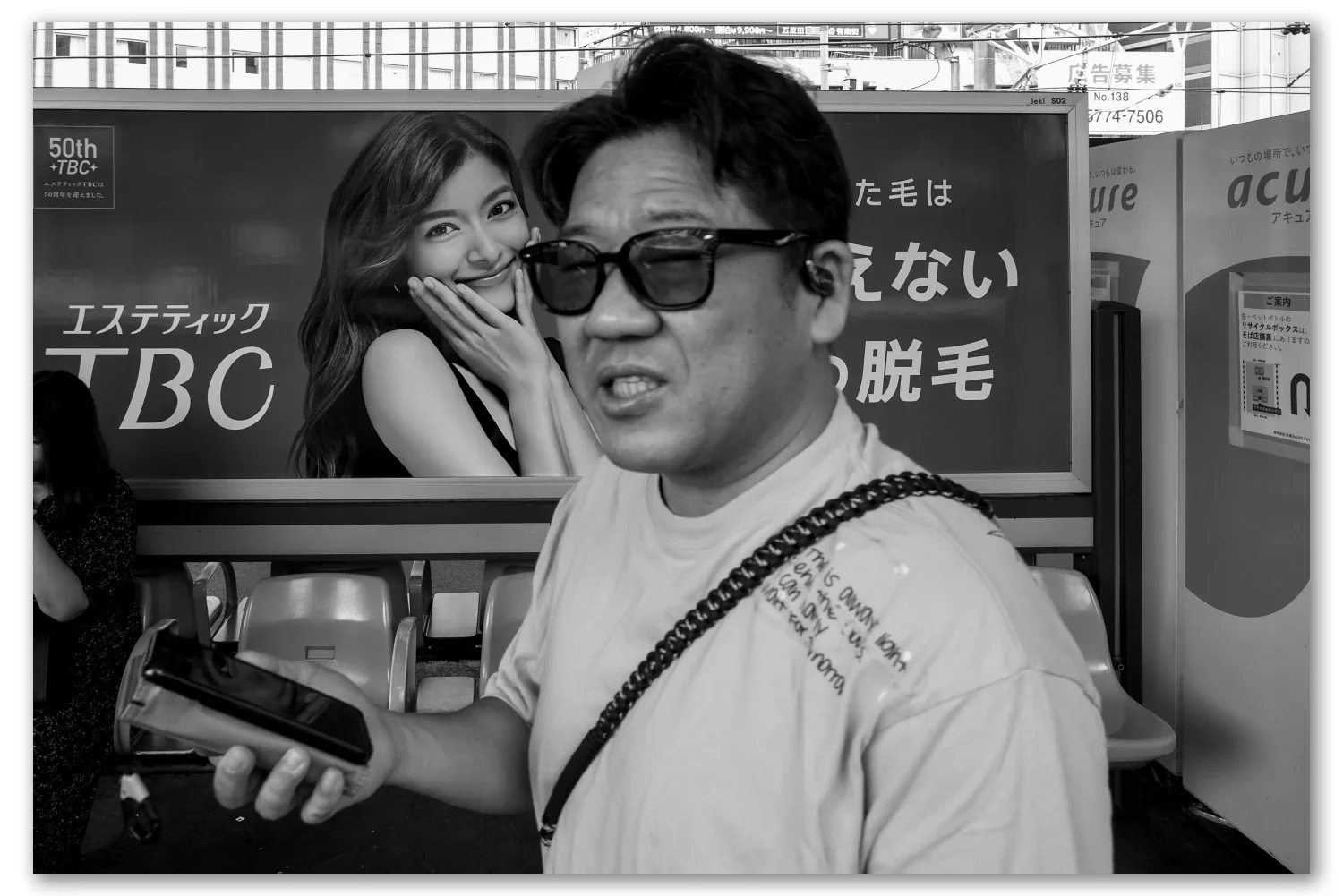
Gotanda Station platform-Leica Q2 Monochrom
The streets never look the same way twice. I’m curious—how does this side of Tokyo hit you? Drop a comment below.
I live on flat whites and shutter clicks. If you’ve found value in these shots, toss a coffee my way to keep the sensor humming.
For those who want to skip the tourist traps and shoot the real Tokyo, my calendar is open for workshops. Explore the Masterclass here or email me at jeff@tokyoforgeries.com.
See you in the shadows.
Tokyo Forgeries is an evolving archive of Tokyo street photography and vintage-lens deep dives. We spend 30 days in every ward, using mid-century brass and glass to capture the city’s soul. This is a roadmap for the active pursuit of craft—documented through the geography of Tokyo and the character of its light.