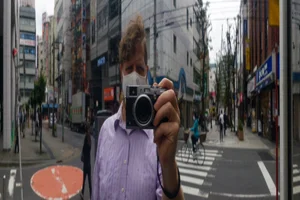
Akabane to Tokyo Tower on Two Focal Lengths
Photographing people is what street photography is all about. Do they always need to make eye contact in order to make the picture good? My take is a resounding no. What makes a street photo good is a moment of human interaction. That interaction does not always or does not need to include the documenter or the street photographer in this case.
When people are having a moment and I'm close enough to photograph it in a way that's pleasing, that is every bit as authentic. It's just as authentic and genuine and beautiful, as if they looked at me and gave me a smile.
Despite the ridiculous summer heat of Tokyo, I've spent the day walking through Akabane, Kanda, Akihabara, Hamamatsu-cho, ending up around Tokyo Tower. I've brought along with me a favorite 35mm and a lesser-used and, I would argue, greatly misunderstood 200mm f4. Can the 200 mm be used for street photography ethically? I think so. I use it almost once a week. My preference is to shoot reflections and often through the large crowds. 35mm is, of course, a street photographer's standard lens, one that should be in everybody's kit bag. How I go from one to the other and what kind of images they produce, is what this article is all about.
Akabane: the jumping-off point
I started the day in Akabane. Although I can bypass it on the subway, I find it a great jumping-off point for a day of shooting in Tokyo. This place has a real authenticity — a time forgot authenticity. Remembered for a little while, then ultimately forgotten again.
Although there are many wonderful characters to photograph in Akabane, I was after the neighbourhood's accoutrements. The day would begin with a telephoto lens and end with a 35mm.
The telephoto lens is the above-mentioned Nikkor 200mm f4. With a 52 mm filter diameter this lens is a fraction of what you might imagine it to be. It quite nearly sits in the palm of my hand. Because I've been through Akabane a million times I like to use that place to challenge myself, and certainly, a 200 mm lens in street photography is quite a challenge.
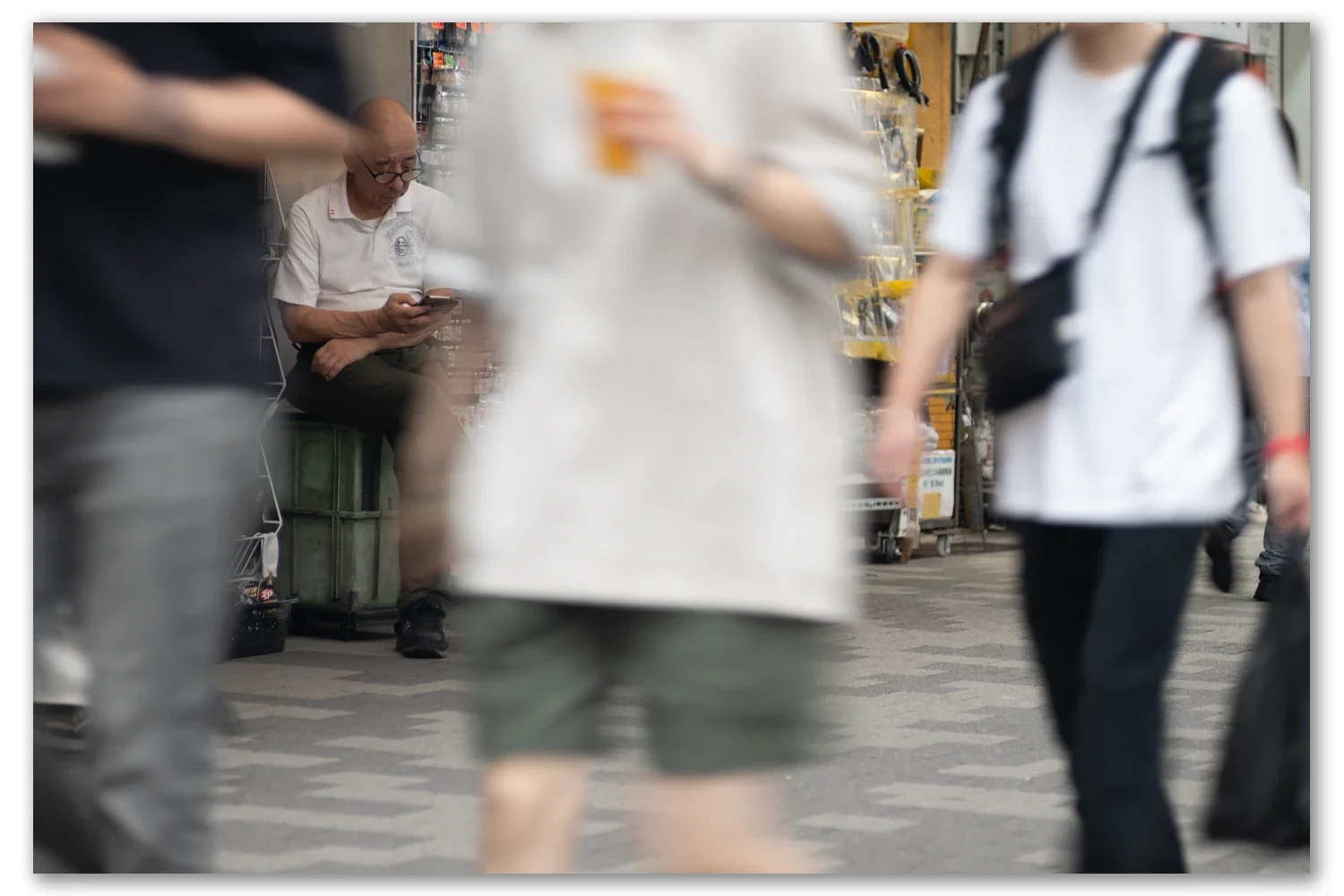
How can you remain ethical, decent, and provide an authentic and genuine image with such a long focal length? Typically, I use it in some of the really busy hubs of Tokyo to compress depth. In that scenario, it feels ethical and natural to me to use that focal length because there are so many people. We've all become completely anonymous. Akabane is a different story.
In a neighborhood like Akabane, using a 200 mm f/4 lens for street photography becomes more of a creative or artistic choice. Here I'm trying to shoot reflections through store windows, through taxi windows, and I'm looking for something interesting on the other side of that. It can be a little bit abstract. It it can also be a little surprising.
The reason I use this lens is to train my eye, to train my brain, and ultimately to express myself above and beyond what's deemed typical or classic in the art of street photography. It doesn't always work, but that's not the point. Effort and growth are.
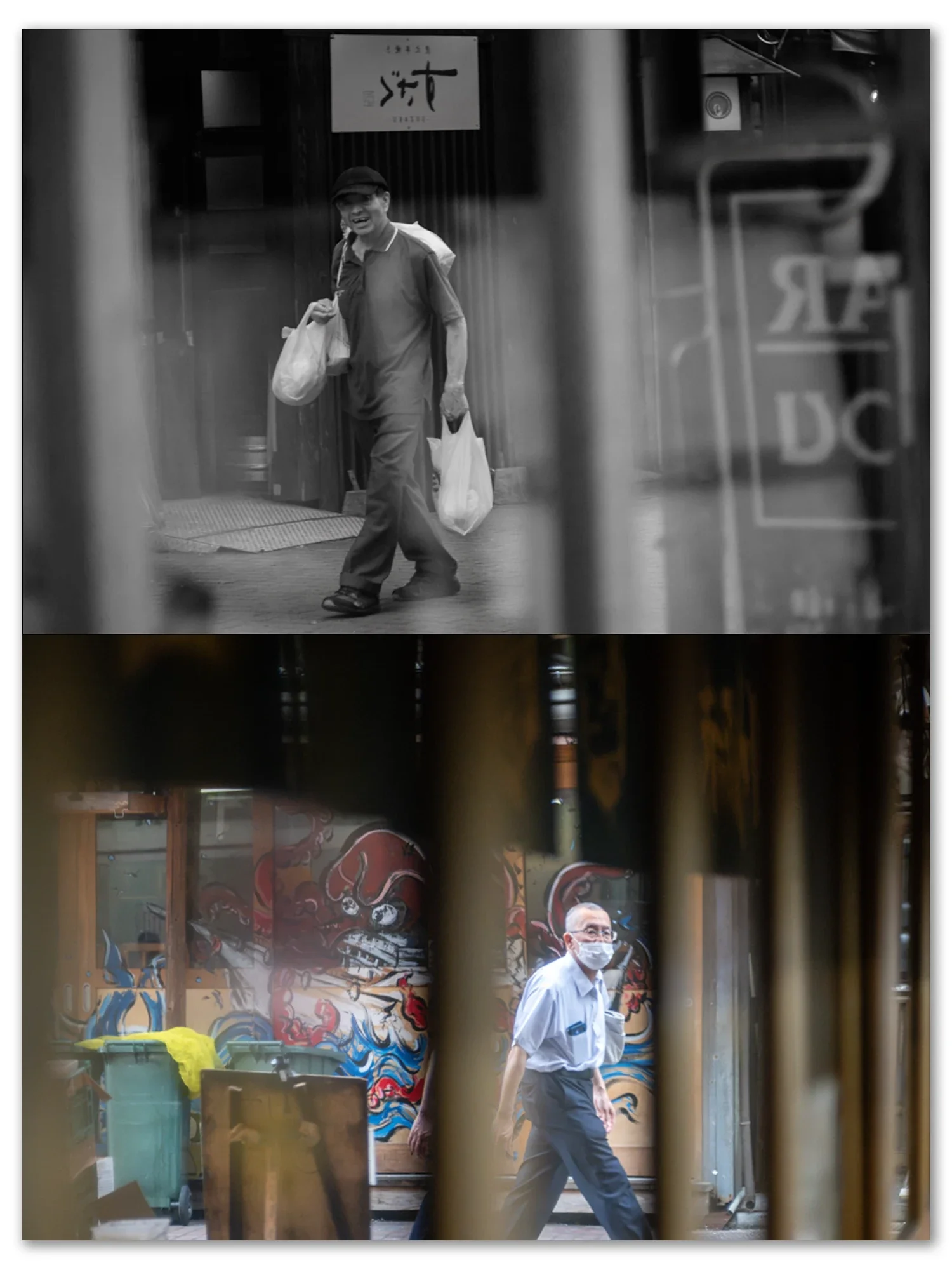
Akabane at 200mm. Vintage Nikkor 200mm f4
Kanda: a detour
Making my way quickly through Akabane, I hopped on the Keihin-Tōhoku Line headed into the east side of Tokyo. My chosen location was Akihabara, but on the train I decided to go one more stop to check out something in Kanda. With mild success on the platform there, I turned around and headed back to Akihabara. I was feeling the longer focal length, so I decided to keep shooting with it.
Akihabara: the boy in the trading cards
Akihabara did not disappoint. My first idea worked quite well — and then it started to rain, quickly.
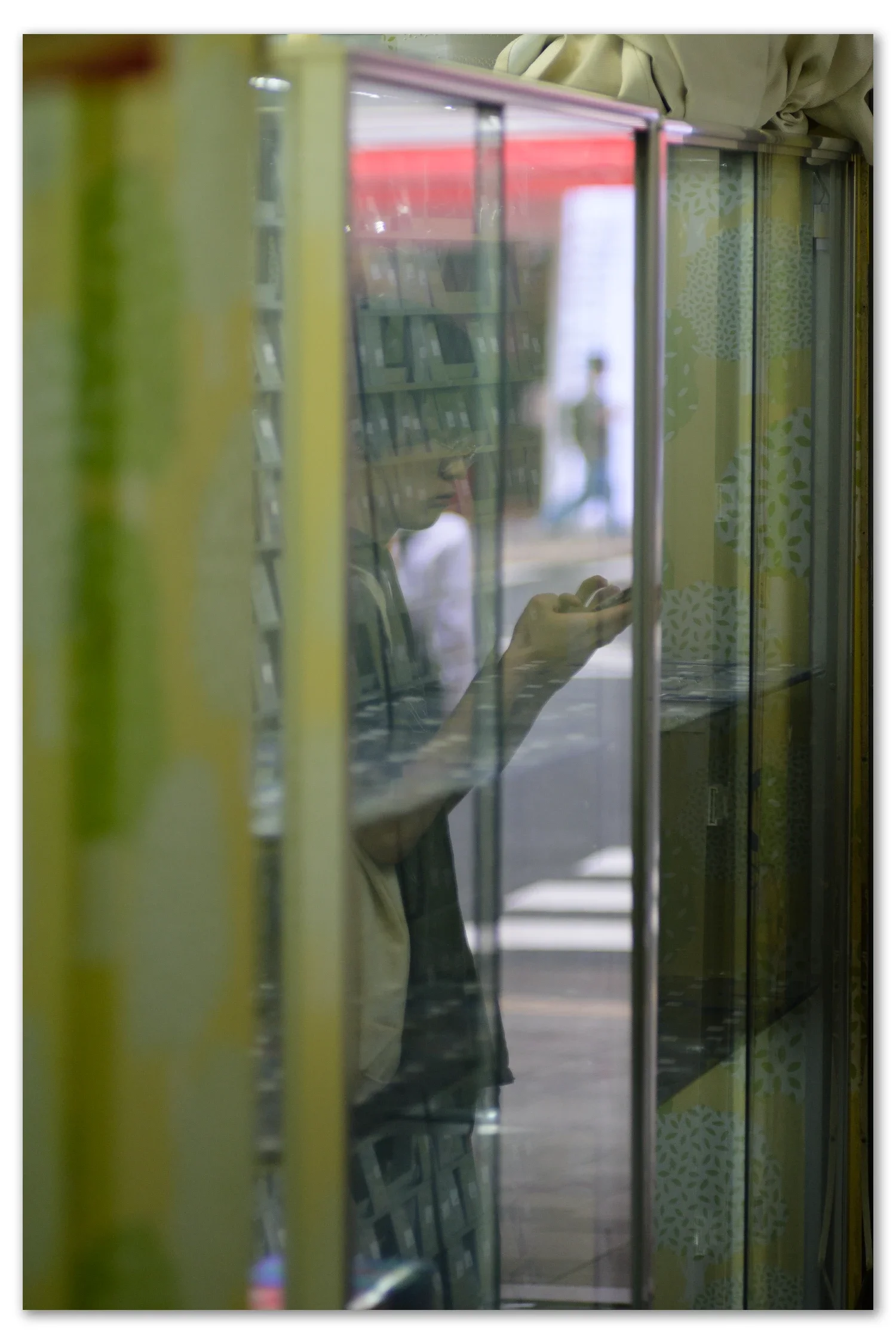
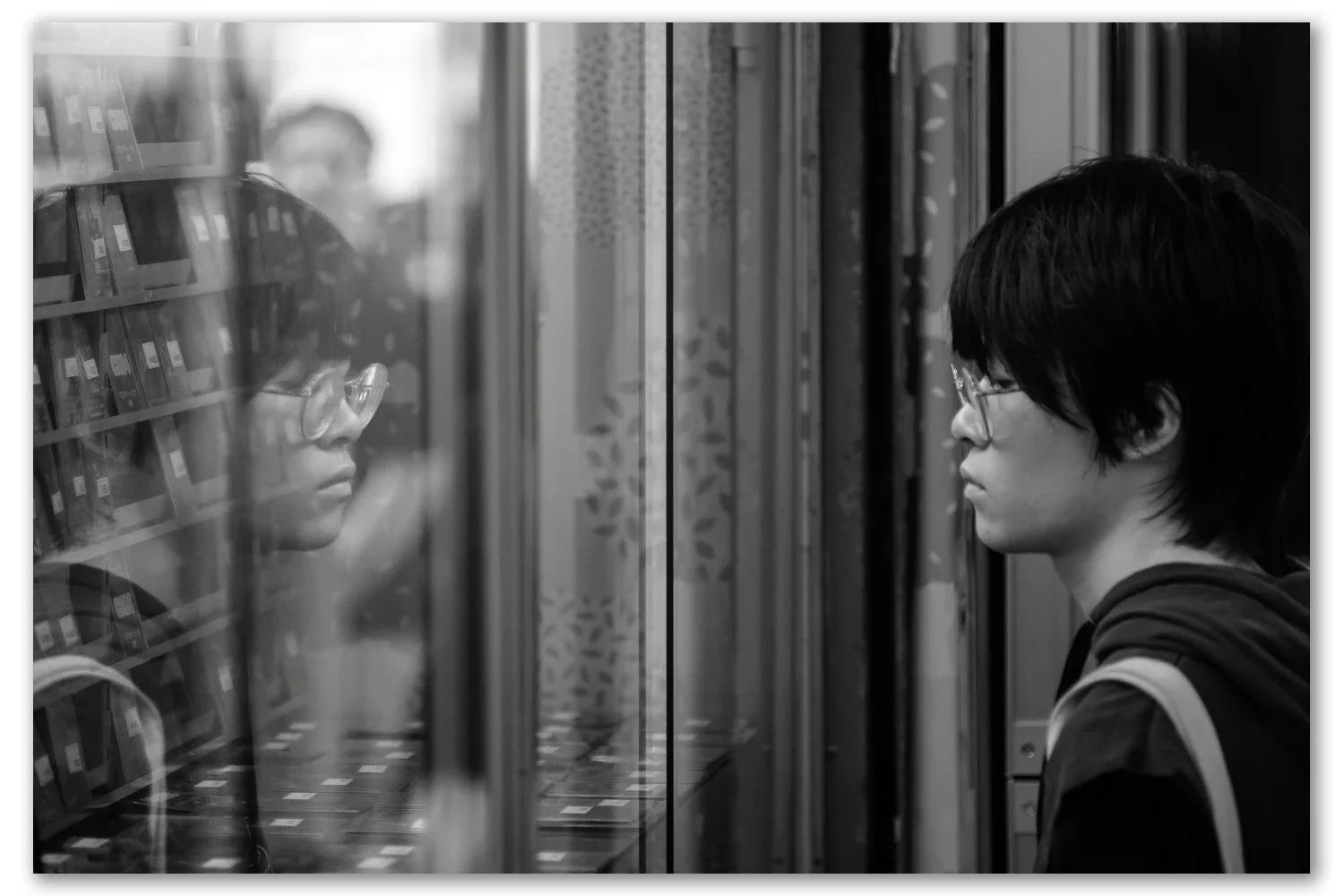
Hopping into an alleyway, I found this lovely young man in a dream world of trading cards. He was on another planet. I was fortunate to make several images of him and his reflection.
Direct eye contact, interesting facial expressions — those are wonderful things in street photography. A real connection to the audience. I love those things, as a shooter and as a viewer. But there's something to be said for someone in a state of deep concentration. Oblivious to the outside world. We can all understand that. We can all feel that. I think it makes a great image. It tells both his story and, to a certain degree, our own.
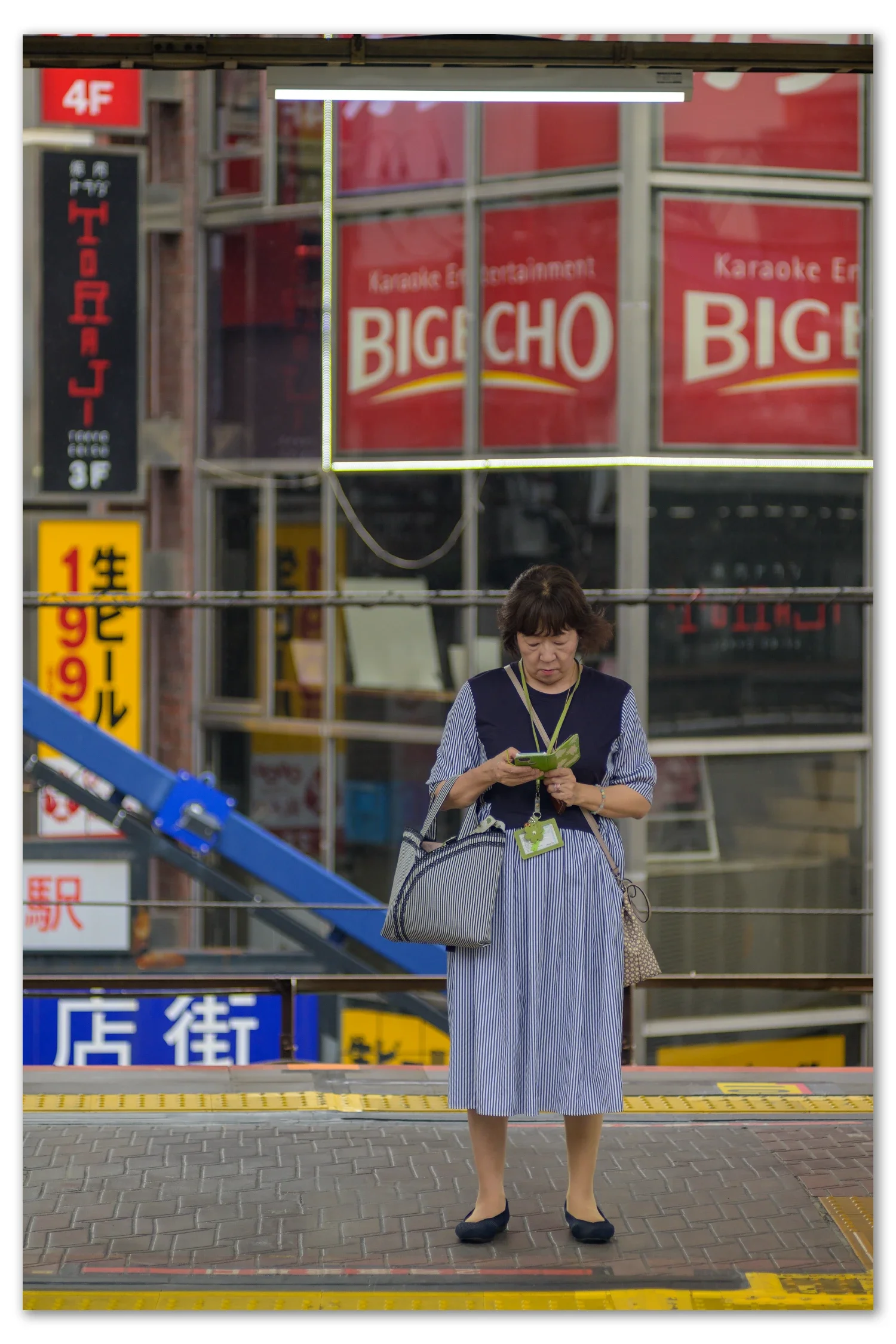
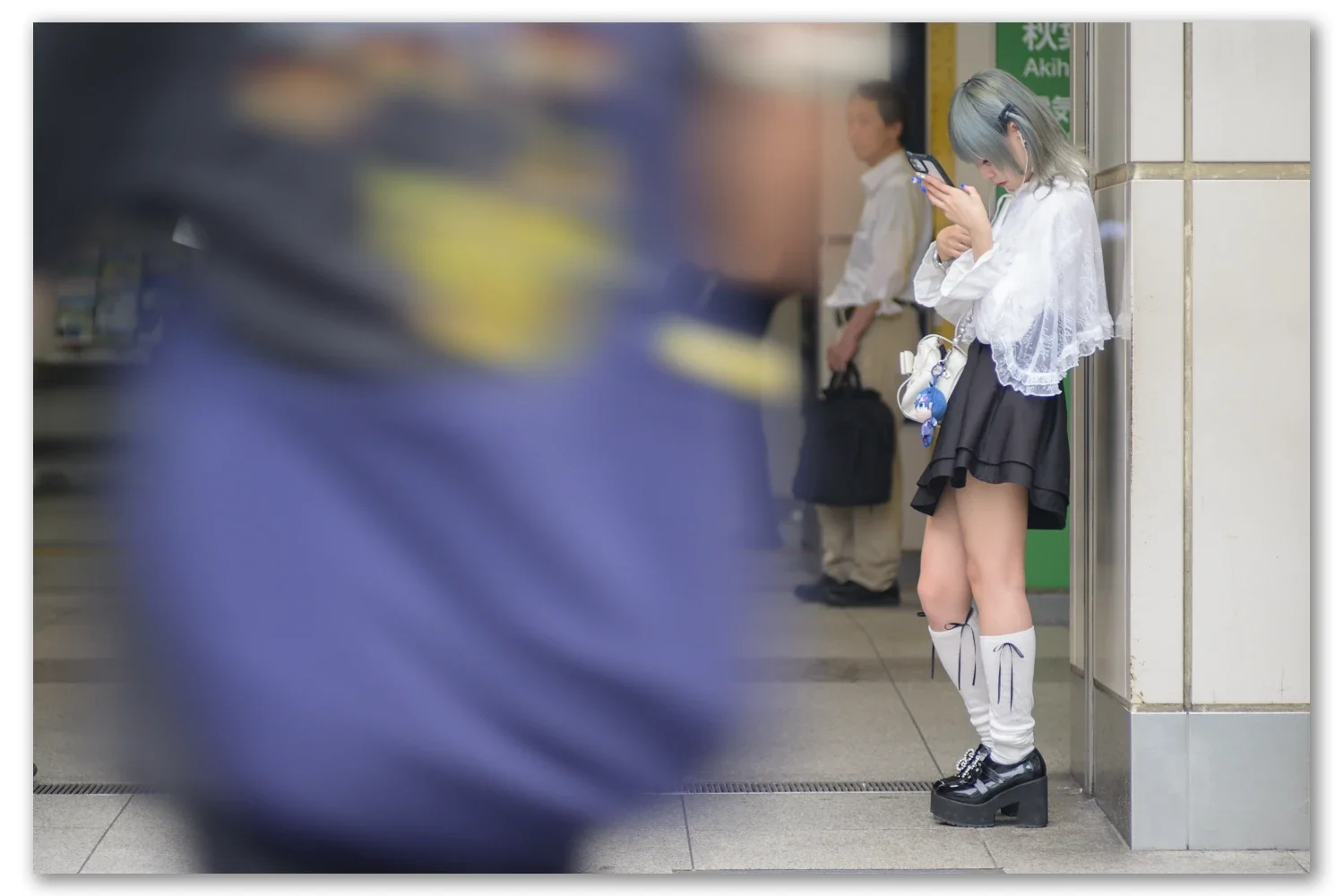
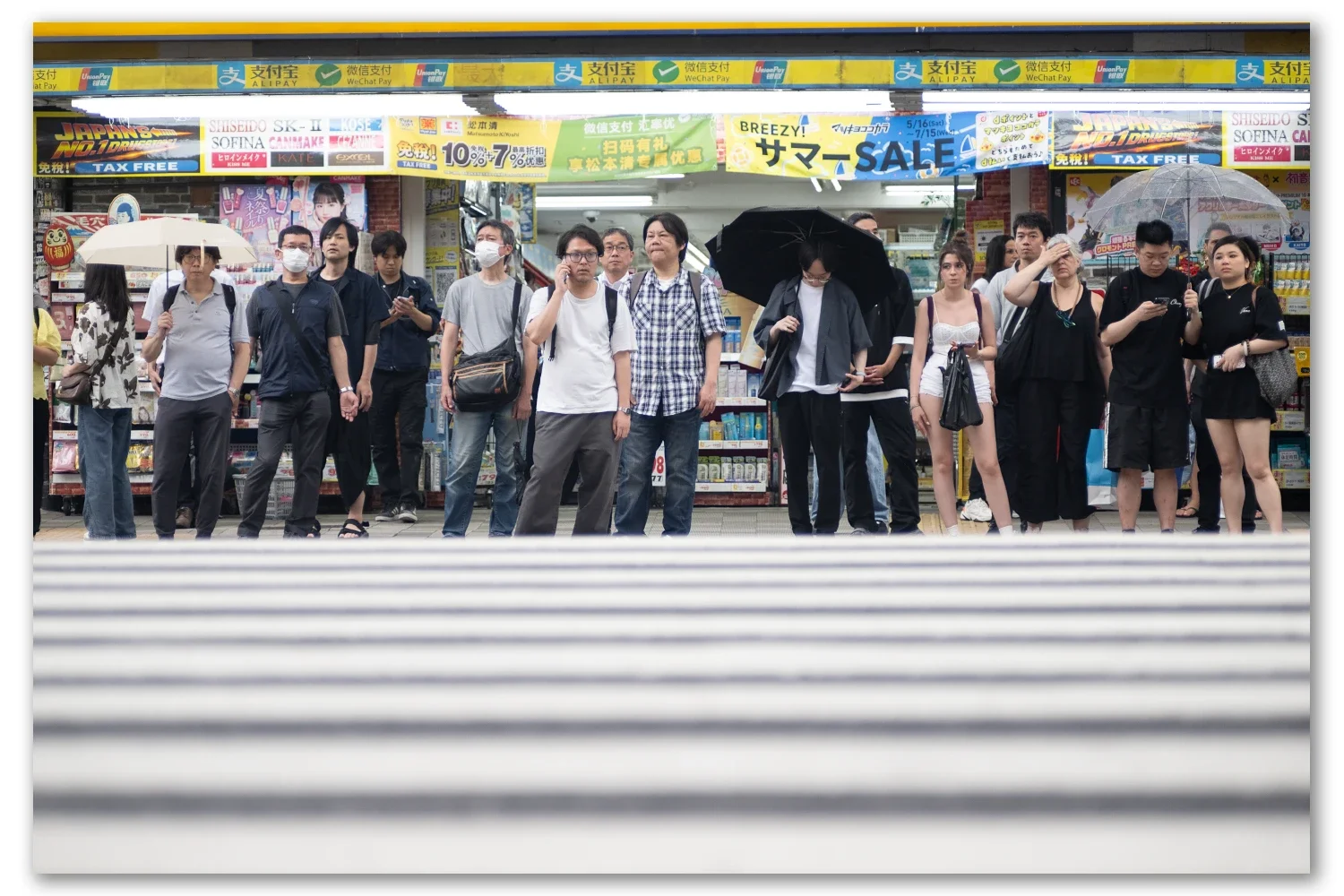
Then I decided to brave the rain and just stand outside. There's a wonderful sign at the main crossing in Akihabara. It requires something wider than 35 — something like 24. I know that it does, and every time I go by I have to try to shoot it anyway. The reason is that it always yields something really wonderful, but I still haven't quite gotten the shot. The one great shot. I know it's in there, and one day I'll have it.
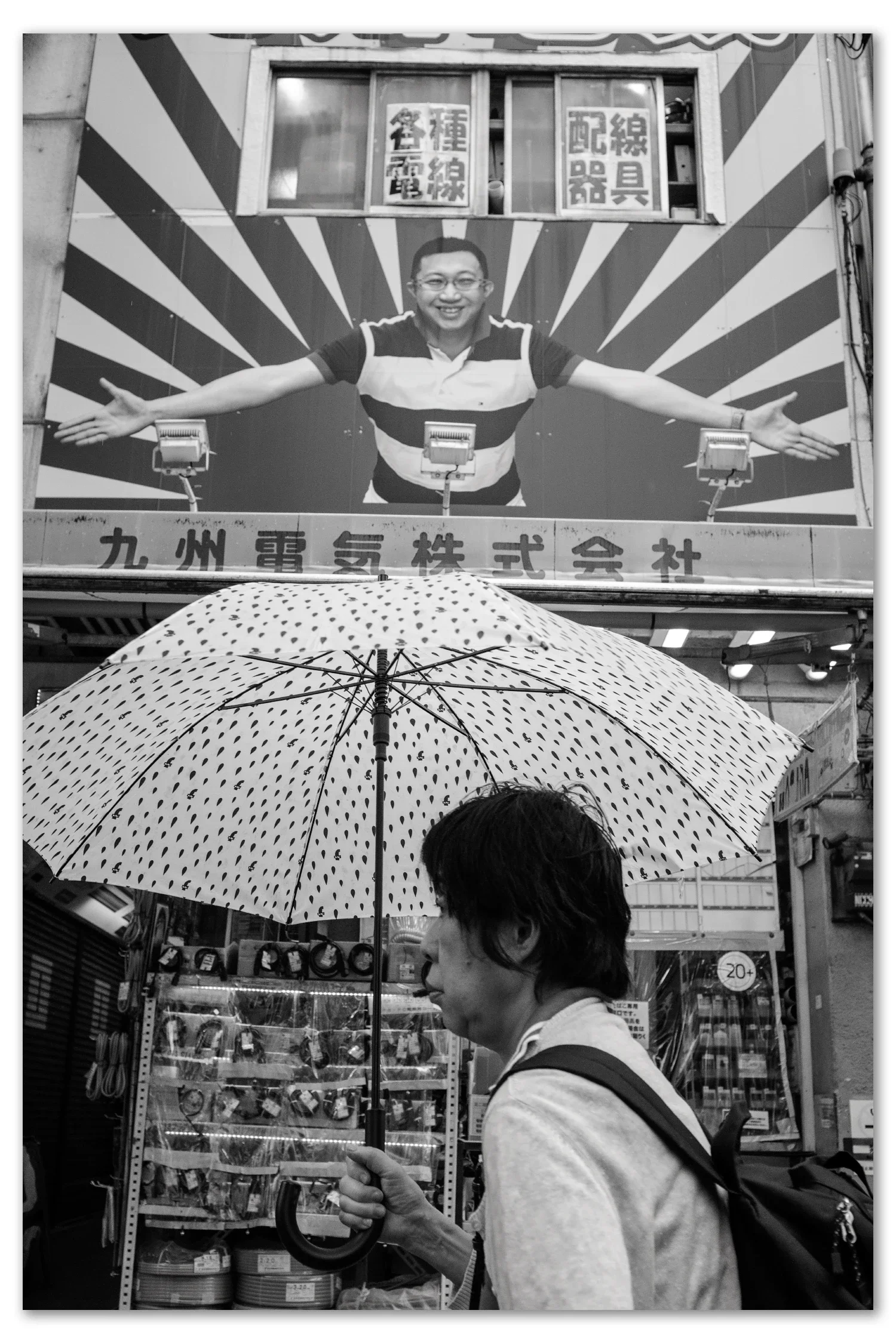
The famed Akihabara electric town shot with a vintage 35 mm f/2.8 Nikkor lens
Hamamatsu-cho: a salaryman paradise, empty
The heat in Tokyo in summer is something to behold. Early July hasn't seen the full force of the humidity yet, but the city is in the middle of a heat wave. I already had several frames I was more than happy with and, for all intents and purposes, should have gone home. Two hours into the day, I decided to push on instead — into an area of the city not known for street photography at all.
Hamamatsu-cho is a salaryman paradise. Unfortunately, all the salarymen were enjoying the office air conditioning. The streets were so quiet it was like a Sunday morning. I just kept walking. Through Zōjō-ji, and quickly I found myself at Tokyo Tower. Pretty dead there too.
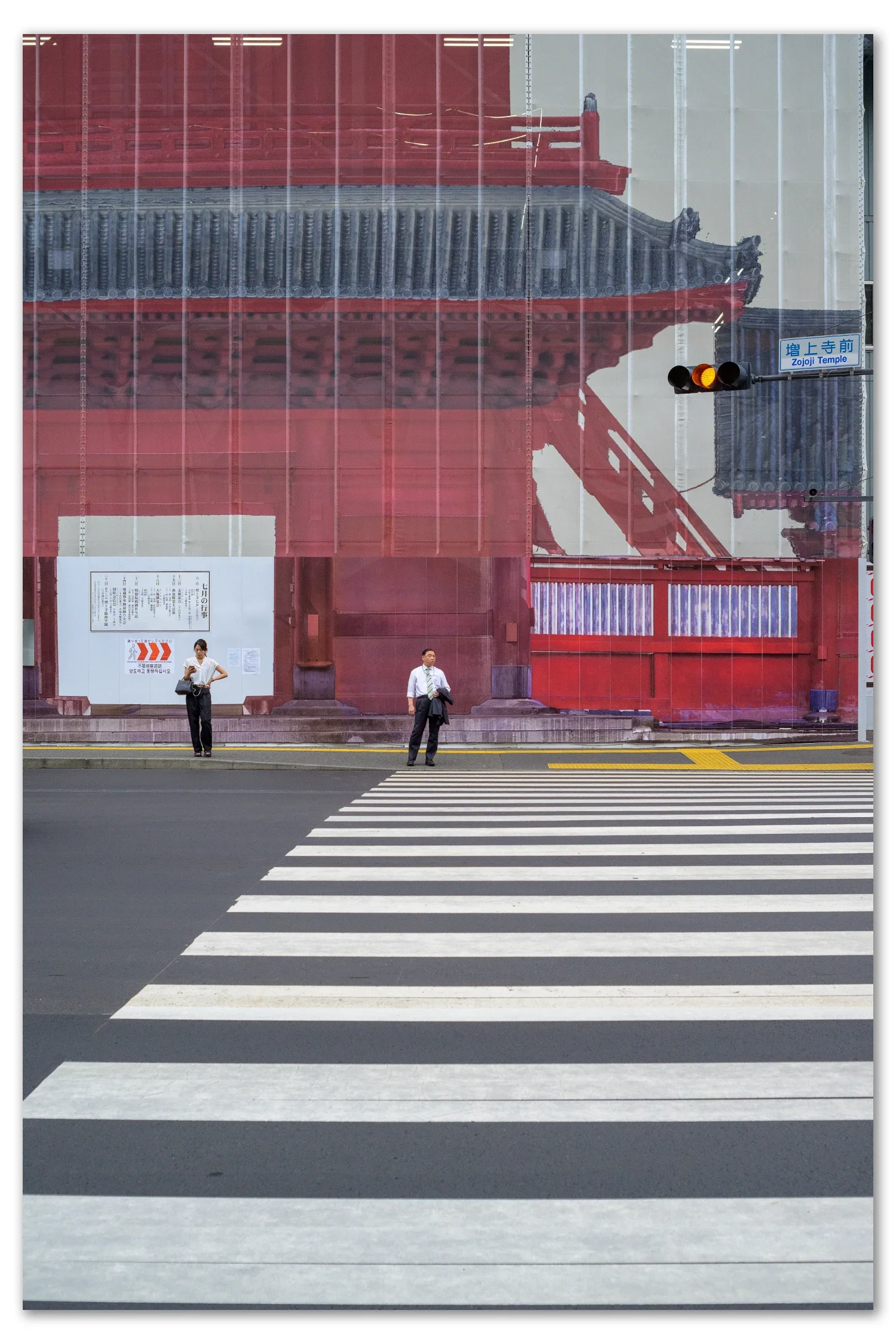
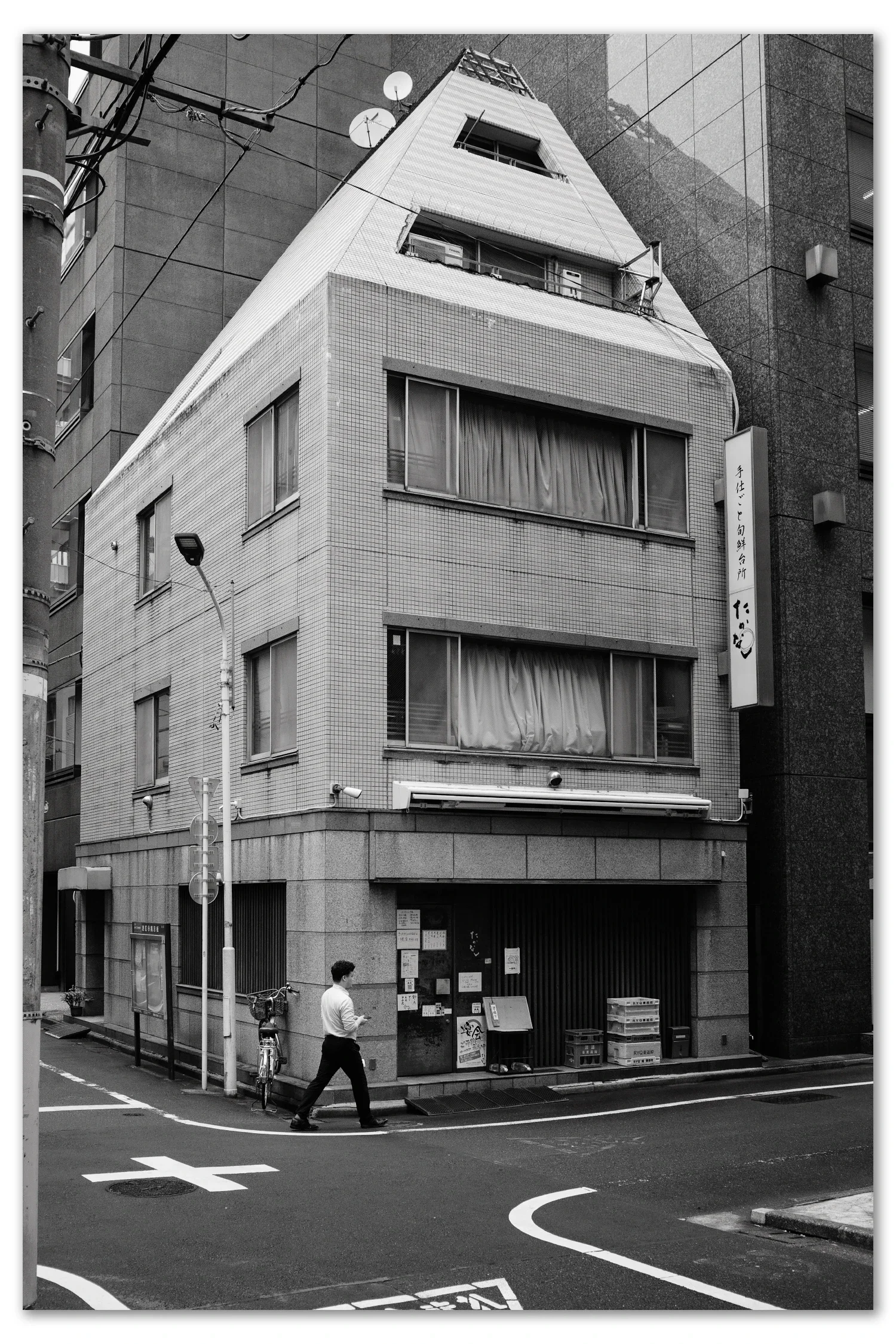
I was fortunate enough to witness a family eating ice cream in the heat. There was a pigeon standing on the bench next to them, so patiently waiting, so eagerly anticipating a morsel of food dropping to the ground. I waited patiently too, and the pigeon did not disappoint.
This is where a lens like the 35mm really shines. It forces you close enough to have the detail you need to tell the story, but it's wide enough to include more context than, say, a 50mm would. Definitely one of my favourite frames from the day.
At that point I was losing the battle to the heat. I made my way from Tokyo Tower to Azabudai Hills, where you can walk underground in relatively cool air conditioning, and on to Roppongi-itchōme station.
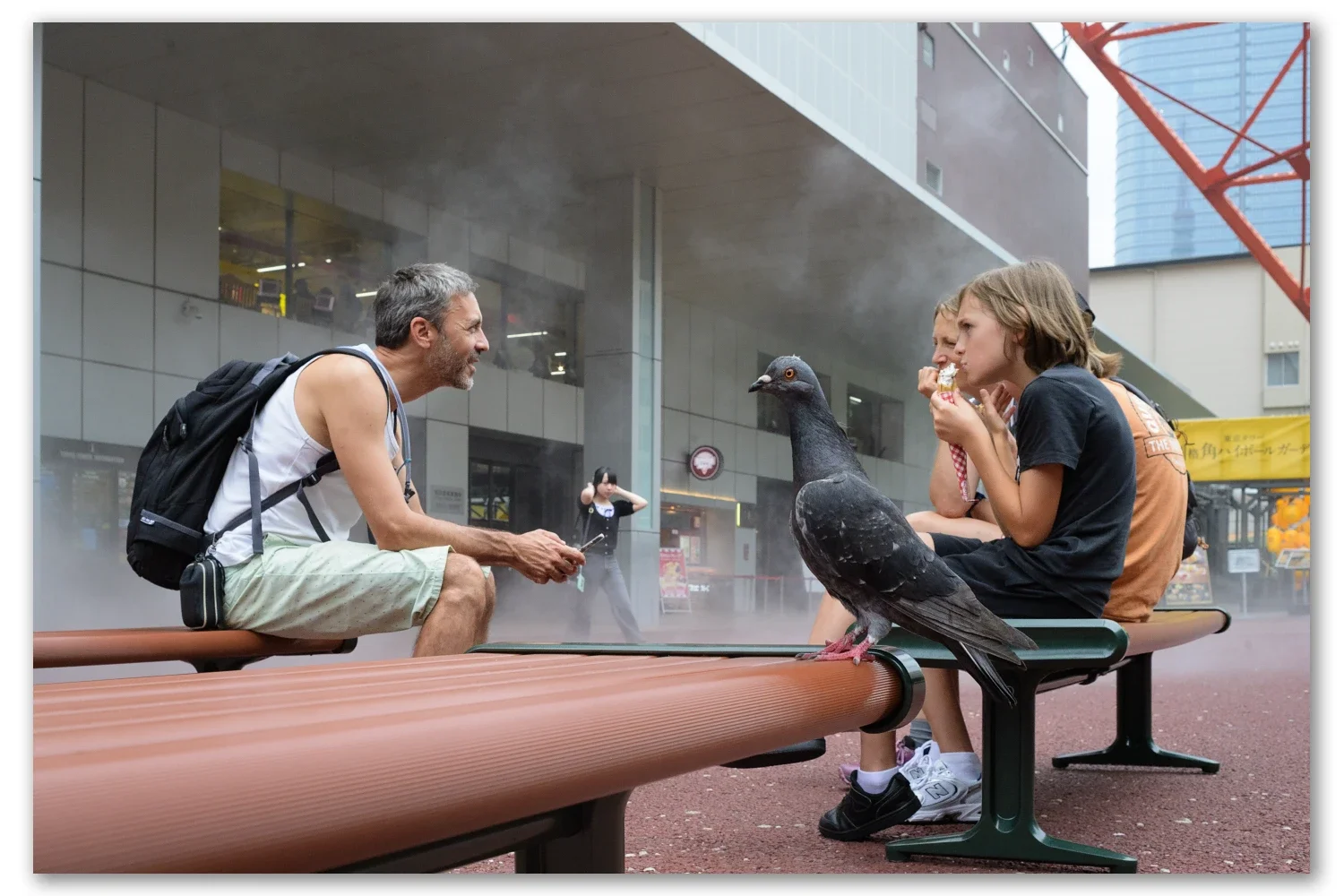
Vintage Nikkor 35mm frame of a family and a pigeon eating ice cream on a hot day at Tokyo Tower.
The Tokyo summer heat is something to behold. As a street photographer, it's unfortunately just another element you have to march through in order to find the next frame.
How to read a district before you raise the camera — and when to change focal lengths mid-day — is what the masterclass works through one-on-one. → tokyoforgeries.com/masterclass
The streets never look the same way twice. I’m curious—how does this side of Tokyo hit you? Drop a comment below.
I live on flat whites and shutter clicks. If you’ve found value in these shots, toss a coffee my way to keep the sensor humming.
For those who want to skip the tourist traps and shoot the real Tokyo, my calendar is open for workshops. Explore the Masterclass here or email me at jeff@tokyoforgeries.com.
See you in the shadows.
Tokyo Forgeries is an evolving archive of Tokyo street photography and vintage-lens deep dives. We spend 30 days in every ward, using mid-century brass and glass to capture the city’s soul. This is a roadmap for the active pursuit of craft—documented through the geography of Tokyo and the character of its light.