Inside The Sanja Matsuri: Street Photography
Sanja Matsuri Street Photography 2026
The Origins: A Brief Sanja Matsuri History
To truly capture the kinetic chaos of the Sanja Matsuri, you have to look past the neon and concrete of modern Asakusa and turn back to the year 628. The story began not with emperors or high priests, but with two fisherman brothers—Hinokuma Hamanari and Takenari—who hauled a small, golden statue of the Bodhisattva Kannon out of the murky depths of the Sumida River. Alongside a local intellectual named Hajino Nakatomo, who recognized the artifact's divine weight, they consecrated the image and laid the foundations for what would become Senso-ji, Tokyo’s oldest temple. The festival itself is a beautiful, cross-faith paradox: a wild Shinto celebration dedicated to the kami (spirits) of these three mortal men who dedicated their lives to building a Buddhist sanctuary.
What started as an ancient act of local reverence transformed during the Edo period into something far more visceral. Held over the third weekend of May, the Sanja Matsuri is the exact moment Tokyo sheds its clinical, theme-park veneer and exposes its raw, historic grit. Over three intense days, the claustrophobic alleys encircling the temple collapse into a suffocating labyrinth of nearly two million people. It is an overwhelming assault of sensory layers—the piercing whistle of flutes, the rhythmic, chest-rattling thunder of taiko drums, and the heavy haze of street food stalls. For a street photographer, the atmosphere becomes a dense, high-contrast canvas where past and present collide in real-time.
The true soul of the festival rests on the shoulders of the mikoshi—the elaborate portable shrines that serve as temporary vessels for the deities. While Saturday sees a hundred smaller neighbourhood shrines swarm the district, Sunday belongs to the three massive, black-lacquered titans owned by Asakusa Shrine itself. Borne by waves of locals in matching happi coats, these shrines are violently bounced, shaken, and jostled in an ancient ritual known as tamafuri. This deliberate agitation is believed to amplify the power of the kami, spilling good fortune out into the packed community. It creates an erratic, high-stakes environment—the ultimate theatre of "life in flux"—where you must step directly into the crowd's personal space to capture the sweat, exhaustion, and ecstatic devotion etched into the participants' faces.
Yet, what gives the Sanja Matsuri its most compelling visual weight is its unique, unspoken truce with Tokyo’s underworld. This is the one weekend of the year where members of the Yakuza step completely out of the shadows, stripping down to traditional fundoshi (loincloths) to mount the carrying poles of the shrines. Under the harsh afternoon light, their intricate, full-body irezumi tattoos are proudly displayed, offering a stark, biting contrast to the sacred Shinto ritual unfolding around them. For the street photographer pursuing authenticity rather than a beautiful fake, this juxtaposition offers a rare, tactile honesty. It is a fleeting window into the city's hidden, gritty layers, framed perfectly by a thousand years of tradition.
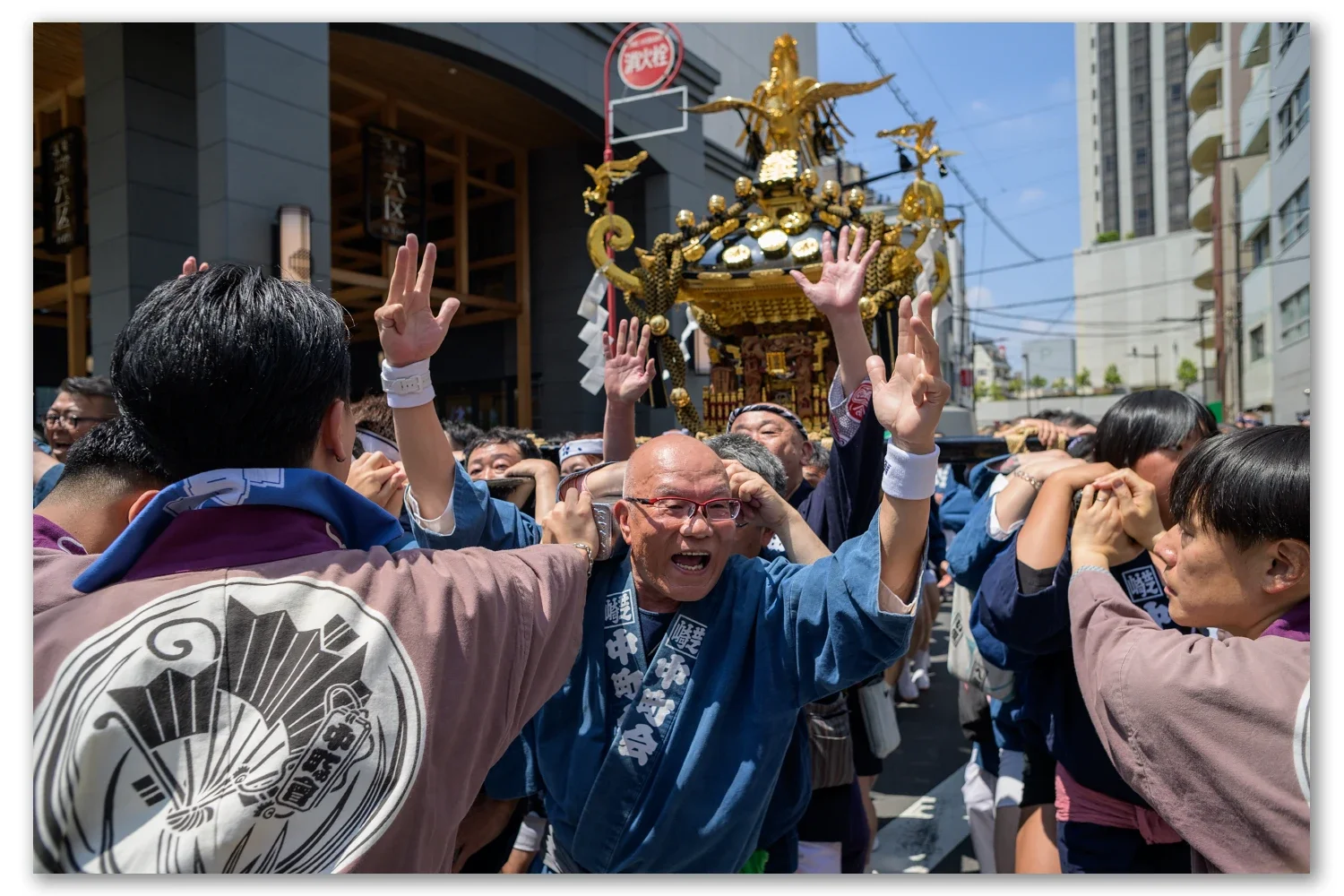
Sanja Matsuri 2026, Locals carry Mikoshi, shot with the 24mm NC Auto Nikkor
Shooting The Sanja Matsuri
It is overwhelming if you let it. It is just as it’s supposed to be if you can see it. These customs would be observed regardless of the crowds; they aren't for them; they're most definitely for the locals.
With that in mind, I shoot for the faces, not the crowd. I am there to record the locals, not the grand reaction to them. Understanding that, stripped away all the noise, and allowed for the intense focus this festival deserves.
I spent a couple of days leading up to the matsuri walking the side streets and back alleys of Asakusa. It is at these locations that the mikoshi will begin their journey during the festival.
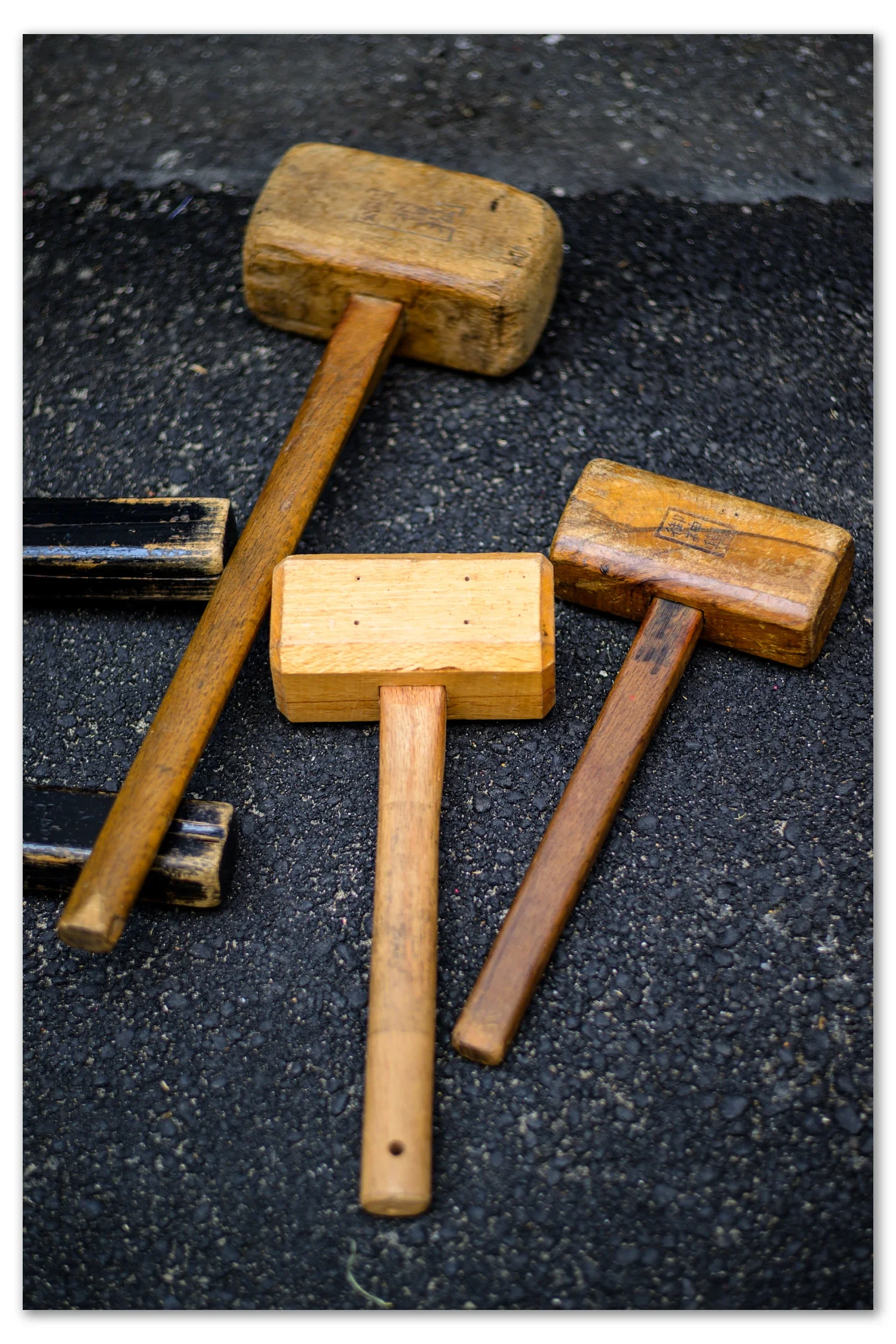
I watched many groups build the structures the mikoshi will sit upon. Craftsmen hammering and tying them all together. Sweat on their brow, every movement predetermined and precise as a tea ceremony.
Becoming familiar with these men and women in the days before the festival built a trust that would allow me to get as close to the mikoshi and those carrying it as I needed on festival day. It also gave me something unexpected: understanding. There was a level of pride on display, not in bravado, in their smile. A genuine sort of appreciation just for being there.
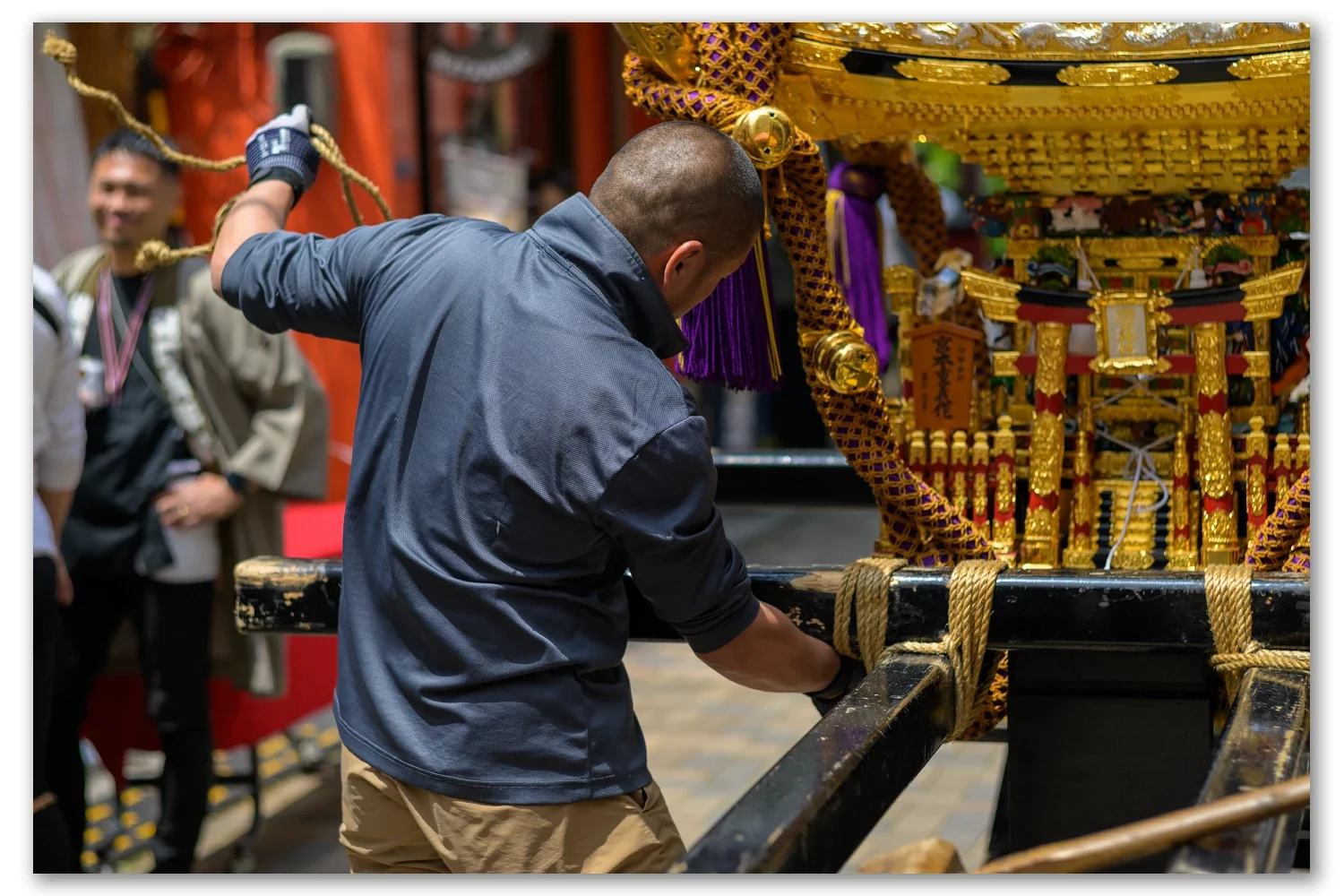
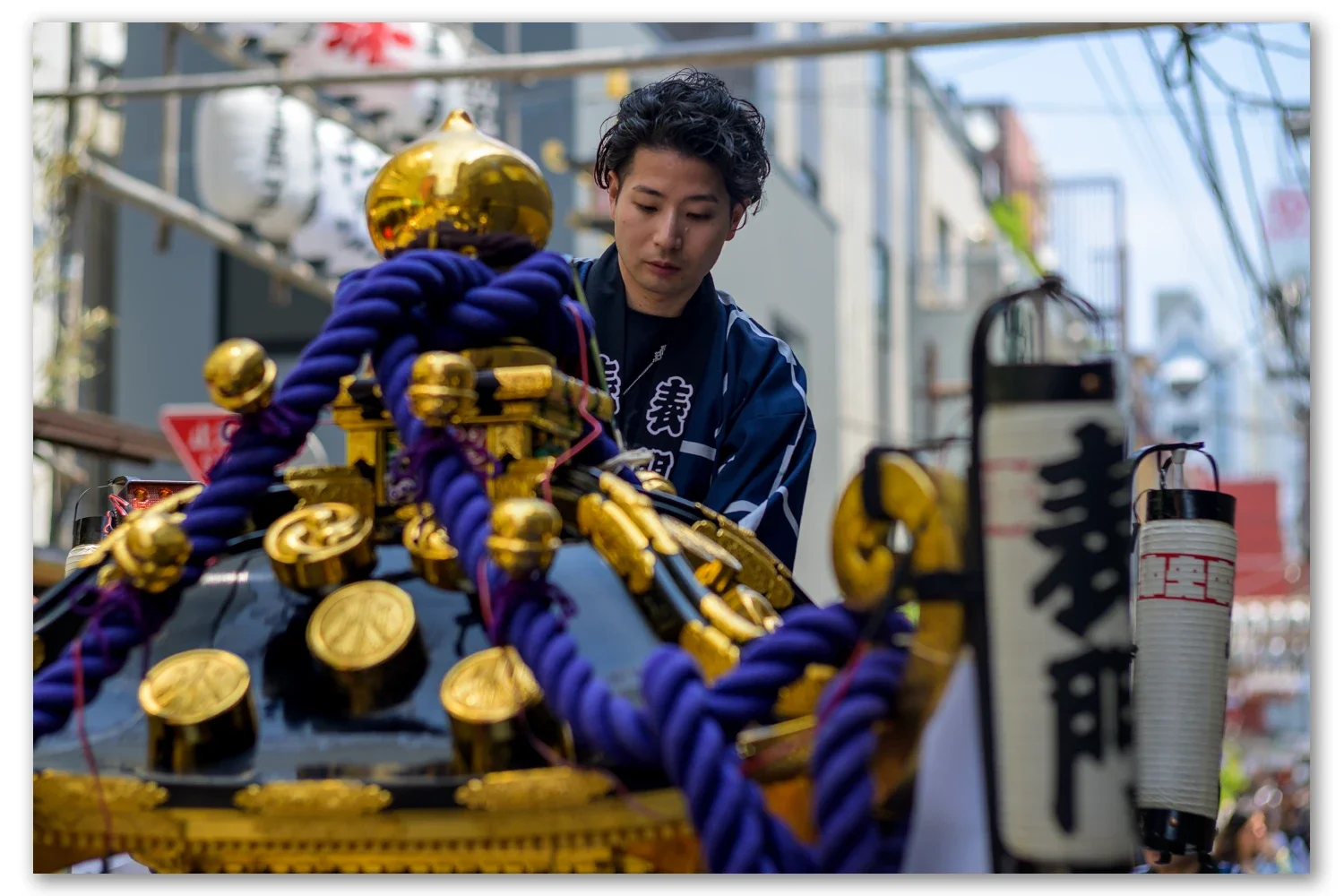
On festival day two, 100 mikoshi leave the local streets en route to Sensoji Temple. I arrived early and photographed two groups as they made their way to the temple grounds. I was close enough to touch the Mikoshi. I had freedom to move up, down and across the group without police or festival officials moving me to safety. These were as real and powerful a moment as I would feel the entire three-day festival.
Shooting on festival grounds was exciting, but also limiting. There were only certain spaces to stand and shoot. The crowds surged at certain points, making the experience feel more like paparazzi clamouring for the best worst shot of the passing celebrity.
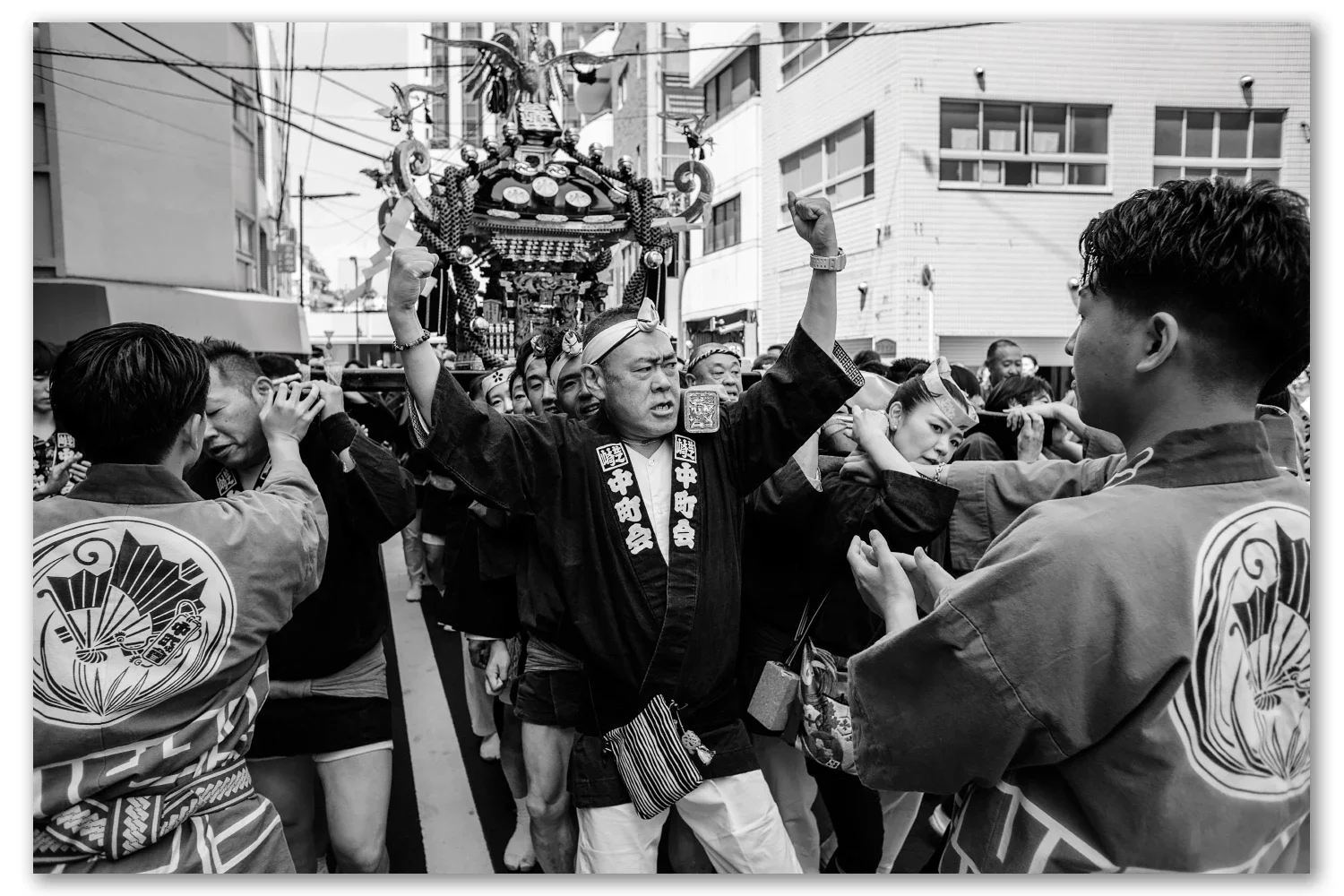
Sanja Matsuri Mikoshi carried in the streets of Asakusa
I moved from spot to spot, always trying to focus on the locals carrying the Mikoshi, searching for moments of joy, pride, and exhaustion. There was plenty to be had.
The Nikkor-NC Auto 24mm and H-85mm were my go-to lenses this day. Moving along with the surging Mikoshi, the 24 mm let me stay extremely close without too much distortion. Taking a step back, the frame could include the whole body, arms outstretched.
The 85mm Nikkor-H Auto allowed me to show the scale of the event. The compression narrows the focus, giving me a sense of what it was like to be there. The wider shots of the same scene carry too much information for my taste, big and overwhelming without any of the subtle emotion that impact requires.
I also used the Leica Q2 Monochrom camera, which has a 28mm Summilux lens. This proved to be a great partner to the 85mm, allowing for a quick change from narrow to wide frame whenever needed.
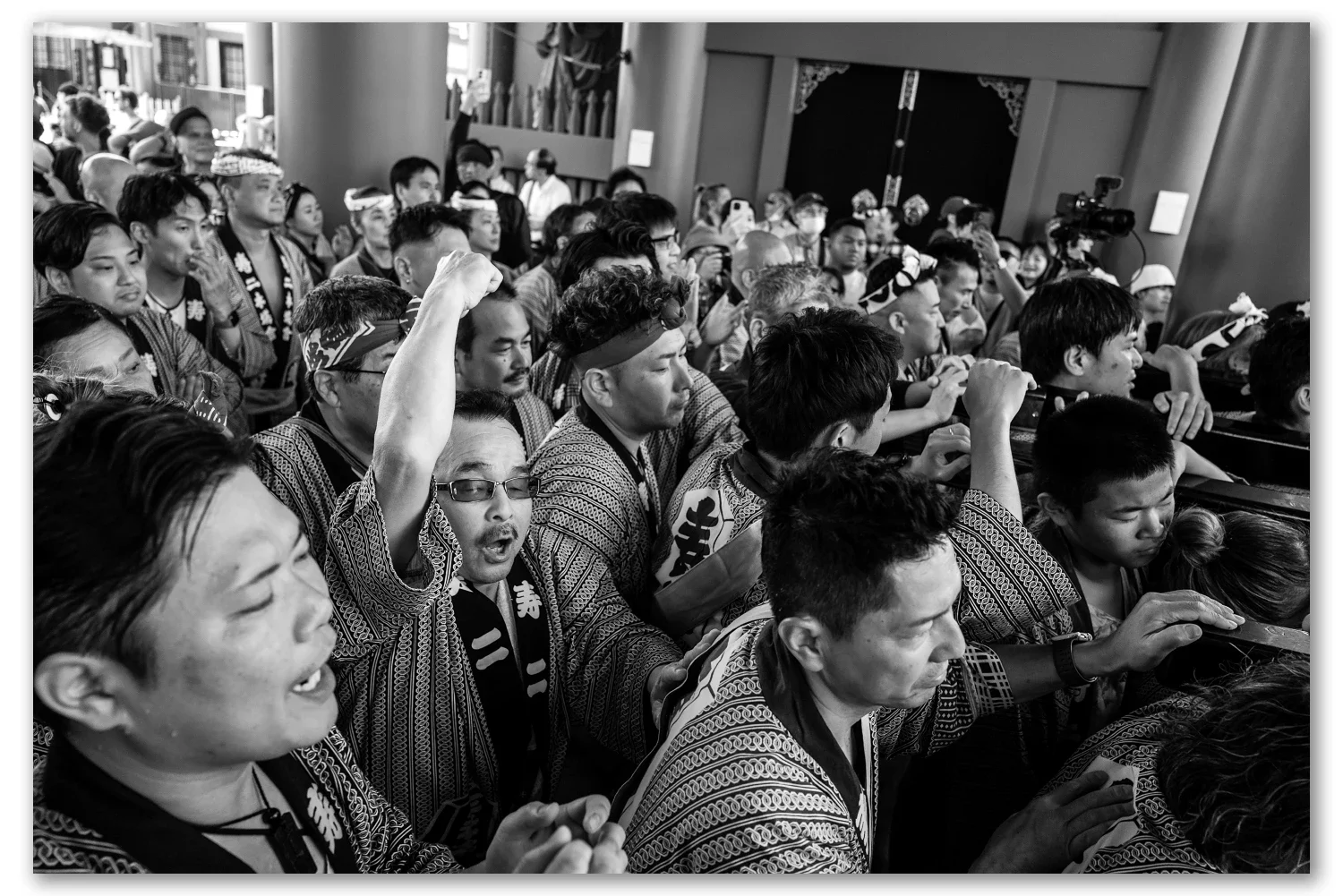
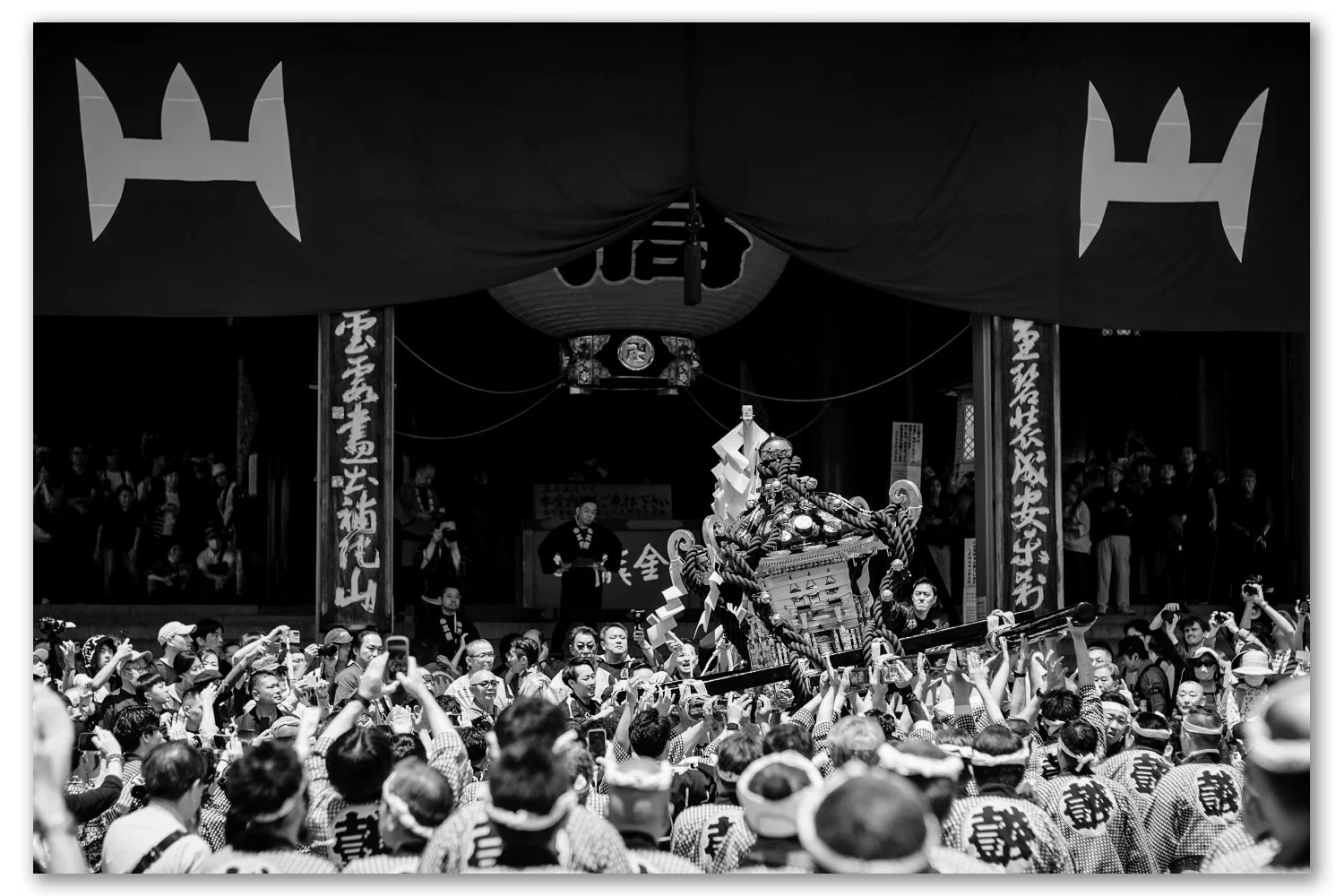
Hozomon Gate during the Sanja Matsuri 2026
Final Thoughts on Sanja Matsuri Street Photography
The Sanja Matsuri does not need a photographer. It has been happening for nearly four hundred years of recorded festival history, and the weight of that continuity is impossible to fake. What a photographer can do — if they are patient, if they arrive before the crowds, if they have spent the preceding days earning the right to be close — is bear witness to what is actually there, underneath the spectacle.
What is there is ordinary people doing something extraordinary for reasons that have nothing to do with tourism or content. The craftsman lashing bamboo at 6:00 AM. The old woman watching a mikoshi pass from the same doorway she has watched it from for sixty years. The carrier whose exhaustion and devotion have become indistinguishable from each other — his face a record of everything the festival asks of a body.
These are the photographs I came back with. Not the ones that reproduce well, necessarily. The ones that hold.
The history of the Sanja Matsuri stretches from two fishermen pulling a goddess from the Sumida River to this — two million people pressed together in the alleyways of Asakusa, moving in a rhythm that predates the city that surrounds them. Somewhere in that continuity is a truth about Tokyo that the skyline and the subway maps do not contain: that underneath the architecture of the new, the old city persists. It has its own rituals, its own loyalties, its own calendar.
You do not photograph the Sanja Matsuri. You go to it. The photographs are the ones you find along the way.
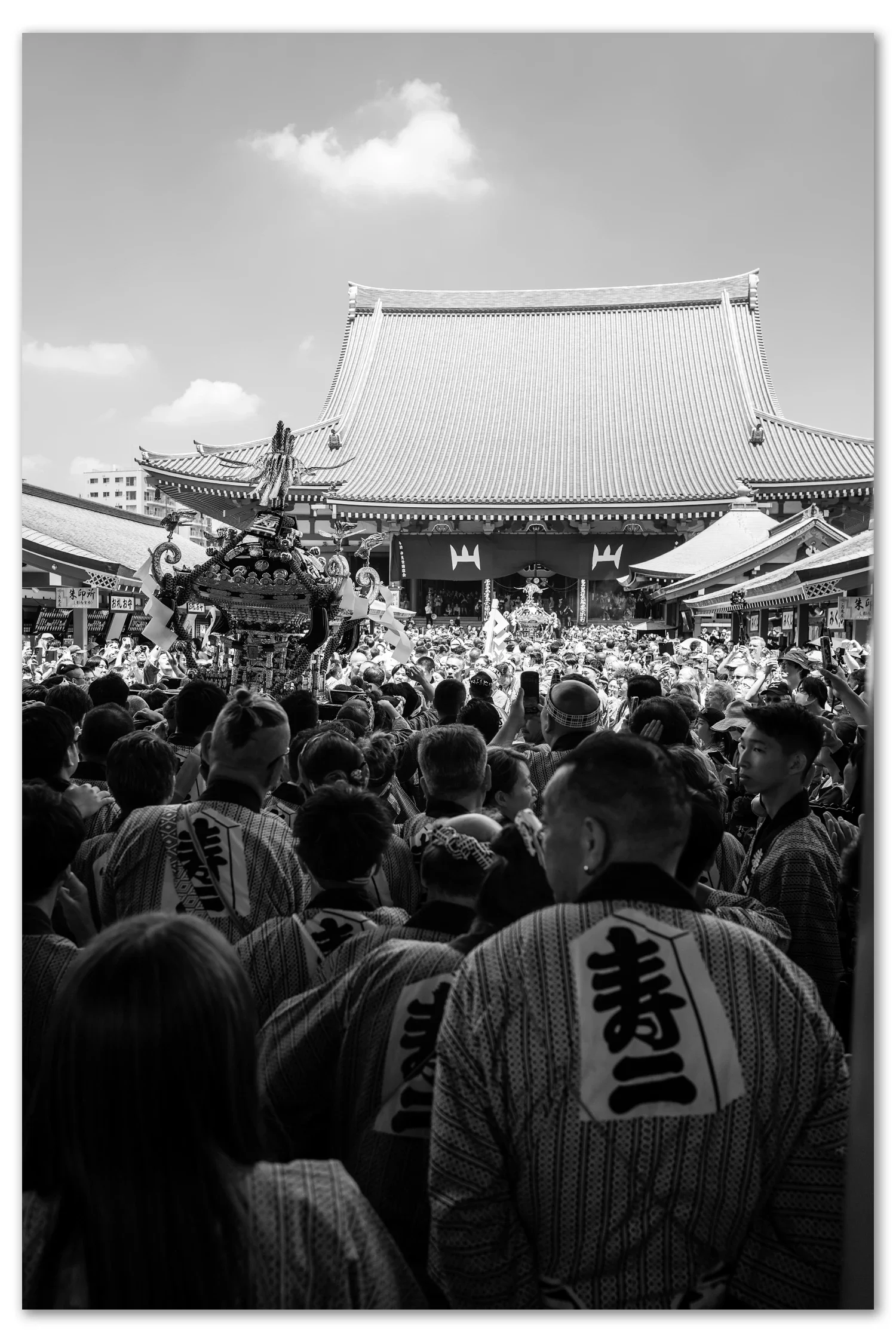
Sanja Matsuri crowd at Sensoji Temple
The streets never look the same way twice. I’m curious—how does this side of Tokyo hit you? Drop a comment below.
I live on flat whites and shutter clicks. If you’ve found value in these shots, toss a coffee my way to keep the sensor humming.
For those who want to skip the tourist traps and shoot the real Tokyo, my calendar is open for workshops. Explore the Masterclass here or email me at jeff@tokyoforgeries.com.
See you in the shadows."
Tokyo Forgeries is an evolving archive of Tokyo street photography and vintage-lens deep dives. We spend 30 days in every ward, using mid-century brass and glass to capture the city’s soul. This is a roadmap for the active pursuit of craft—documented through the geography of Tokyo and the character of its light.