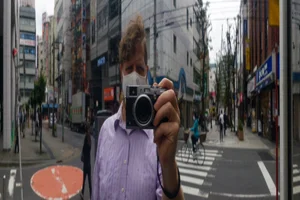
The Nikkor-H Auto 85mm Romantic Beast
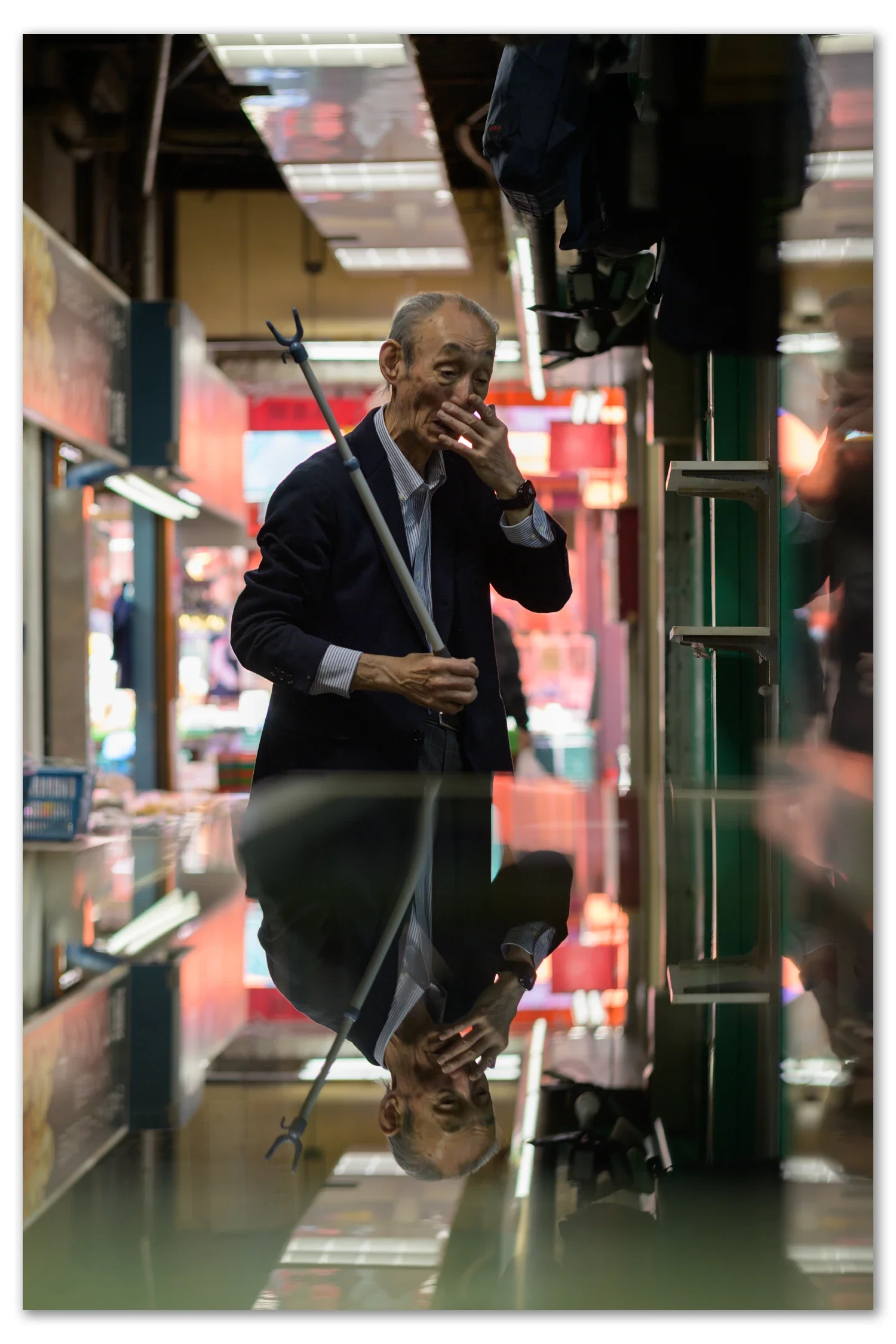
Shop Keeper in Ueno, One of the first shots with the 85-H Auto Nikkor
The Nikkor-H Auto 85mm: Romantic Beast Review
May 12
A quality lens review must include charts, graphs, and mathematical formulas that quantify the lens's exact qualities. Explanations of those charts and graphs, and how the reviewer came to decide which of them to use, fill pages of content to arrive at the very simple question: how does it look?
That is oversimplifying things, but it's the thought occupying my mind as I read page after page of interesting yet unnecessary information. How does this lens look? That is the question I will answer in this review: in the use case of street photography, how does this lens look?
How does this lens look?
It's gorgeous. Sharp where you want it, soft and buttery-smooth everywhere else. It renders colour warm to neutral, with an organic feel. The contrast holds its own without ever lacking in punch. Some lenses need to be turned up to 11 in order to perform at their best. The Nikkor-H Auto 85mm hits on all cylinders at 8. It is tuned to look beautiful without needing anything extra.
What it is. What it isn't.
Built between 1960 and 1970, the Nikkor-H Auto 85mm is a lens from an era when imprecision was simply part of the craft. The focus ring has weight and travel — a long, deliberate arc that asks something of you before it gives anything back. The bokeh roll-off is not a feature; it is a consequence of the glass itself, the way light decides to dissolve at the edges of its attention.
Fast is relative. The aperture opens to f/1.8, which sounds fast enough. But this lens has its own inertia. It is not mathematically sharp — it was never designed to be. It was designed to render life the way memory does: accurate in the middle, softer toward the edges, always a little warmer than reality.
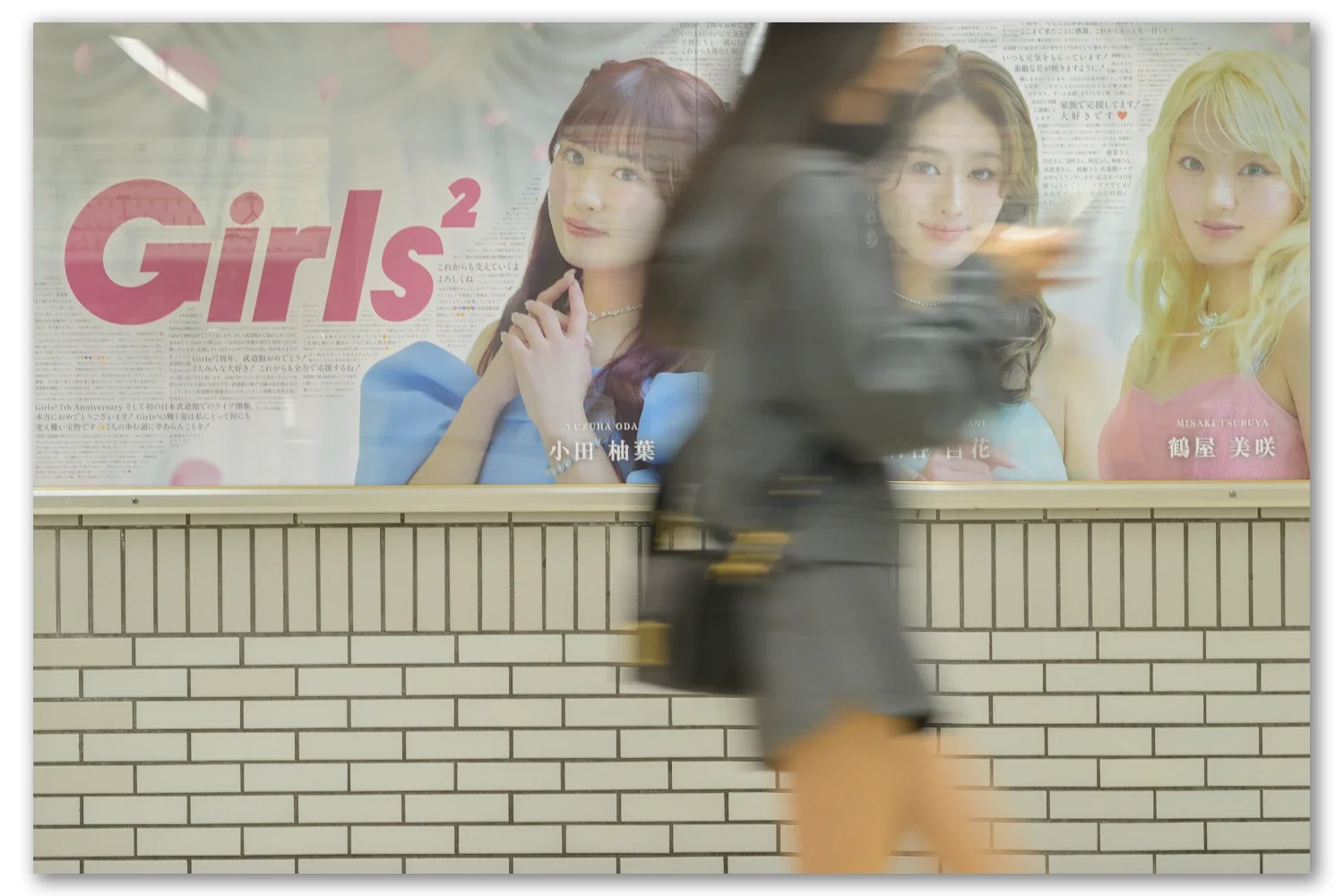
Layers in Ikebukuro Station with the vintage 85-H Auto lens
The Feel
There is a ritual to picking this lens up. The aperture ring clicks with intention — each stop deliberate, each position earned. The focus throw is long and smooth, the kind that slows you down in a way that sharpens your thinking. It balances well on the camera. Not too heavy for a long walk through Shinjuku or Yanaka, present enough in the hand that you never forget you're holding something with a history.
On the shoulder, it disappears. On the street, so do you.
The Render
Wide open, there is a subtle glow — not a flaw, a quality. The transition from sharp to soft is immaculate, the kind of roll-off that portrait photographers spend years chasing with modern glass and editing software. But the Nikkor-H doesn't negotiate. It renders warm and graceful, and that is what it does.
Colour sits just to the warm side of neutral. Not shifted. Not stylized. Just honest. Skintones, stone walls, the brass fittings on an old shopfront in Koenji — all of it returned to you with a quiet fidelity. There is little to edit because the lens gets so little wrong.
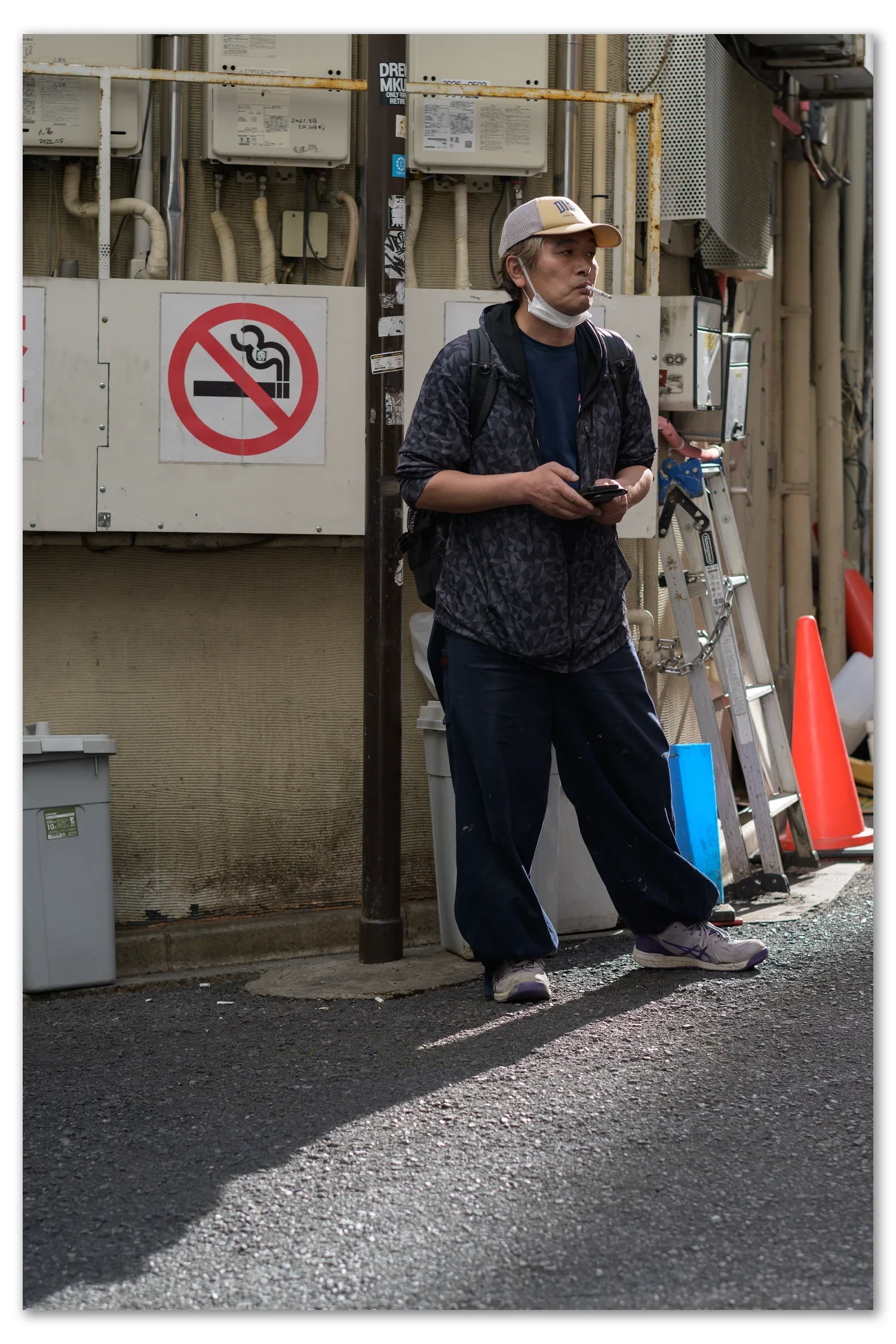
The best Ikebukuro alley for street photography
On the Streets of Tokyo
This lens requires vision. Not skill exactly — vision. You have to see the frame before you arrive at it, because by the time you've adjusted focus on a moving subject in a crowded alley, the moment has already moved on. What it teaches you, slowly and without apology, is patience.
Tokyo rewards patience. The streets compress and expand. Light falls at angles that wider lenses miss entirely. At 85mm you are pulling the frame toward you — isolating a face from the noise of the city, finding the one detail in a scene that contains everything else. A man waiting for a train. A woman adjusting her umbrella. The geometry of shadow falling across the entrance to a covered shotengai. The lens is not subtle, but it is quiet. Small body. It does not draw attention. It does not disappoint.
This is not a spray-and-pray lens. It is not a lens you pick up and immediately trust. It asks that you stand still long enough to know what you want — and that standing still, that moment of stillness inside the rhythm of a city that never stops moving, is where the image begins.
My Gut Feeling on the Nikkor-H Auto 85mm
This lens has a look. It is difficult to put that look into words. I will say that it renders the image warm and accurately — in a way that leaves me with little to no need to edit. This is not a nostalgic look. It's not cinematic. It just doesn't get in the way of itself.
The modern lens is made for a modern landscape. It provides the photographer with a technically flawless image — one that can be pushed and pulled into whatever is needed. I love that. But it is not what this lens does. This is a character lens. It looks the way it looks, and editing it into something else seems counterintuitive. I love that even more.
The Romantic Beast earns both names. Romantic because it sees the world with warmth and a little softness at the edges, because it insists on beauty even where none was intended. Beast because it demands something back — patience, stillness, a willingness to work at its pace rather than your own. To yield to the glass, and trust what the glass gives you.
Not every lens forges a relationship with the photographer. This one does.
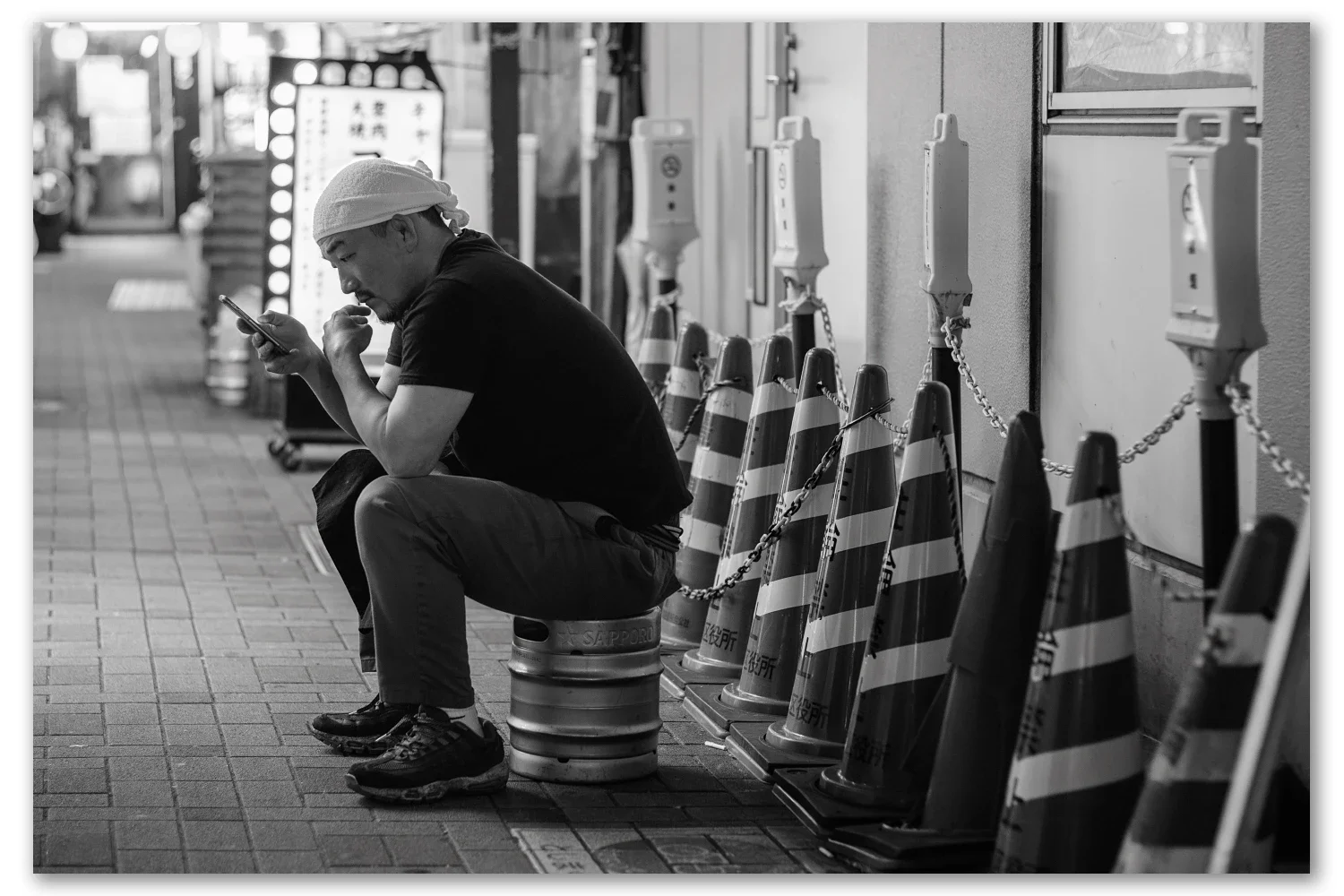
F1.8 with the Nikkor 85mm-H Auto vintage lens in Ikebukuro
The streets never look the same way twice. I’m curious—how does this side of Tokyo hit you? Drop a comment below.
I live on flat whites and shutter clicks. If you’ve found value in these shots, toss a coffee my way to keep the sensor humming.
For those who want to skip the tourist traps and shoot the real Tokyo, my calendar is open for workshops. Explore the Masterclass here or email me at jeff@tokyoforgeries.com.
See you in the shadows."
Tokyo Forgeries is an evolving archive of Tokyo street photography and vintage-lens deep dives. We spend 30 days in every ward, using mid-century brass and glass to capture the city’s soul. This is a roadmap for the active pursuit of craft—documented through the geography of Tokyo and the character of its light.