Neither is more ethical by default; they produce different photographs. A candid frame shows someone absorbed in their own life and keeps the place around them; a street portrait shows how a person holds themselves when they know they're being looked at. Shoot candid when the picture is about what a place does to people; ask when it's about the person — and if you shoot candid, acknowledge them afterwards.
This gets asked as an ethics question, and it is not one. The ethics I have dealt with elsewhere — the line is whether you are telling someone's story or taking advantage of them, and that line runs through both approaches equally. A street portrait made with a nod can still be exploitation. A candid frame can be an act of respect.
The real question is a craft question, and almost nobody asks it: the two methods do not produce the same photograph. They produce different pictures, with different subjects, and the difference is visible in the frame to anybody who knows what to look for.
What a candid frame actually contains
A person whose attention is elsewhere. That is the whole thing. Because they are not looking at you, the picture holds their trajectory — where they came from, where they are going, what they were in the middle of. You get gait, gesture, the shape of a life in motion, and a face doing whatever a face does when nobody is asking it for anything.
You also get the world. The subject has not arranged themselves against the background, so the background stays in the picture as a fact rather than a setting. Candid frames are pictures of a person in a place, and the place keeps its vote.
What a street portrait actually contains
Attention, arriving at the lens. The person composes themselves — and that is not the failure everyone treats it as. What a person does with their face when they know they are being looked at is a genuine subject, and in some ways a harder one. You get stillness. You get eye contact held long enough to actually read. You get the relationship between the two of you, because it is now in the photograph whether you like it or not.
And you lose the world. They have stopped doing what they were doing. The background usually simplifies too, because you moved to make it work. A portrait is a picture of a person facing you, and the street becomes a wall behind them.
Neither is more honest. They are honest about different things.
The third thing, which nobody names
There is a register between the two, and it is where my strongest frames live: the acknowledged candid. Not stealth, not permission. You are working, the person notices you mid-frame, and you keep going.
The moment of being noticed is itself a subject. For about one second the person is neither absorbed nor posed — they are deciding what to do about you, and the frame made in that second contains the whole transaction: a stranger, a camera, and an unresolved question. Go through my Ueno work and the pictures that hold up are disproportionately these. The man behind the glass door. The vendor who looks up. It is not the candid, and it is not the portrait. It is the second in between.
Which is why I almost never take one frame of a person
There are usually several before the one you have seen, and one or two after. Not machine-gunning — working. Each frame is another attempt at the same problem, and the run is where I find out what I got wrong: too early, too far back, the background fighting the head, the hand out of the frame.
Two things come out of that habit. The first is practical: options, and a record of my own mistakes that I can actually learn from. The second is the honest one. Shooting a sequence rather than snatching a single frame means I am contemplating this person more than once, trying to make the photograph as good as it can be rather than taking what I can get and leaving. There is more respect in that than in speed.
And here is what the runs taught me, which I did not decide in advance: the frames I keep are overwhelmingly the ones where they are aware of me. Not posed. Aware. That is not a rule I set out to follow. It is what survived the edit, year after year, until I noticed.
So ask afterwards
This practical reordering dissolves most of the supposed dilemma. Take the candid. Then acknowledge — the nod, the small bow, the held-up camera, the smile. You keep the unguarded photograph, and the person is still treated as a person rather than scenery. If they object, you have a decision to make, and you already know what I think of it.
Asking first buys you a different picture. Asking after costs you nothing but nerve.
If you are going to ask, get good at it
Most photographers are bad at this in one specific way: they ask for permission, which puts the other person on trial and invites a no. Announce an intention instead and leave room — a lifted camera, a gesture at the light, すみません、一枚いいですか — then stop talking. The pause does the work.
Take a refusal instantly, warmly, and without negotiating. You are not only spending your own credit at that stall. You are spending the credit of every photographer who walks down that alley next week.
And know the real cost, which nobody admits: asking will get you a worse photograph more often than not. The person stiffens, the world stops, and the picture you are left with is a stranger being polite. Street portraiture is harder than candid work, not more virtuous. The frame almost always arrives in the ten seconds after the posing — when they relax, or get bored, or turn back toward what they were doing — and almost everybody leaves before that happens.
## What actually decides it
Ask what the photograph is about. If it is about what a place does to the people in it, shoot candid — the moment you ask, the place stops doing it. If it is about a person, and you want them to be a person rather than an example of something, ask, and then stay long enough for the pose to wear off.
Candid shows you what someone was doing. A portrait shows you what they do when somebody is looking. Both are true. Neither of them is the truth.

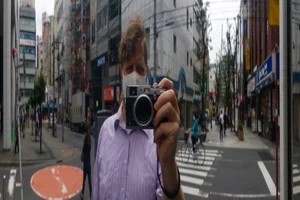
Reflected life in Ueno Market
The common counterpoint
Asking is simply the honest option, and candid work is theft with better public relations. The test is obvious: if you cannot tell your subject what you are doing, you already know there is something wrong with it. The claim that candid work is more "truthful" is self-serving nonsense — an unposed photograph is not more true than a posed one; it is only taken without the person's knowledge, which is a fact about consent, not about truth. And the proof is the work: the durational, consent-based tradition has produced photographs with more depth in them than any amount of shooting from the hip. The candid tradition is largely a history of people with cameras deciding that strangers' faces are raw material.
My answer
The truth claim I concede before it is even made, because I made it myself above. Candid is not more truthful. Anyone defending it on those grounds is defending it with the wrong argument, and the argument collapses the moment somebody pushes.
The consent-based tradition has produced extraordinary work and I am not going to pretend otherwise. Staying with people over years gets you something no afternoon can.
Here is where the objection fails, though, and it fails on a single assumption: that asking is always available.
Asking does not observe the thing. It ends it. If the subject of the photograph is a market at work — people absorbed in labour, a hundred small acts of concentration under a railway — then the question converts every one of them into a person looking at a camera, and the photograph you came for no longer exists anywhere in the world. That is not a claim that candid is better. It is a plain observation that some subjects only exist unobserved, and a rule requiring consent first does not make those photographs more ethical. It makes them impossible.
On the test — if you cannot tell them what you are doing, you know it is wrong — I largely agree, and I do tell them. Afterwards. That is the nod, and it is the same instinct as the question I use on every frame: would I show this person the back of the camera?
The last charge lands hardest and I will not wriggle out of it. The genre does have a history of men deciding strangers are material, and pointing at the good candid work does not cancel the bad. The answer is not to abolish the method. It is to stop pretending the discomfort is not there — to keep it in the room, where it makes you a better photographer, rather than arguing it away with a slogan about public space.
Part of Street Photography: Twenty Questions, Answered — a series answering the questions people most often ask about street photography.
Frequently asked questions
Is it better to ask before taking a street photo?
It depends on what the photograph is about. Asking changes the picture: the person composes themselves and stops what they were doing. If the moment is the subject, shoot first and acknowledge afterwards. If the person is the subject, ask, and stay long enough for the pose to wear off.
What is an acknowledged candid?
A frame made in the second someone notices you. They are neither absorbed nor posed, and the photograph holds that brief exchange between a stranger and a camera. Many of my strongest frames are made this way.
How do you ask a stranger for a photo in Japan?
Announce an intention rather than asking for permission: raise the camera slightly, gesture at the light, and say すみません、一枚いいですか. Then pause. If the answer is no, accept it warmly and immediately.
Notes and sources
The "smile and nod" etiquette appears in Chapter 06 of my Ueno zine. The observation about acknowledged candids comes from reading through my own Ueno frames.