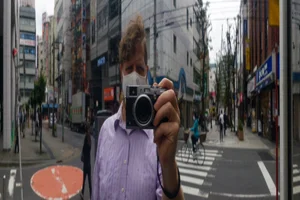
Nikkor H Auto 85mm f/1.8 First Impressions:
This past week, I came into possession of the venerable Nikkor H Auto 85mm f/1.8. It took a few days to test out because I also came to own a 24mm Nikkor Auto NC. The 24mm lens would not come off the camera body for several days. It wasn't stuck; I was just having so much fun with it.
I am a big fan of the 85mm focal length; it has just the right amount of compression, which I love in the noisy Tokyo environment, but doesn't have you standing too far from your subject. It can provide both isolation and context.
This particular lens has a lot of character, which is why I chose it. There are a number of newer, faster and cheaper options. Currently, I am after character over mathematical perfection. This lens has that in spades.
I shot in both the Ueno and Shimbashi Station areas. In truth, I wasn’t in full lens-testing mode. I was in both locations for about 30 minutes each. I did not shoot as much as I wanted, but what I did shoot made me very happy.
The lens delivered as promised—sharp, clear, and contrasty with a natural feel. Its focus throw is long and smooth, enabling me to focus quickly and effortlessly, almost as if I were using a medium format camera. The experience thus far is really quite enjoyable.

Shop keeper in Ueno Market-Shot with the Vintage Nikkor 85mm H Auto f/1.8
The Nikkor-H Auto 85mm History
The Nikkor-H Auto 85mm f/1.8 is more than just a vintage prime; it is a heavy-metal artifact from the golden era of Nikon’s F-mount, first appearing in 1964. The "H" in its name stands for Hexa, denoting the six elements in its optical formula—a design that successfully transitioned Nikon’s portrait expertise from the rangefinder world into the burgeoning SLR market. This lens wasn't just built; it was engineered to outlast its owners, featuring a solid brass barrel and a distinctive scalloped focus ring that feels like precision machinery in the hand.
In an age where modern 85mm lenses are corrected to the point of sterility, the Nikkor-H offers a masterclass in optical personality. Wide open at f/1.8, it possesses a gentle "bloom" or spherical aberration that acts as a natural skin-softener for street portraits. It isn't "soft" in the derogatory sense; rather, it provides a sharp central core wrapped in a glowing, ethereal character that modern coatings have scrubbed away.
The unique quality of this glass lies in its rendering of light. Being a single-coated (or early multi-coated) lens, it handles Tokyo’s aggressive neon and high-contrast sun with a vintage flair—literally. It produces organic, petal-shaped flares and a warm colour palette that breathes life into the cold concrete of a ward like Shinagawa.
As you stop it down to f/2.8 or f/4, the "H" sheds its dreamlike skin and becomes a razor-sharp instrument capable of staggering detail. But it’s the bokeh that remains its calling card: a buttery-smooth transition from the focal plane into the shadows, with just enough mechanical vignetting to pull the viewer into the frame. For the street photographer, it is a lens that doesn't just record a subject; it elevates it into something nostalgic and, dare I say, sublime.

Girl in Shimbashi shot on the vintage nikkor-H Auto 85mm f/1.8
The streets never look the same way twice. I’m curious—how does this side of Tokyo hit you? Drop a comment below.
I live on flat whites and shutter clicks. If you’ve found value in these shots, toss a coffee my way to keep the sensor humming.
For those who want to skip the tourist traps and shoot the real Tokyo, my calendar is open for workshops. Explore the Masterclass here or email me at jeff@tokyoforgeries.com.
See you in the shadows."
Tokyo Forgeries is an evolving archive of Tokyo street photography and vintage-lens deep dives. We spend 30 days in every ward, using mid-century brass and glass to capture the city’s soul. This is a roadmap for the active pursuit of craft—documented through the geography of Tokyo and the character of its light.