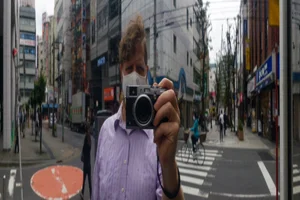
The Ghost in the Glass: A Ginza Sunday at 1/15th of a Second
"There's a ghost in the glass." Sharpen it against current culture —
Sunday is the day
Ginza is a special place to visit any time of year, any day of the week. If you could only visit one day, I would suggest a Sunday. Many of the main streets are closed to traffic, which creates a perfect atmosphere. Tables, chairs, and umbrellas lined up right down Chuo-dori for several blocks. Locals, tourists, shoppers, and people just out for a walk all intermingle on a Sunday afternoon in Ginza.
This is a time and place I look forward to visiting. I have been fortunate to visit many times. Today, though, I'm still in the testing phase of a new lens — which makes me equal parts nervous and excited. The plan was to shoot the day at ƒ8 on zone focus and follow my nose from picture to picture. Looking back at the files, I spent almost the whole afternoon at ƒ2.8 instead. That's testing for you: you set out to be disciplined, and the light has other ideas.
That worked perfectly, because I was also spending the afternoon with my youngest son, Hugo, who has begun to take an interest in photography. He shoots a Fuji X100. It's early days for him, so his image choices feel quite random, but it's so much fun to watch creativity expressed right in front of you. He's grown up on the Tokyo streets and is a perfect companion for an afternoon of street photography. As long as there are some cookies involved, he'll be pretty happy all day.
The opposite lens
Although I planned to spend 95% of the day with the 35mm Nikkor, I brought along an opposing focal length, just in case. On most days I bring the polar opposite of whatever I've chosen to shoot with. If I'm having a long day or a tough day, it completely changes your perspective — it can jump-start an afternoon when you need it.
On this day I carried the Nikkor 200mm ƒ4. Not typically a street photography focal length; it can be a little creepy to shoot with, and 200s are often long and heavy. In this case the ƒ4 keeps the size down to something that fits in the palm of my hand.
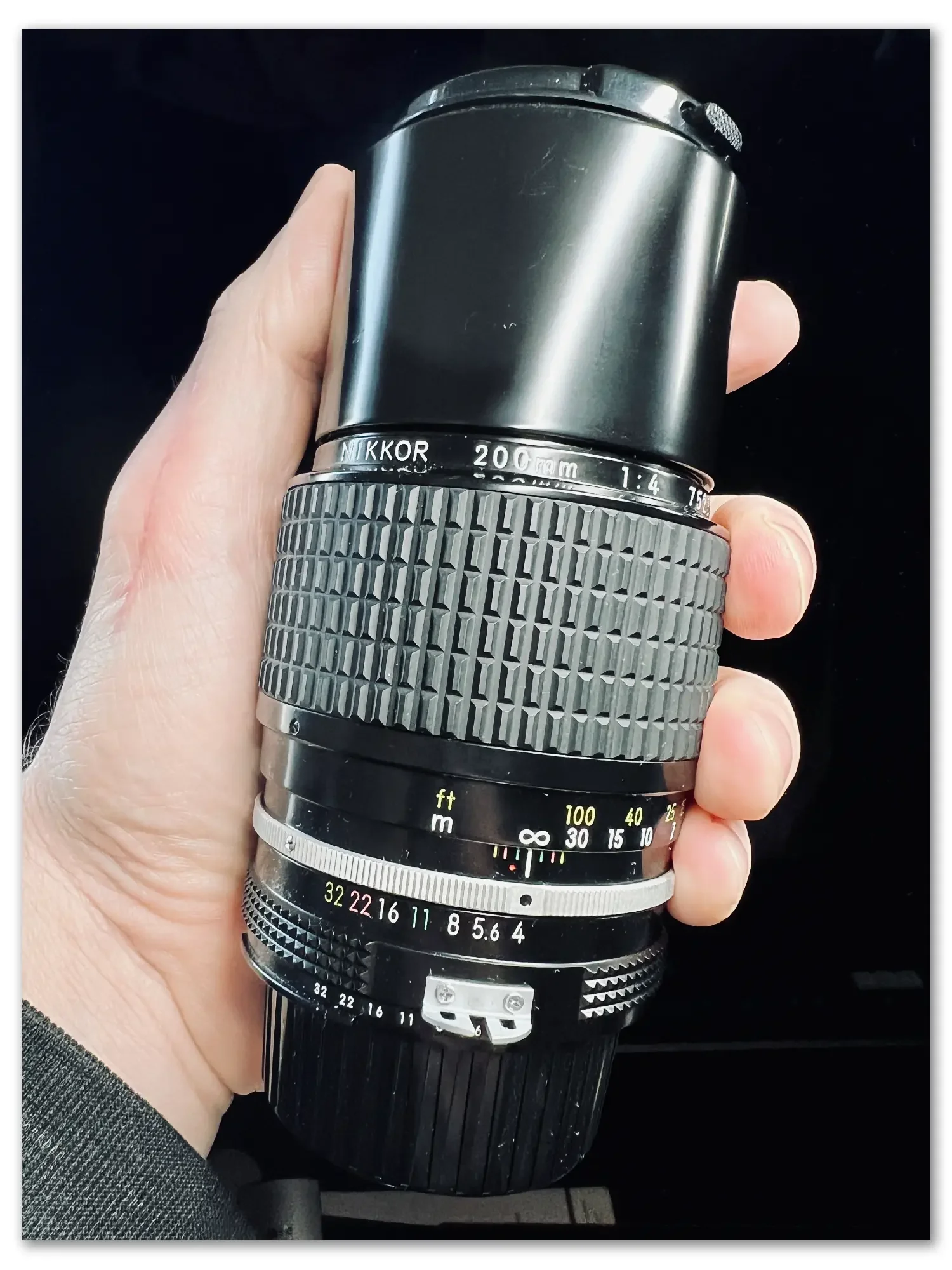
The smallest 200mm lens
I tend to use it for things that are simply impossible to reach — a person smoking a cigarette on a staircase a block over. I use it to cross a very busy street when I can't stand in the middle of it. I shoot a lot of abstract things with it, a lot of through-the-window reflection work. Today, though, I didn't take it out until the trip home.
The double self
We walked up and down just about every street in Ginza proper. Some areas were quite busy, others oddly dead. Tokyo summer can be brutally hot and humid, but this day was overcast and really not bad at all. Neither my son nor I took many pictures until we met the main avenue. That's where Ginza comes alive — the department stores, the flagship brands, all of it running along one route.
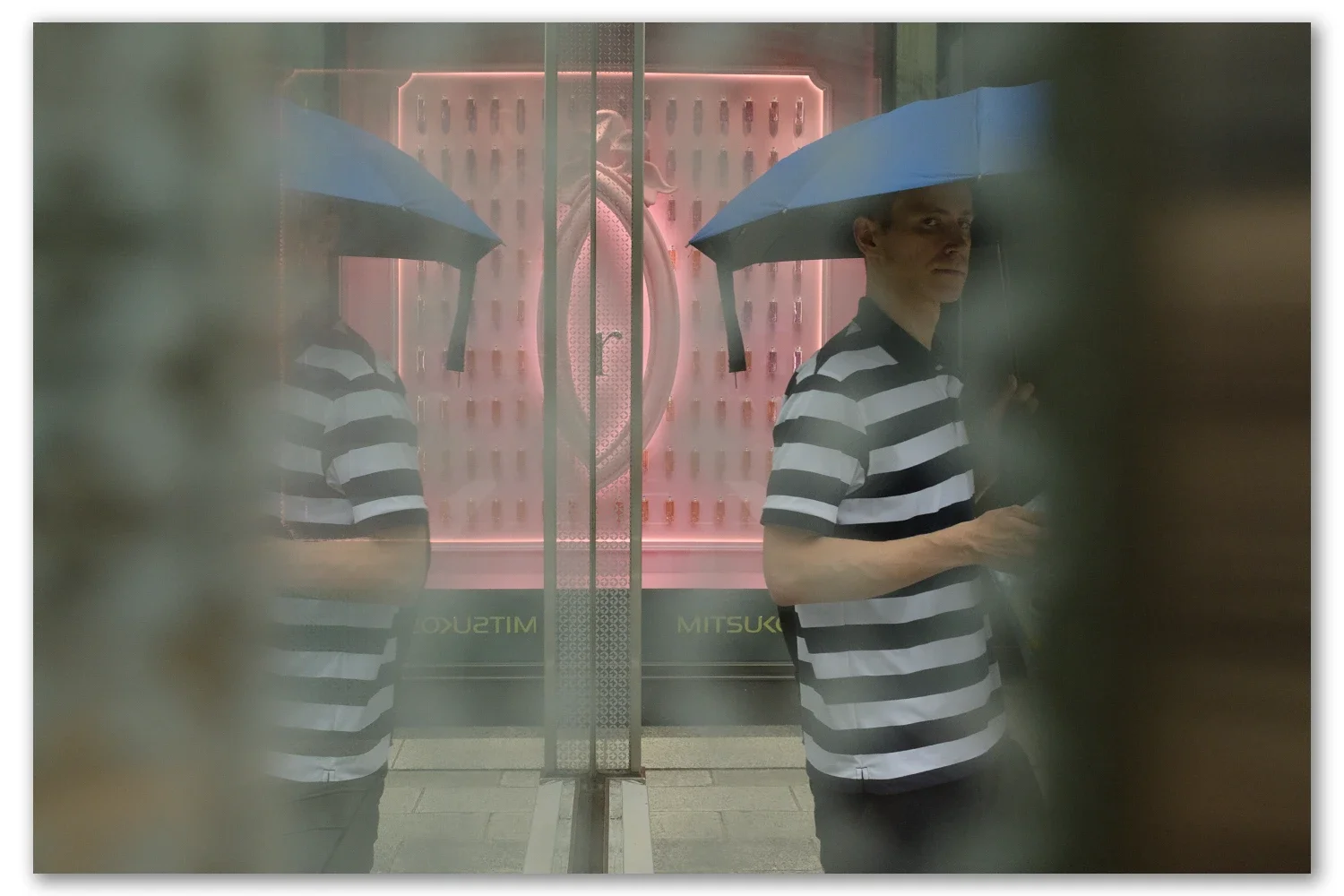
While Hugo shot a little of everything, I found myself drawn to the reflections. I very much identify with seeing the double self in a picture. So often we consider ourselves a single entity, but the truth is our souls can become quite fragmented by the time we reach middle age.
The 35mm focal length has some similarities in this respect. It sees just beyond our natural perspective — and yet, as a lens, it's overwhelmingly regarded as standard. A workhorse.
What I'm coming to understand about my own copy of the Nikkor Auto 35mm ƒ2.8 is what I've found in a lot of vintage glass: there's a ghost in the glass. It's had its own life, its own experiences, and a little of that comes through in the images I make with it. Not unlike driving an older car. It has quirks, but it's built in a way we no longer manufacture things. It's a pleasure to use — a pleasure I think many of us have forgotten about.
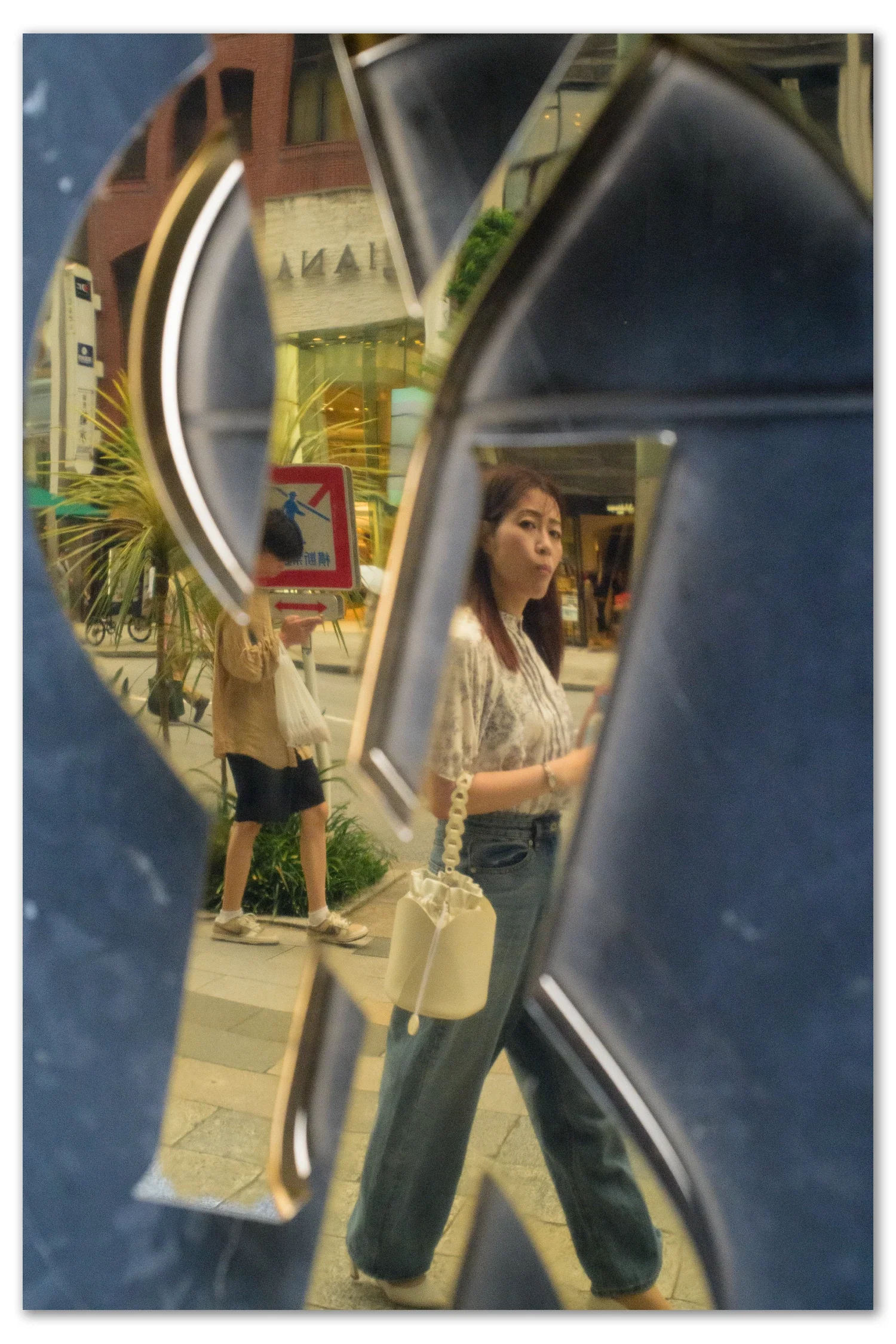
Nikkor Auto 35mm f2.8 lens in action, Ginza.
Lesson one: just shoot
I decided it was time to give Hugo a very slight lesson in street photography. We've been out about half a dozen times now, all over Tokyo. He's even had the luxury of meeting some very famous street photographers — of course he had no idea, but they get a kick out of him walking around pointing his Fuji at just about anything and everything he sees.
That was lesson number one: just shoot.
Lesson two: the hummingbird
Lesson two was about motion. I explained how shutter speed works as simply as I could. You can see the wings of a butterfly flutter. But a hummingbird, only slightly larger, moves so fast you can't see its wings at all. That's how I broke up fractions of a second — and honestly, that's about how simple my own brain works when it comes to math.
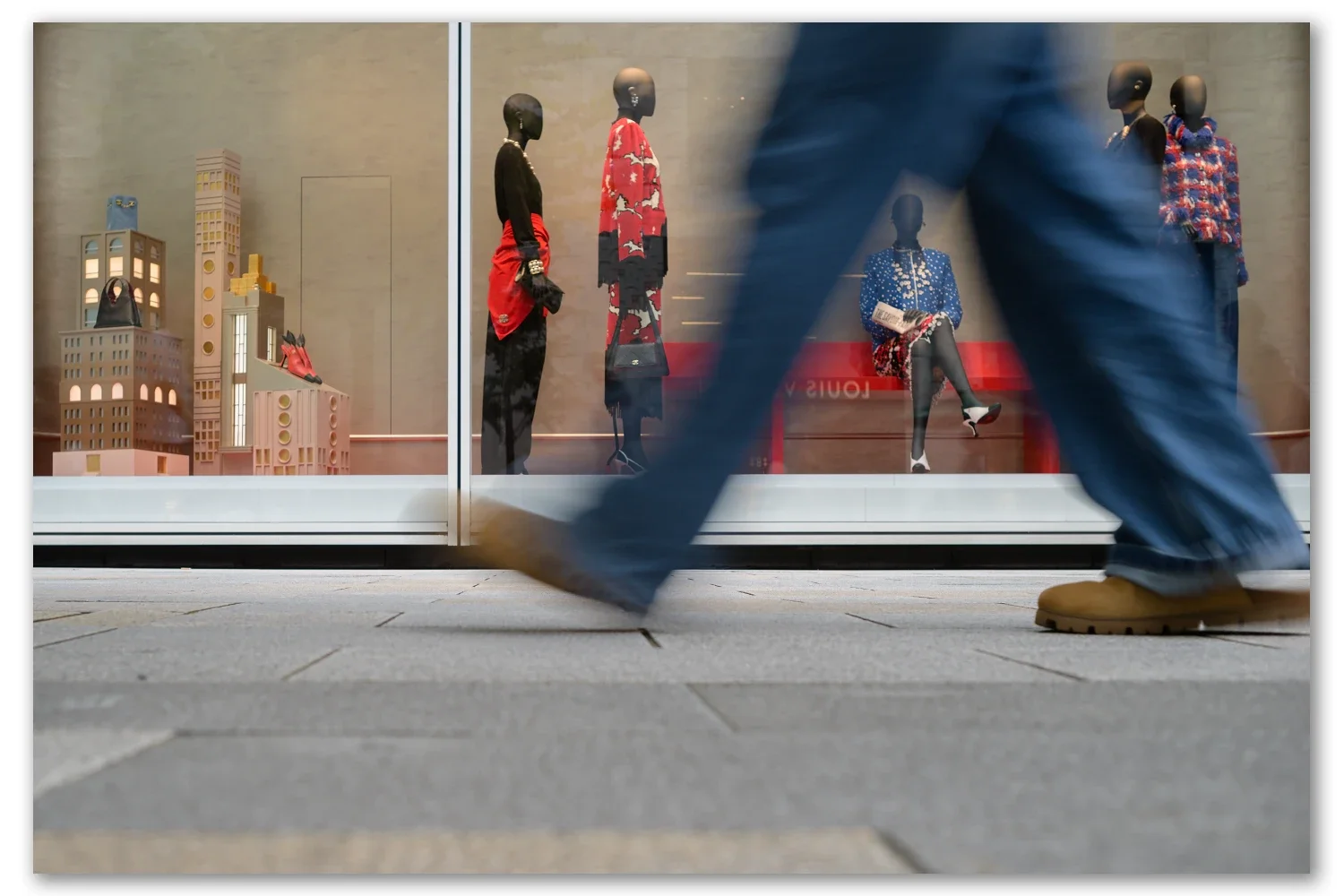
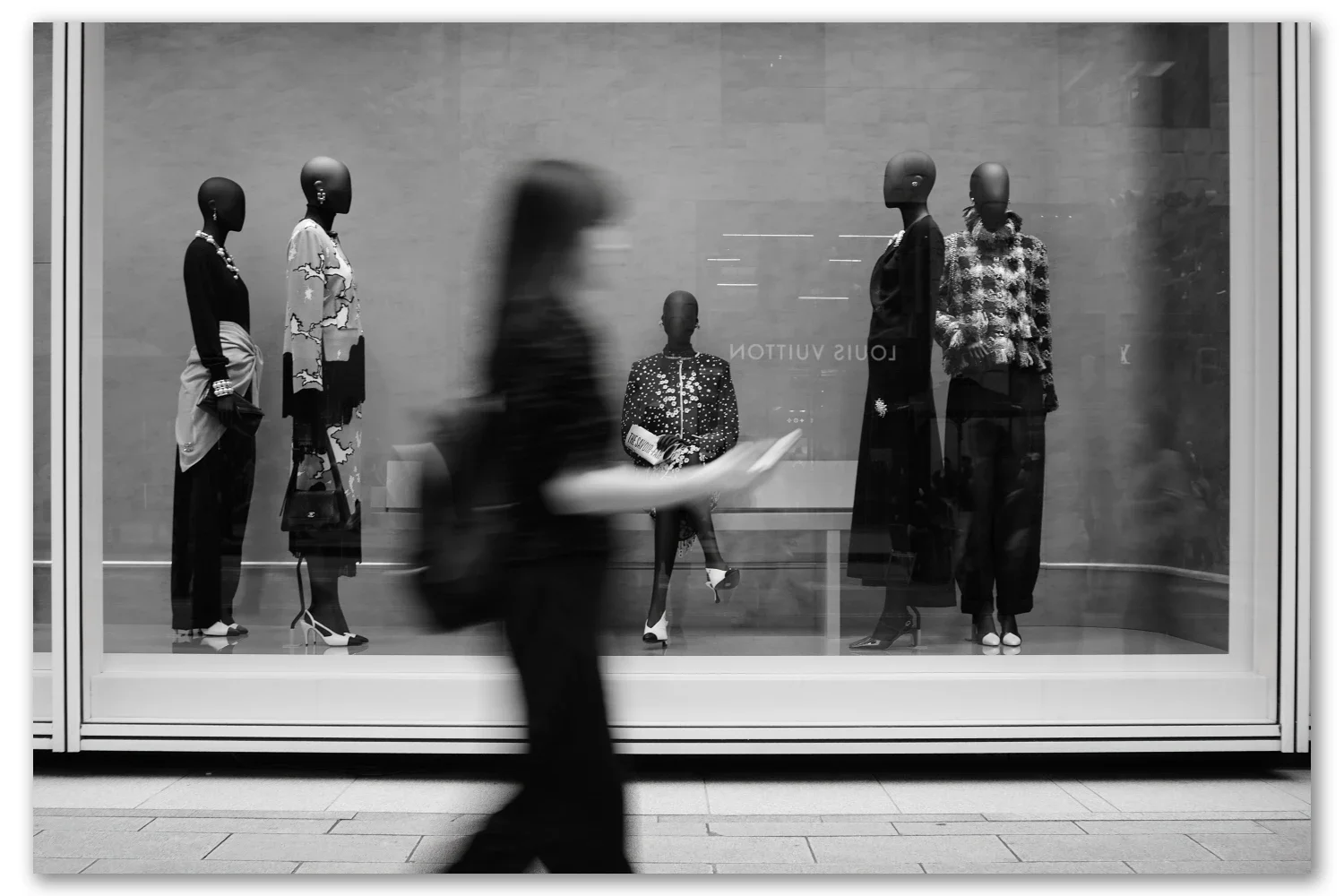
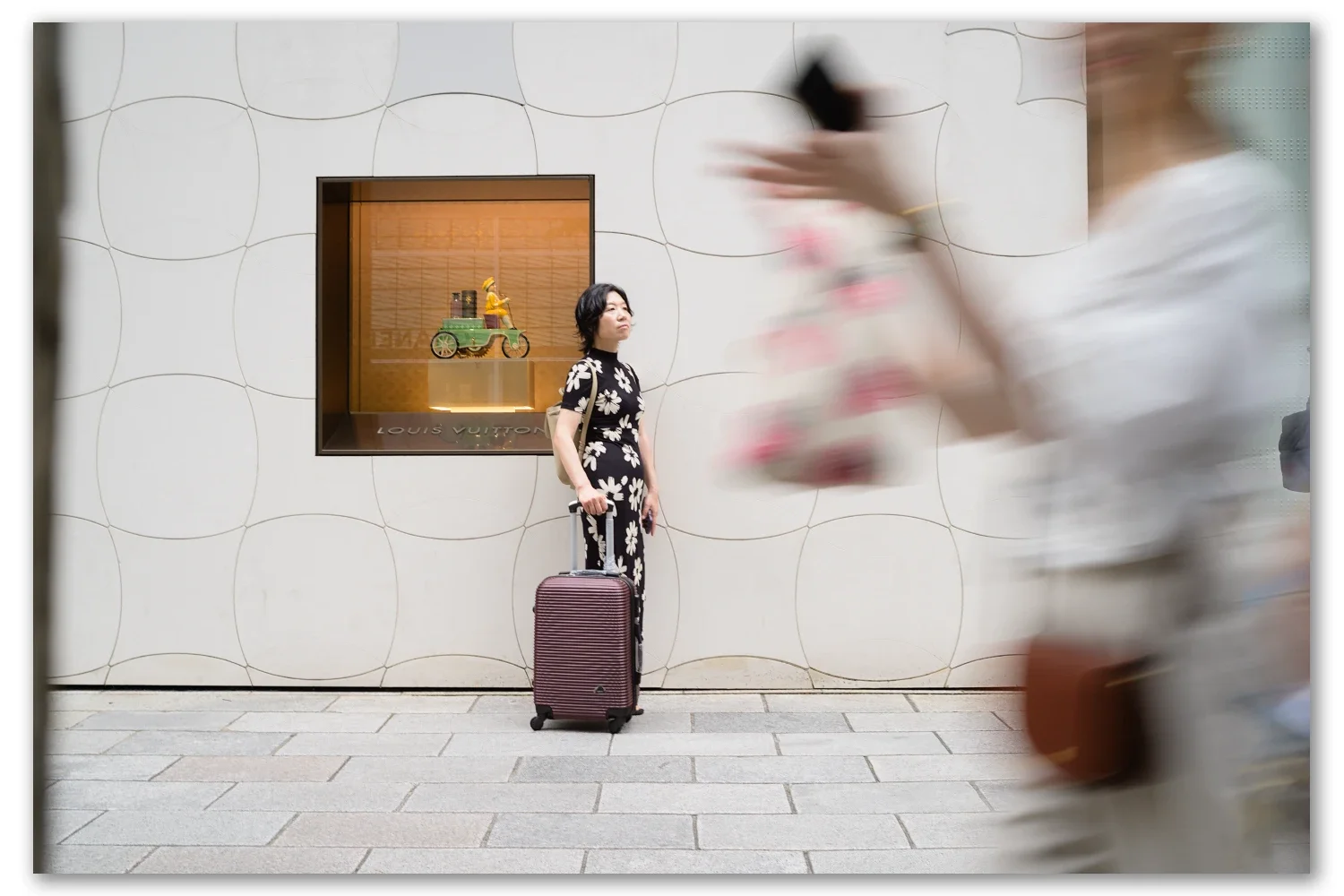
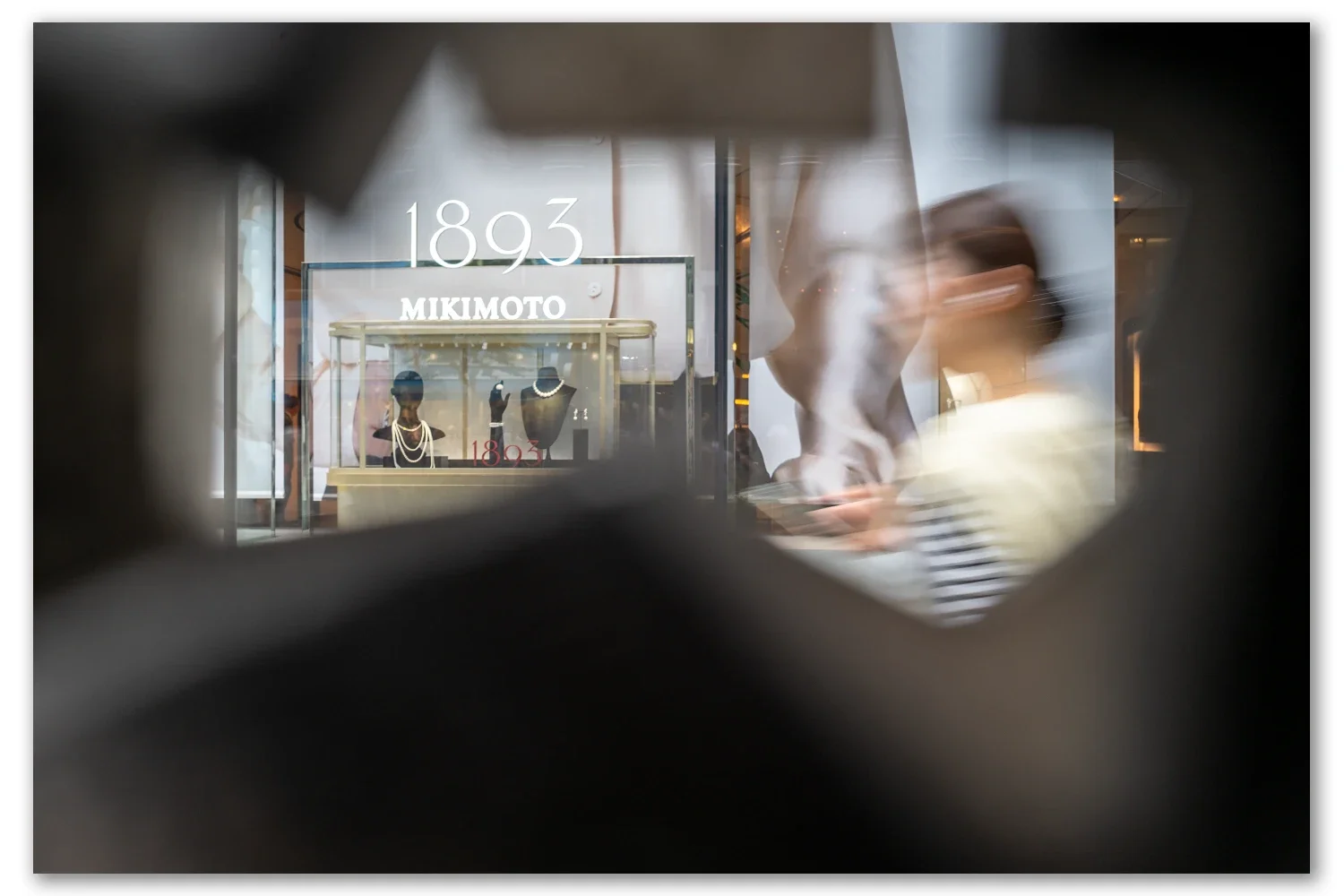
So we slowed the shutter right down — 1/15th, mostly — found something stationary, and took lots and lots and lots of pictures.
That led to discussions about timing, about framing, and about why you might photograph one person walking past you rather than another. As a father, it was a satisfying afternoon. As a street photographer, much the same.
We decided cookies were in order. After a quick search, we found a gourmet cookie shop, ordered a box, sat outside and ate them — reviewing each bite like a YouTube food channel, with an audience of one.
Perfect.
The best of a Sunday in Ginza
I have three images I just love from the day. They made it through my brutal selection process without a scratch. This rarely happens, maybe one a week, never three in a single day. The first is a reflection of a curious shopper in the YSL logo (Saint Laurent). Two main reasons I love to shoot off the YSL logo anywhere in Tokyo. Secondly, I could see this image happen long before it did. There is nothing better than capturing a previsualized street photo.
The second and third images are slow shutter speed keepers. They also fall into the category of previsualized capture. Though the shutter drag does leave some variables out of my control, the frames are as I saw them in my head.
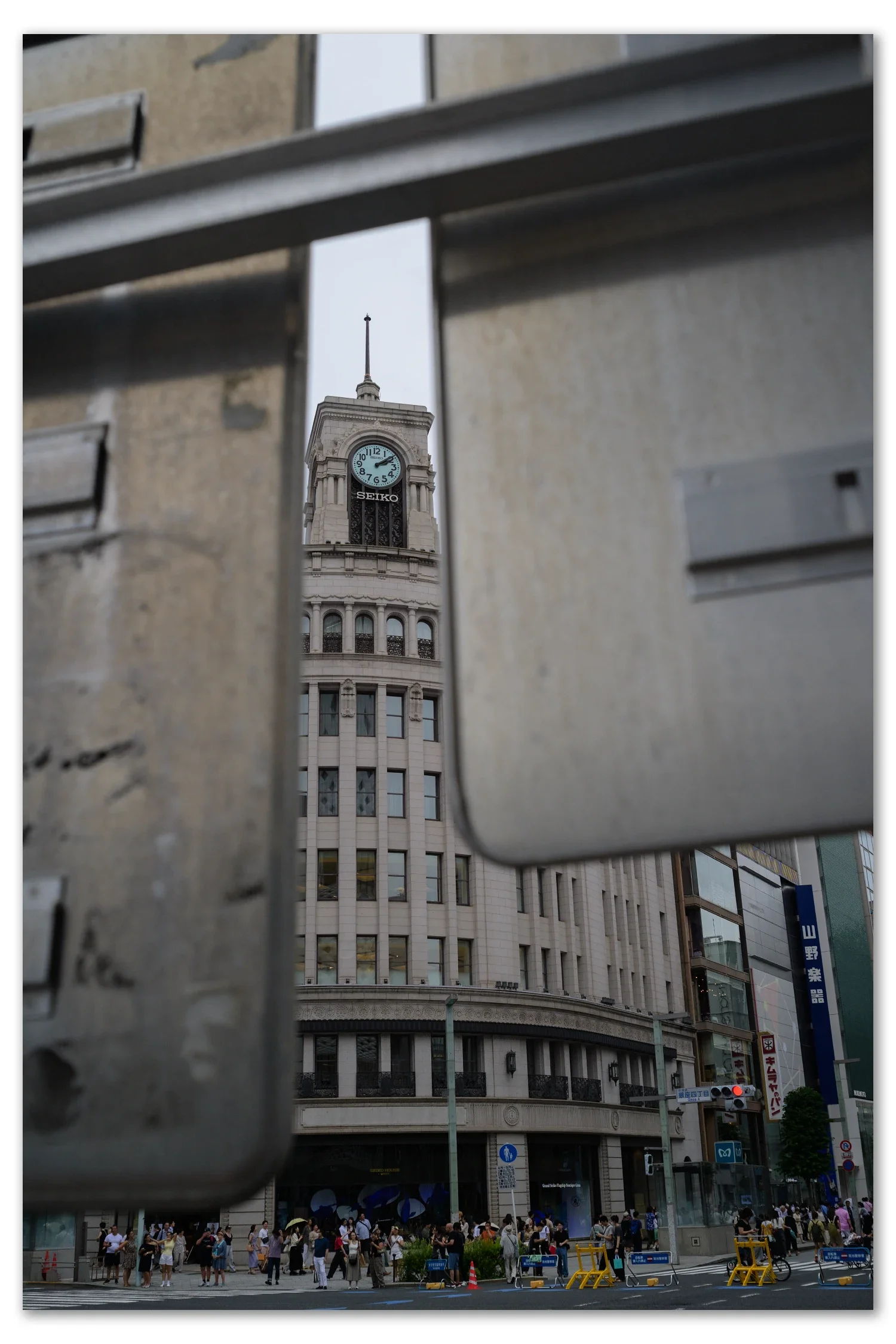
The way of working behind days like this — the zone focus, the light, the patience — is what the masterclass teaches one-on-one. → tokyoforgeries.com/masterclass
The streets never look the same way twice. I’m curious—how does this side of Tokyo hit you? Drop a comment below.
I live on flat whites and shutter clicks. If you’ve found value in these shots, toss a coffee my way to keep the sensor humming.
For those who want to skip the tourist traps and shoot the real Tokyo, my calendar is open for workshops. Explore the Masterclass here or email me at jeff@tokyoforgeries.com.
See you in the shadows.
Tokyo Forgeries is an evolving archive of Tokyo street photography and vintage-lens deep dives. We spend 30 days in every ward, using mid-century brass and glass to capture the city’s soul. This is a roadmap for the active pursuit of craft—documented through the geography of Tokyo and the character of its light.