Using Vintage 200mm Glass for Compression in Tokyo
200mm Vintage Glass Street Photography
I own a couple of 200mm lenses, each with its unique purpose. The VR F/2.8 version is for commercial work; despite being an absolute tank, this lens performs as advertised. The other 200mm lens fits in the palm of my hand. It is from the near-vintage era of the 1980s and has a rather slow f/4 aperture. I use it almost exclusively for street photography.
How can I justify shooting with a 200mm f/4 lens on the streets of Tokyo? Great question. The answer is quite simple. Each lens I carry with me has a purpose that day. There is a specific shot I see and want to get, but didn’t have the correct focal length at that time. Or, in the case of the vintage 200mm lens, there is a sense I feel, or a phenomenon I see, that I want to capture the essence of.
Tokyo has an overwhelming intensity, yet the chaos within is orderly and well-maintained. One such example is the crowds at Senso-Ji Temple in Asakusa. Tens of thousands of people file through the massive Kaminarimon Gate, walk along the Nakamise Shopping Street, before passing a second massive gate, Hozo-mon (Nio-mon). It is, of course, a well-known area for street photography of a more traditional style. I do that too. I also see this surging crowd and want to capture it. The 200mm f/4 is small, light, and perfect for compressing the massive gates in the background while keeping all those people in the foreground.
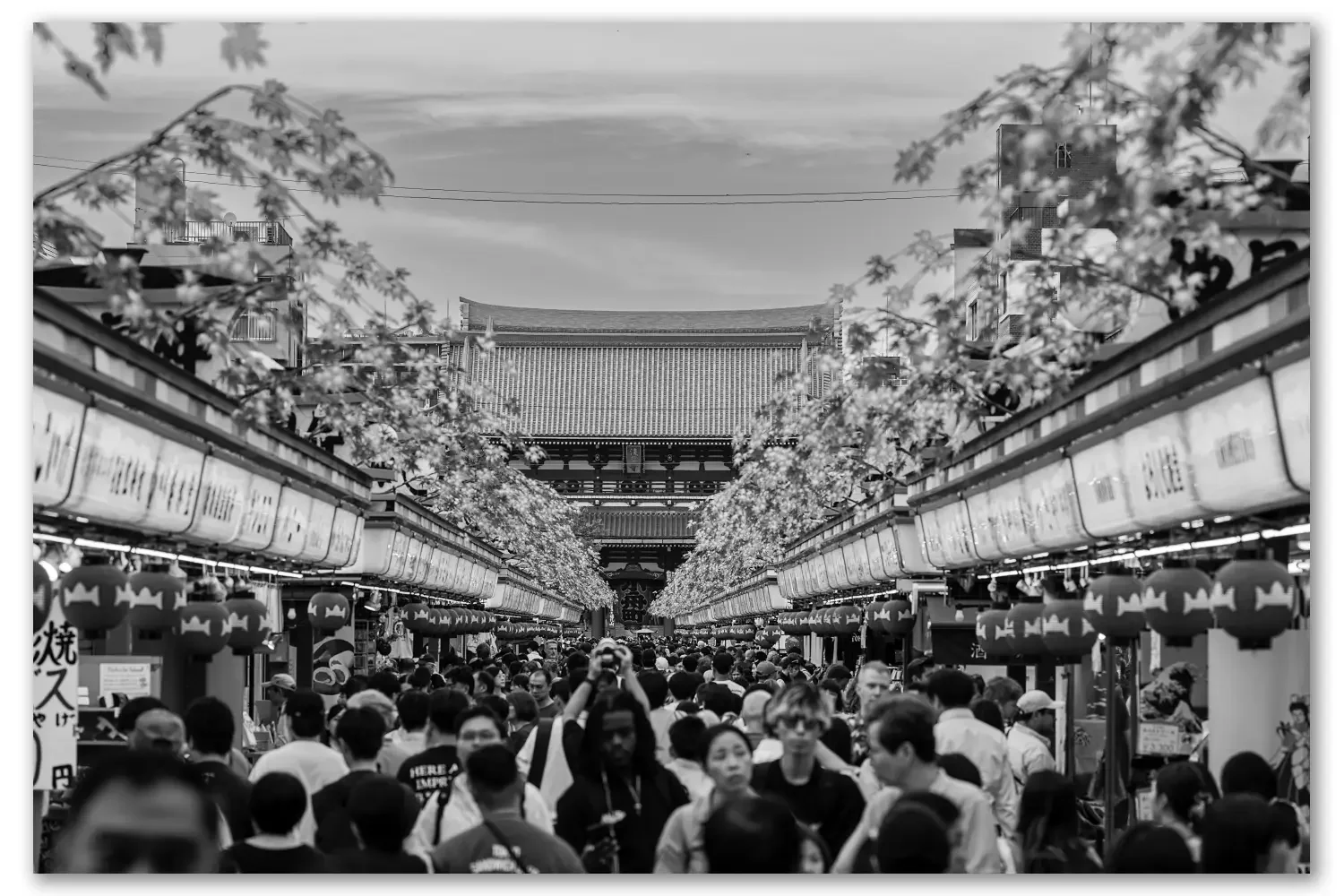
Crowds at Nakamise shopping street in Senso-Ji Temple with the vintage Nikkor 200mm f/4 lens
200mm Vintage Lens Street Photography in Shinagawa Station
A second example for the use of a 200 mm lens in Tokyo are the large and extremely busy train stations. The rush hour is like no other I have ever experienced. A sea of people is forced into the tributaries that are Tokyo’s main train stations. Shinagawa Station serves 1 million-plus commuters each and every day. The orderly chaos mentioned above is ever-present here. The bulk of the people travel to Konan Exit (East Exit), home of Sony and Mitsubishi.
I have used a variety of focal lengths here; during rush hour, nothing translates the feeling of being there more than 200mm. The compression of the main hall concourse, the surge of ten thousand commuters, with all but a single line of people sharply focused, the rest caught in the creamy roll-off of the vintage glass. The anonymity, the loneliness, the humble cosmic insignificance of the Tokyo commute in a single frame of sad truth.
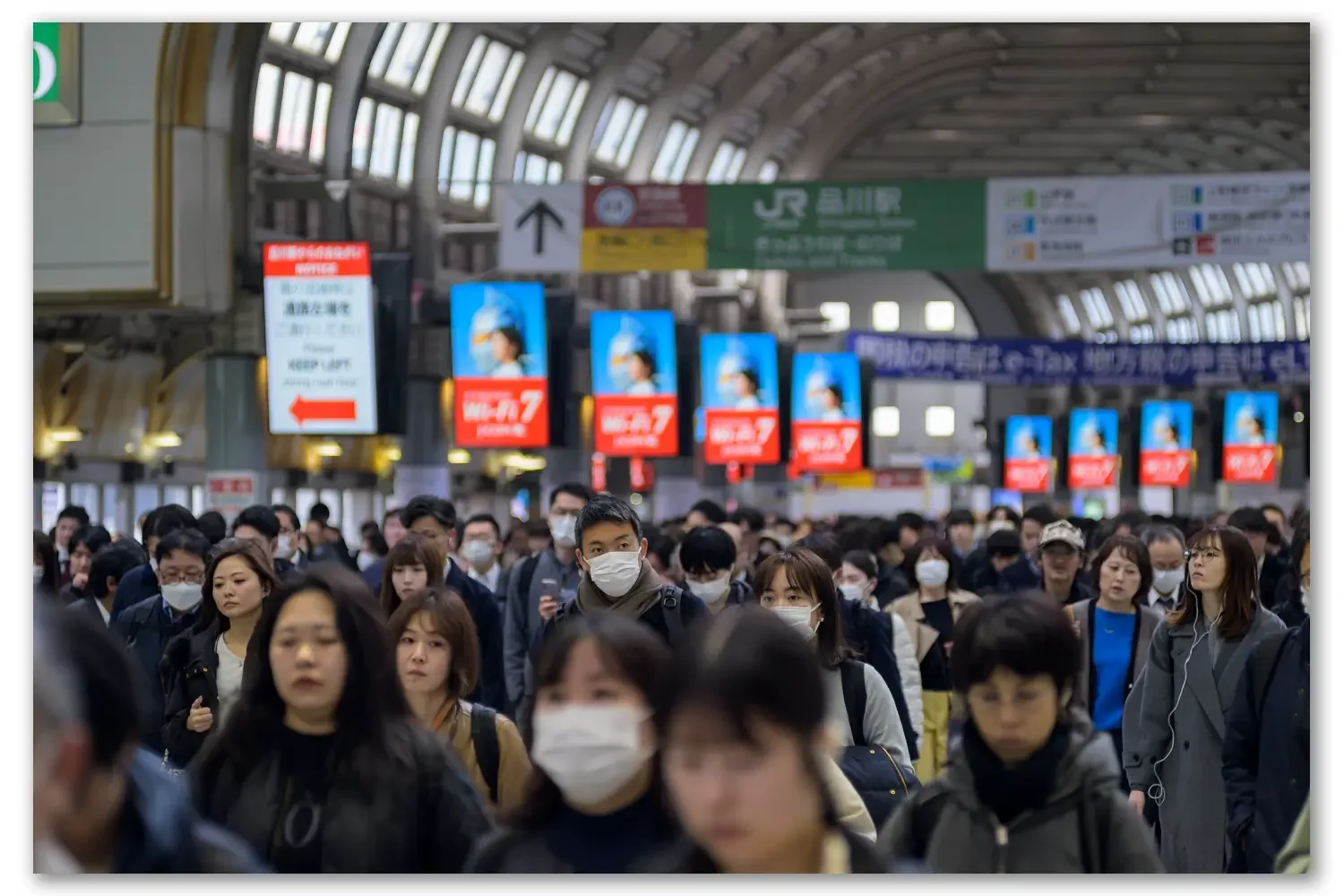
Shinagawa rush hour with a 200mm f/4 vintage lens
Nikkor 200mm F4 Vintage Lens History
The Nikkor 200mm f/4 AI-S is more than just a piece of vintage glass; it is a masterclass in Nikon’s "golden era" of optical engineering. For street photographers in Tokyo, where the urban sprawl feels like a living, breathing labyrinth, this lens offers the perfect tool to harness street photography compression in Tokyo, pulling the neon signs of Shinjuku and the skyscrapers of Marunouchi into a single, overwhelming frame.
The Genesis: The Nikkor-Q Era (1961)
The history of the Nikon 200mm f/4 begins in 1961 with the release of the Nikkor-Q Auto 200mm f/4. At the time, it was a revolution for the Nikon F system. As one of the first true telephoto lenses for SLRs, it allowed photographers to step beyond the 135mm limit of rangefinders. This original version featured a 4-element, 4-group design. While sharp for its day, it was a heavy, "long-snouted" beast that required a minimum focusing distance of 3 meters—hardly ideal for the fast-paced nature of modern urban exploration.
The Great Redesign (1975–1977)
In the mid-70s, Nikon designer Teruyoshi Tsunashima set out to create one of the most compact telephoto lenses for street photography ever conceived. The result was the 1975 "K-type" New Nikkor 200mm f/4. Tsunashima moved to a 5-element, 5-group optical formula, successfully shrinking the lens barrel while simultaneously improving contrast and reducing flare. This version also saw the minimum focus distance drop to 2 meters, making it far more versatile for capturing tight details in the crowded alleys of Golden Gai.
The Evolution to AI and AI-S (1977–1996)
In 1977, Nikon introduced the AI (Aperture Indexing) version, which kept the stellar 5/5 optics but updated the mechanical coupling for newer camera bodies. However, the definitive version for the Tokyo Forgeries aesthetic is the vintage Nikkor 200mm f/4 AI-S lens, released in December 1981.
The AI-S version is prized for its mechanical refinement. It features a shorter focus throw than its predecessors, allowing for faster manual tracking of moving subjects. Mechanically, the AI-S also improved the aperture blade design. While the AI version occasionally suffered from "saw-tooth" bokeh at certain apertures, the 9-blade diaphragm of the AI-S ensures the bokeh of vintage Nikkor lenses remains smooth and circular, even when stopped down to f/5.6 or f/8.
Why It Thrives Today
When using vintage lenses on digital cameras for street photography, the 200mm f/4 AI-S stands out because of its incredible portability. It is barely larger than a standard 135mm lens, yet it provides that signature telephoto "flatness" that makes a distant train in Shibuya look as though it’s brushing against the shoulder of a nearby salaryman.
With its built-in telescoping lens hood and rock-solid metal construction, this lens was built to outlast its owners. For the modern photographer, it remains the ultimate budget-friendly gateway to high-compression street work, offering a distinctive, organic look that modern, clinically sharp autofocus lenses often struggle to replicate.
Would you shoot Tokyo, or any other city, with a 200mm F4 lens? Let me know in the comments section below.
The streets never look the same way twice. I’m curious—how does this side of Tokyo hit you? Drop a comment below.
I live on flat whites and shutter clicks. If you’ve found value in these shots, toss a coffee my way to keep the sensor humming.
For those who want to skip the tourist traps and shoot the real Tokyo, my calendar is open for workshops. Explore the Masterclass here or email me at jeff@tokyoforgeries.com.
See you in the shadows."
Tokyo Forgeries is an evolving archive of Tokyo street photography and vintage-lens deep dives. We spend 30 days in every ward, using mid-century brass and glass to capture the city’s soul. This is a roadmap for the active pursuit of craft—documented through the geography of Tokyo and the character of its light.