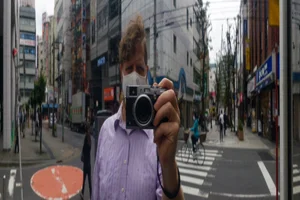
Akabane Street Photography — The Corner Not for Instagram
GROUND REVIEW
Akabane, Kita-ku · JR Keihin-Tōhoku, Saikyō, Shōnan-Shinjuku, Utsunomiya/Takasaki · Akabane Station
Shot here since: 1999 · Visits: Hundreds+ · Last walked: July 2026
In street photography, a famous corner hands you a famous photograph — which is to say, an image somebody else has already taken. Akabane hands you nothing. The last real neighbourhood in Tokyo's Kita-ku before the city becomes Saitama makes you work for every image, and that is what makes every image worth making.
Akabane is a place that time forgot, remembered briefly, and then forgot again. That mismatch of nostalgia is what makes it ideal for street photography. Its old buildings and untravelled alleyways are a testament to its age — layers of rust that have begun to rust again.
An almost entirely local population makes this hard ground for a beginner. This is not a neighbourhood for shooting from the hip or stealing an image. Confidence and courage are the order of the day.
Akabane at a glance
Light: Low northern sun rakes the side streets, morning and late.
Rhythm: People stay. Daylight drinking, nobody on a clock.
Invisibility : Total among commuters. Near zero among locals, who clock you fast
Working Distance: Close alleys and open ground both. Carry two focal lengths.
Layers: Signage, reflections, windows, framing. Plenty to build with.
Friction: Low, on blue-collar manners. Smile, nod, bow.
Reliability: Works at noon, in rain, in every season but high summer.
Return: Two hundred visits in, the person at the oden counter nods when I pass.
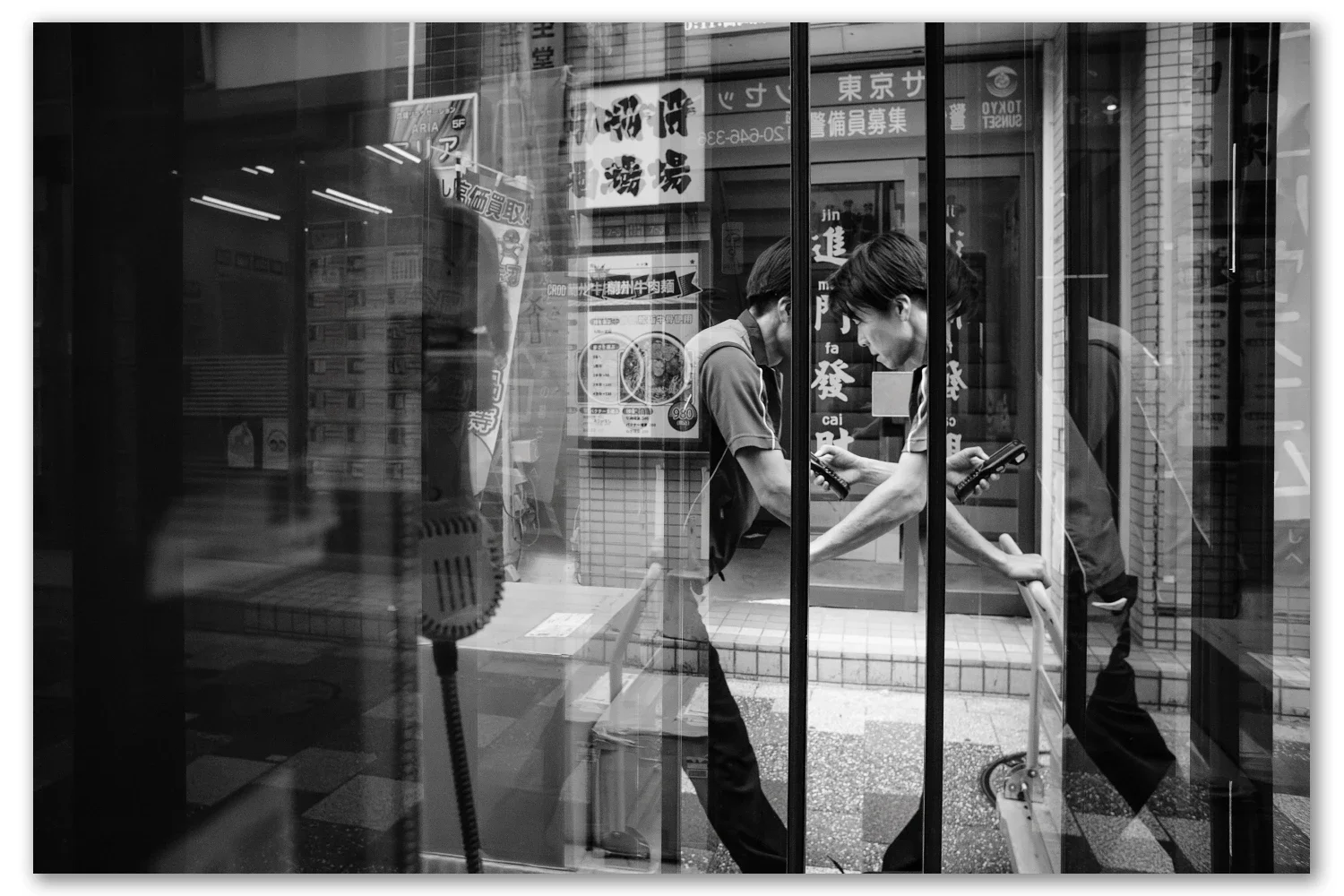
Double reflection in Akabane. Street photography.
What Akabane actually is
Akabane is split down the middle, literally and figuratively, by the train lines that run through it. Akabane Station is the last major hub before Tokyo becomes Saitama, and like every hub it carries about a one-block radius of valuable commercial property serving the morning and evening commute. After that, the real Akabane begins — a mix of commercial and residential, neither of it built to be looked at.
Street photography around the station is street photography around any Tokyo station. It has its moments. It is not why you come here. You come for the old neighbourhoods, the rundown commercial blocks, and the local-only drinking alleys on the far side. These are what I think of when I think about what real Tokyo is.
Regular streets, average people, small businesses, decent homes. And underneath it a history that isn't always visible but is always there to be felt — in certain places almost palpable. As a foreigner from a young country, I have nothing to compare it to. A small temple with eight hundred years behind it is unimaginable to me.
The ward also keeps an odd balance. Everyday locals going about their lives, and a quieter element that has been here just as long, sharing the same few streets without ever sharing a block. An elementary school, a tea shop with an old woman behind the counter, and a red-light corner all exist within a few minutes' walk of each other — and each one knows exactly where the others end. Nothing about that is hidden. It is simply understood, and it has been for eighty years.
The history of the Akabane streets
Akabane was a 軍都 — a military city. The Imperial Japanese Army's 陸軍被服本廠, the Army Clothing Depot, occupied the high ground west of the station, and military supply factories were scattered across the low ground to the east with dedicated rail lines serving them.
Then the war ended, and a district built entirely around army supply lost its purpose overnight. The goods were still there. So were the workers, and so were the rail connections. That is precisely the raw material of a black market, fifteen minutes up the line from a starving city, and one formed outside the east exit almost immediately.
It organised rather than dispersed. In January 1946, eighteen people formed a cooperative to rebuild the ground in front of the east exit out of the burnt ruins. The city redrew the plots in 1952 under a formal land readjustment, consolidating the roads into the layout that stands today — and the trade survived the redrawing. What was set in the ashes was not erased by the planners; it was absorbed into their plan and kept its character anyway.
The west side went the opposite way. American forces took the military land and held it until the end of the fifties, and when it came back the high ground was rebuilt as the Akabane-dai danchi — the largest public housing estate in the twenty-three wards at the time, and now redeveloped again as Nouvelle Akabane-dai.
So the split you photograph the moment you leave the station is one military estate disposed of two different ways. West: the army's high ground, cleared and rebuilt as housing, reached by stairs cut into the plateau. East: the supply flats, which became the market, which became the alleys.
Worth keeping in proportion. Something built in the 1950s is new here. There are earthquake-proof shrines in this country a thousand years older than anything in this story. This is not Kyoto — not its younger brother, not even its nephew. Think of Akabane as a great-great-grandchild. A place with a history entirely its own, and one worth the walking.

The out-of-doors office, Akabane Street Photography
My history with Akabane
Before the subway reached the suburb I call home, I took the bus to Akabane because it was the closest train station. For a short while it seemed like the biggest place on earth. That title went to Ikebukuro soon enough, where I also spent a great deal of time.
I used Akabane the way everyone does at first — as a hub. Suburban salarymen connect here because it opens onto both the east and the west of the city. Very quickly I found myself arriving early before the commute and staying late on the way home, just to walk the streets. There was something here. Still uninitiated in street photography, I couldn't have told you what it was, but I could feel it.
Akabane is where I cut my teeth on real street photography. It is the place where I stopped taking pictures of things and started forging moments with people in them. Ikebukuro deserves some of the credit — the two ran alongside each other for years. Akabane on weekdays, Ikebukuro on weekends.
With everything Tokyo offers, it would have been easy to leave Akabane behind. I never did. The place doesn't change much, and yet there is always something new to photograph. Locals lost in time, commuters racing against it, and always a frame somewhere between the two.
What it's like to shoot in Akabane
Some Tokyo districts are known for their nightlife, their shopping, their markets. Akabane is different in that it never fully switches off.
There is an oden shop in Ichiban-gai that opens early in the morning. It is known for takeaway, but it functions as a de facto third party for anyone still drinking their way into the daylight hours. It isn't unusual for my first frames of the day to come from old men sitting beside partygoers over a one-cup of sake. I pass often enough now that I occasionally get a nod of approval — a badge of honour I am proud to wear.
The alleyways at that hour hold a mixture of those still living last night and the rest of us getting on with today. Shopkeepers ready their stalls, commuters push toward the station, and there is always a handful of people loitering in between times, watching it go past.
Closer to the station it stays busy all day — not the hectic of Ikebukuro or Shinjuku or Shibuya, but a steady hum, like the factories of old churning out people instead of Imperial Army uniforms. Inside the station gentrification is nearly complete, right down to an American burger chain and a Starbucks.
You don't have to walk far to get back into it. Cross the street on the east side and you're in a red-light district only a few blocks square. Go a little further east and you're into the old neighbourhoods west of the river — shops, homes, schools, locals.
There is a park out there straight out of the 1970s, with play equipment that looks purpose-built for broken bones and concussions. It is still full of screaming and laughter. Like the rest of Akabane, it holds two realities at once.
There is enough open ground that you can shoot at whatever focal length you favour, though it pays to keep something wider in the bag for the claustrophobic alleys. I have never feared for my safety here. I do stay aware, because this is a local place and I am not local. A smile reads in any language.

Powdering his nose on the Saikyo Line train platform at Akabane Station
Where to shoot — Akabane's findable corners
Search Akabane and you'll turn up Ichiban-gai and OK Yokochō. They are good starts, and I find both of them worth the walk morning, noon and night — different people, different light, different pictures.
Ichiban-gai will give you the most opportunity of anywhere in the ward. It's directly across the street from the east exit and runs several blocks, including a covered market. Early in the morning, midway along, there's an eel restaurant where the chef butchers the fish out on the street. Worth stopping for, and worth the conversation.
OK Yokochō sits in the same area but is entirely its own thing — smaller, narrower, darker, a little rougher, and somehow still like home. Restaurants and izakaya of every size. Keep your wits about you and respect people's privacy. It is also the best place in the ward for texture.
Maruken Suisan is the oden shop mentioned above. A good place to stop for lunch and a better place to find the real characters of Akabane. It sits inside the covered market, so the light barely changes all day: dark, grimy, slightly diffused. Perfect.
The puddle — if you're lucky enough to arrive after rain, a large one forms on the pedestrian walkway just outside the main smoking area on the east side of the station. Ideal for reflections. You will have to get down on the ground for it.
Akabane Suzuran Street Is a long covered shopping street closed to traffic. There are several avenues of the mani street worth exploring. This shopping arcade is twice in length and size as Ichiban-gai.
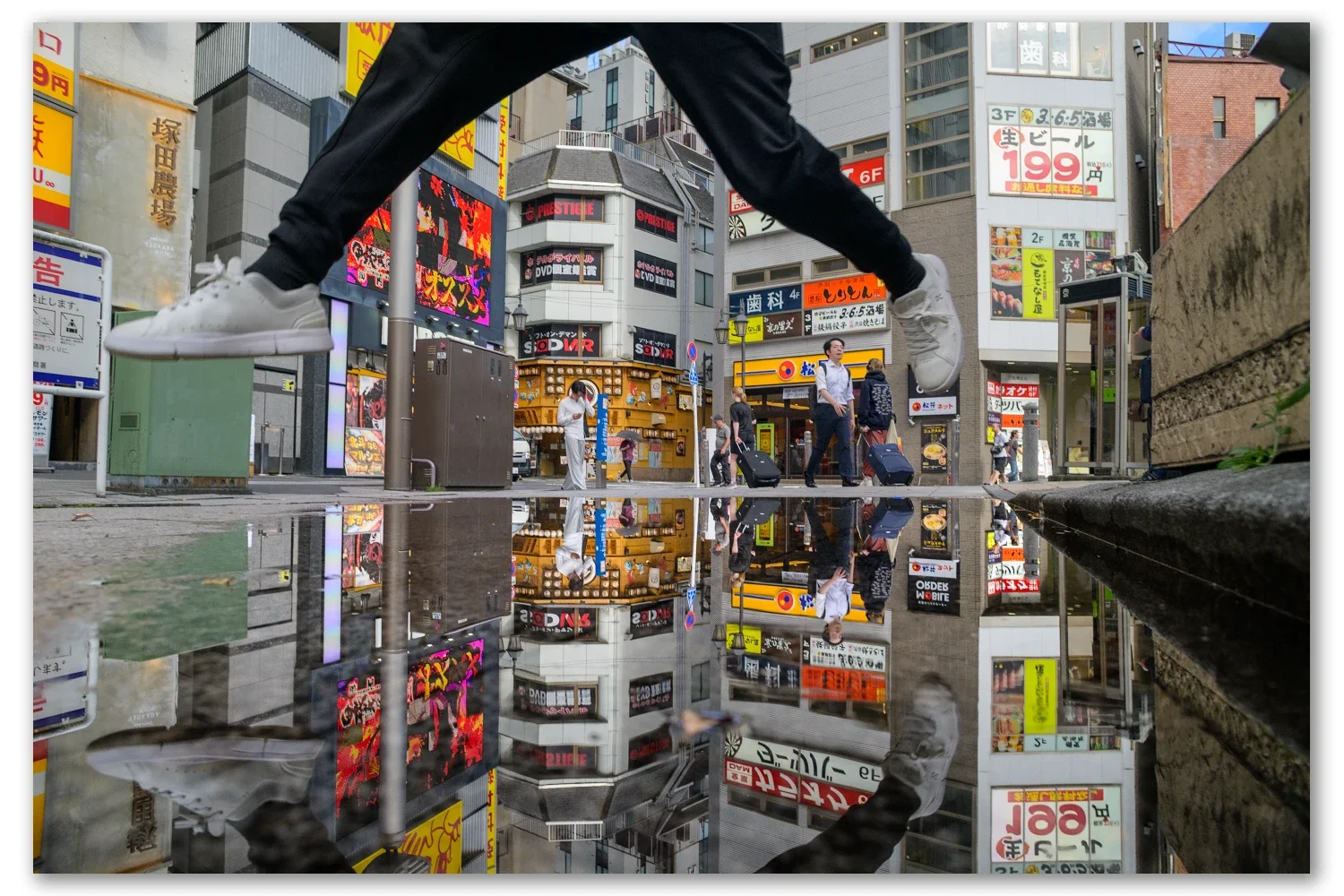
Akabane street photography, jumping the puddle.
The Akabane corners I keep
The moment you map it, it stops being yours and becomes a checklist — which is exactly what I left the famous wards to get away from. So I'll tell you it's here. I won't tell you where. These aren't districts like the ones above. They are smaller than that: a particular spot, a particular set-up, where I know there is always an image waiting if I'm willing to stand there long enough.
The cost to find one of these special spots is time. I keep three or four in my pocket to share with clients. They come with the kind of a guarantee that will provide those on the masterclass with a keeper image every time, and me wanting more each visit (knowing I will get it). The only thing that makes happier than making a great shot is helping someone else make that shot too.
Light, weather and season
Akabane is one of the few places that works almost any hour, in almost any season. The one stretch I'd avoid is July and August, when the heat and humidity make street photography anywhere in Tokyo difficult at best. If that's when you're travelling, shoot at night — it's cooler, the nightlife is worth it, and it's all within a few blocks of the station.
Otherwise it is at its best in the early morning and mid-to-late afternoon. Warm light, long shadows. Many of the buildings here are low enough to let that light spill down the length of the alleyways, which is where the reflections and the shadow play come from.
The best time of all is late afternoon into evening, just after rain. The puddles are up, the neon is on, and everyone is out for a good time and entirely unbothered by a camera.
Friction and manners in Akabane
Etiquette is everything in Japan. As a foreigner you get a slight reprieve, but you are still expected to behave. Akabane adds three variations worth knowing.
First, this is a blue-collar neighbourhood, and it asks for blue-collar manners. Show respect and you'll be given it back. Walk around firing a flash into people's faces and you won't. Be courteous, smile, nod, bow slightly. That goes a very long way toward letting everyone understand you mean no harm.
Second, Akabane is a transport hub and therefore an entertainment district, so on any given night there are people here from all over Tokyo, and they came to enjoy themselves. You may see the ordinarily reserved become loud and gregarious. That's fine — this is the place for it. Keep your own cool. Smile, nod, bow.
Third, and hardest: not everyone here wants to be photographed(criminal element), and the ones who most don't are not always the ones you can spot. Some will not care at all. Some will care a great deal. This is not the moment to stand your ground and quote your rights. Smile, apologise, bow, move on. Neither of you wants a scene, so it very rarely becomes one — but be aware that it can.
The rest of it is disposition. I try to stay confident, smile, enjoy myself, and take nothing too seriously. It tells everyone I mean no harm, and it keeps my ego out of the way of the work.

A Happy Accident creates layers of street photography at Akabane Station.
Gear and approach
Akabane asks for different things in different places, so it's worth splitting four ways.
By day, the ward is generous. Bright sun down the side streets and even light under the arcades means a modest zoom will carry you through almost anything. When clients come through here with one or two primes, I tell them to bring a slower zoom as well and stop worrying about it.
At night, it's well lit, but you'll want something fast — not exotic, just fast enough to stay honest at ISO you can live with. Evening is when both the portraits and the atmosphere are available, which is the one time I'd carry two lenses rather than one.
In the open ground around the station there's room to work at any focal length, and this is where a longer lens earns its place: distance, compression, and the chance to take a portrait out of a crowd without entering it.
In the alleys — the best shooting in the ward — a 35 is hard to beat. Go wider if you want the walls in the frame. But because the alleys are narrow and straight, a 50 or even an 85 will pull the whole length of one into a single image, which is a picture most people never think to make here.
The honest summary is that a 35 and a 50 will cover you nearly everywhere, and everything else is for the one or two frames a day that need it. None of it is the point. The ward doesn't reward the kit. It rewards standing still long enough, and behaving well while you do.
Getting there
Akabane is a hub, so it's easy. From the west of the city, the Saikyō Line. From the east, the Keihin-Tōhoku. Both run through everything.
Come out of the east exit at the north gate. There's a wide open square and a small bus terminal — a good place to get your eye in before you go anywhere. Commuters in and out, smokers in the smoking area, locals moving through.
The loop. From the square, cross left into Ichiban-gai and follow the main avenue about two blocks, until you have the eel restaurant on your left and a fruit market on your right. Turn right toward the dead end, then right again into the covered market, and follow it back out to the main avenue near the station. Turn right and take Ichiban-gai a second time. At the eel restaurant, go left, then take the first small alley — that's OK Yokochō. Walk it to the end, turn around, and walk it back the other way; it reads differently in each direction.
Further out. North of the square there's the small red-light district, then a much larger covered market (Akabane Suzuran Street)— longer and considerably brighter than Ichiban-gai, with very diffused light — and the 1970s park. Side streets run off that market in both directions and all of them are worth an hour.
The west exit is a large bus terminal and taxi stand, with shops and restaurants that turn residential fast. Akabane Hachiman Shrine is within walking distance, and the walk there runs you along under the tracks.
The verdict
Who is Akabane for? To get the most out of it you need to be a genuinely capable street photographer. You don't have to be a professional, but you do need to be able to see the frame before you press the shutter. If that isn't where you are yet, Akabane will still give you something — but understand that it was not built for visitors. It was built for locals, and you will have to work for your images.
The geography stands on its own, which is to say it doesn't need magic light to be worth photographing. The shift from commuter to local to nightlife makes it good at any hour.
Two things work against it. The first is that the harder edges of the ward are unseen rather than obvious, and reading a street you can't yet read is a skill even experienced photographers sometimes lack. Street sense is genuinely required here.
The second is simply where it is. Second-to-last stop before Saitama is enough to put most people off, and that is both the bad news and the good news. Fewer photographers get to see it. Fewer photographers have already shot it.
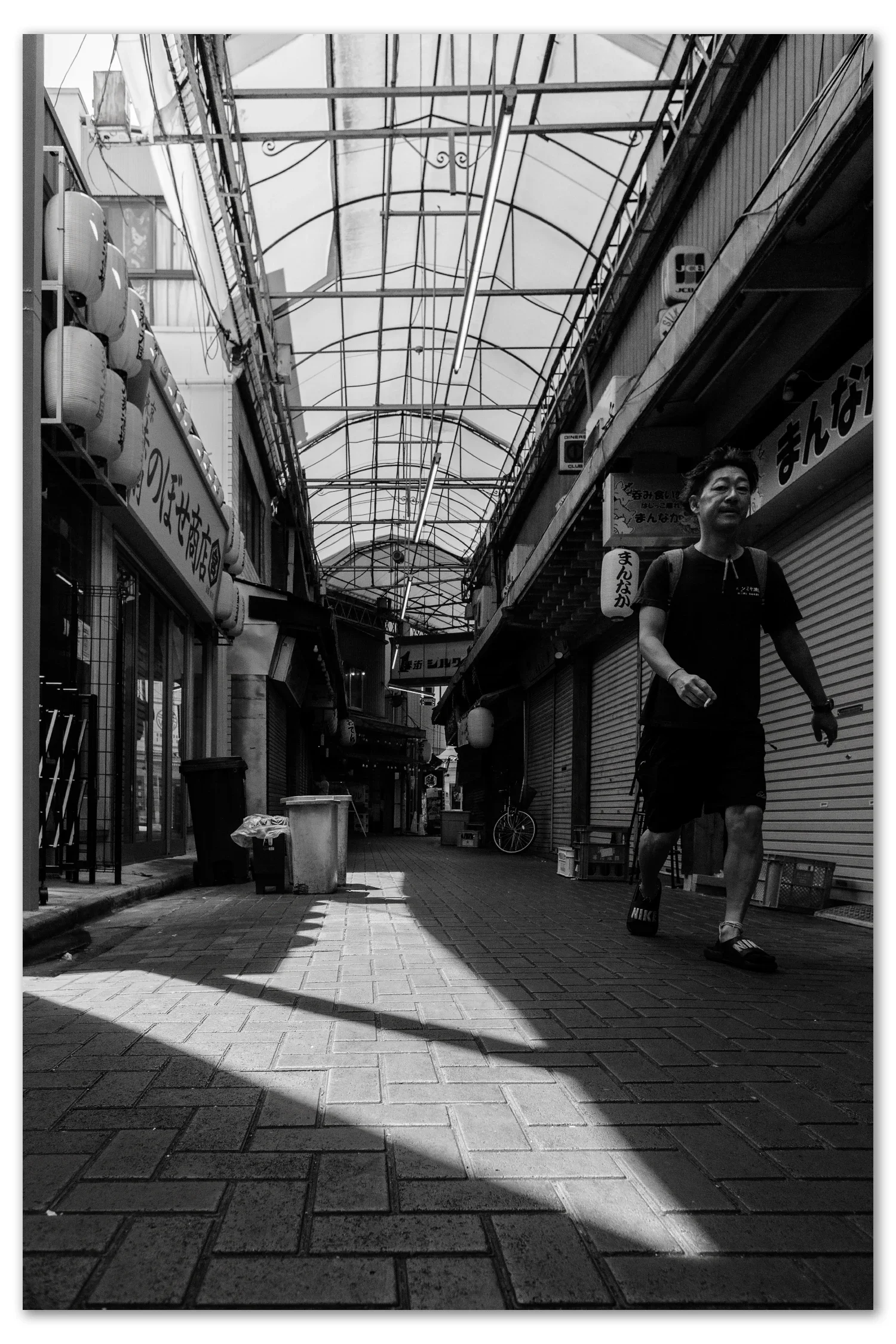
Ichiban-gai Akabane Early Morning Street Photography
The final thought on Akabane
I have a personal history with this neighbourhood, which makes it easy to be biased. But that history is long enough and detailed enough that I can say with confidence the article above is as true as anything I have written.
There are a dozen Akabane-like neighbourhoods across Tokyo, and every one of them is ten times more popular. That popularity comes at a price. Crowds bring money, however few of them there are, and money brings gentrification, and gentrification changes what the place was, even slightly. That has not happened here.
Given the industrial and black-market history, gentrification in Akabane stops at the station doors. Cross the street and there is almost nothing but history. Anything artisanal here has been artisanal for generations. I have spent close to a generation walking these streets myself, and I think it's fair to say nothing is changing soon.
Akabane has never been a place I put on offer. It has been somewhere earned through relationships — a place I share with people I know will make the most of it, and with people who need it.
Now it's a place I share with all of you.
— Jeff
Read my Ground Review of Ueno Market, and why I think it is the best location for street photography in Tokyo. See more coverage of Akabane.
The streets never look the same way twice. I’m curious—how does this side of Tokyo hit you? Drop a comment below.
I live on flat whites and shutter clicks. If you’ve found value in these shots, toss a coffee my way to keep the sensor humming.
For those who want to skip the tourist traps and shoot the real Tokyo, my calendar is open for workshops. Explore the Masterclass here or email me at jeff@tokyoforgeries.com.
See you in the shadows.
Tokyo Forgeries is an evolving archive of Tokyo street photography and vintage-lens deep dives. We spend 30 days in every ward, using mid-century brass and glass to capture the city’s soul. This is a roadmap for the active pursuit of craft—documented through the geography of Tokyo and the character of its light.