Tokyo’s Best Street Photography Location—Ueno Market
Ueno Ameya Yokocho - GROUND REVIEW
Ueno, Taitō-ku · Ueno Station · JR Yamanote, Keihin-Tōhoku, Utsunomiya,
Takasaki, Jōban + Shinkansen lines · Tokyo Metro Ginza, Hibiya
Shot here since: 2000 · Visits: 100+ · Last walked: June 2026
The best street photography location in Tokyo is Ueno's Ameyoko market. Tourists be damned.
Disregard what the guidebooks and the YouTubers tell you. Behind the facade of a tourist haven there is a grit and a grime that is ideal for street photography. Walked at the right hours, this market yields as many keepers in as short a time as anywhere in the city. That is what makes it the best.
And yes — it is full of tourists. That turns out to be the point. Phones and cameras are out everywhere, all the time, so nobody looks twice at yours. The tourists are the camouflage. The locals are the photograph.
Ueno Market at a glance
Light: Veins of it through the tracks. Covered dark, open bright, all day.
Rhythm : Like waves on a beach. Build, crush, build again.
Invisibility: High in the crowd. A few vendors keep a watchful eye.
Working distance: Tight. Shoot fast and shoot accurately, or don't shoot.
Layers: Aged signage, trains overhead, light off the buildings opposite.
Friction: Standing still is the problem, not the camera. Keep moving.
Reliability: Same vendors, same stalls, same light. Every single day.
Return: A hundred visits in: always something new, and so much exactly the same.
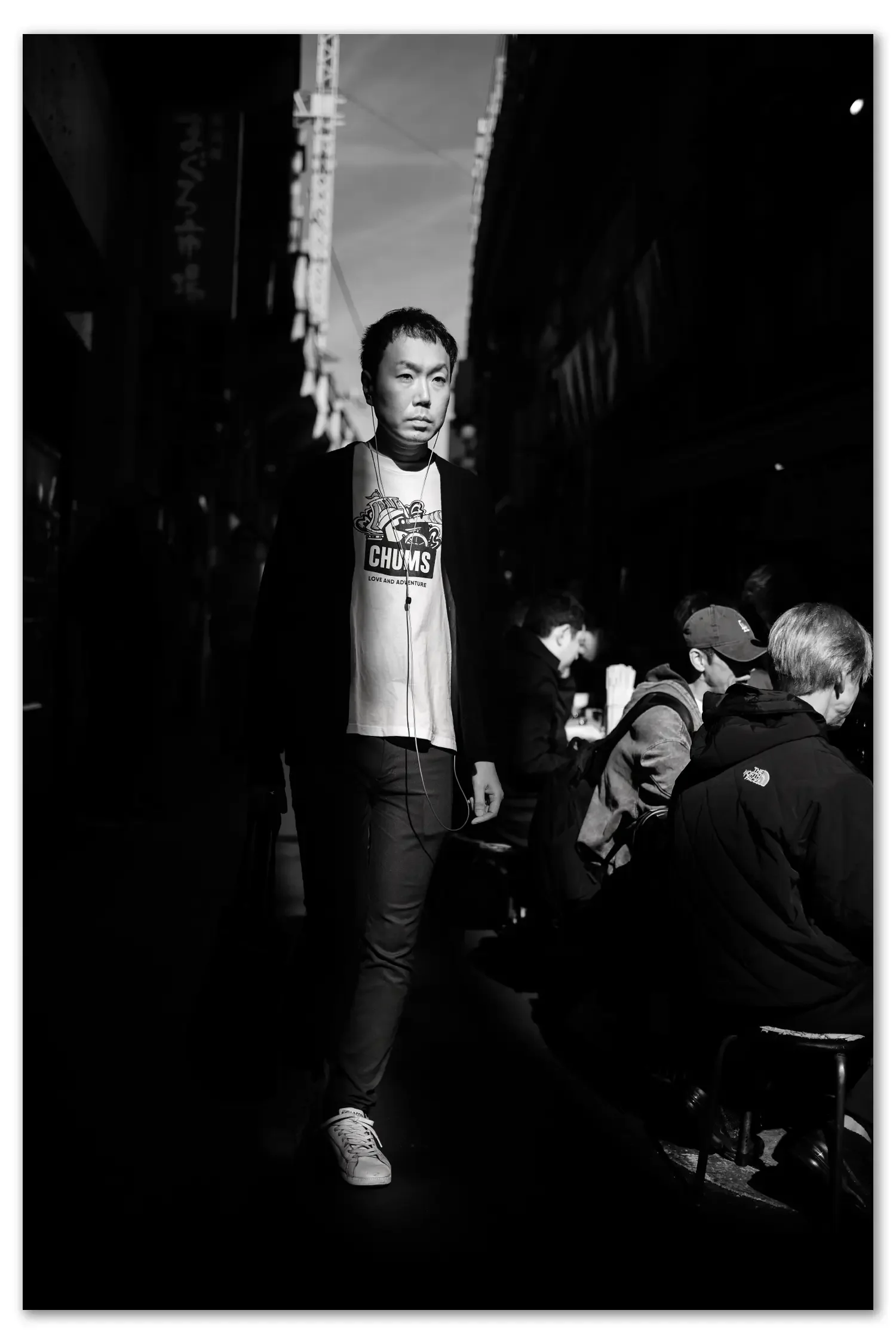
Ueno Market Street Photography: vein of light in between the tracks.
What Ueno Market actually is
Ueno is known as much for its park, its zoo and its museums as it is for Ameyoko. The park can give you compelling frames, but the real treasure is the market. Both are served by the same large, surprisingly navigable station.
Ueno Station's Shinobazu exit leads you straight into the famous end of Ameyoko. It is the tourist-friendly entrance, and it is a fine place to start — but it is not the best one.
For that, take the train one more stop to Okachimachi. That puts you at the back of the market, and it is the only starting point I use.
Working from the back through to the front puts the morning sun on the stalls and on the faces of everyone coming toward you. It also walks you forward through the history. Old signs, older shops, older shopkeepers still. Locals cutting through on their way to work. Vendors opening up for another day.
There is little history in the air and a lot of history on the walls. There is colour and texture on the faces. There is a weariness that lingers, as if to say: this is our best attempt at gentrification, but this place is so old and so beaten down that this is as good as it gets.
And that, it turns out, is street photography perfection. A location that can be your subject.

A Ueno market vendor preparing his stall for the day
The history of the Ameyoko streets
By the end of the war the commercial district around Ueno Station had been burned out by firebombing, and a black market grew in its place, under and alongside the tracks.
Sugar was scarce, so candy sellers filled the gap — more than two hundred of them at the peak. That trade gave the place its first name: Ameya Yokochō, the candy sellers' alley.
At the same time, and in the same market, other stalls dealt in goods diverted from the American occupation forces. Denim, sunglasses, chocolate — things nobody in Tokyo could get any other way. Those stalls earned it a second name: America Yokochō.
Two trades, two names, one market. In time the two names fused into the one it still carries. Ameyoko.
The decades since have taken it well past candy and army surplus. Fresh seafood, dried fish, spices, clothing. Today it runs about five hundred metres, directly beneath the railway between Ueno and Okachimachi stations.
It is that combination — the history, the resilience, the constant reinvention, and all of it packed under a railway line — that makes Ameyoko such a remarkable place to photograph.
My history with Ueno Market
Like a lot of places in Tokyo, I have a long and storied history with Ameyoko.
On my first trips my instinct was that this place was a treasure trove for street photographers. But I was a novice, and I was completely overwhelmed. I could see the images. I just wasn't good enough to make them. So I moved on and explored the rest of Tokyo.
As my experience and my confidence grew, I came back. No expectations this time — just a feeling that the opportunity was there. After a fairly mundane session I found myself in a back alley where a cook had come out for a cigarette on his break. I made a few frames of him. We started talking, and I kept shooting.
Not only was that one of the first good images I made in Ueno, it was one of the first good street photographs I made anywhere in Tokyo.
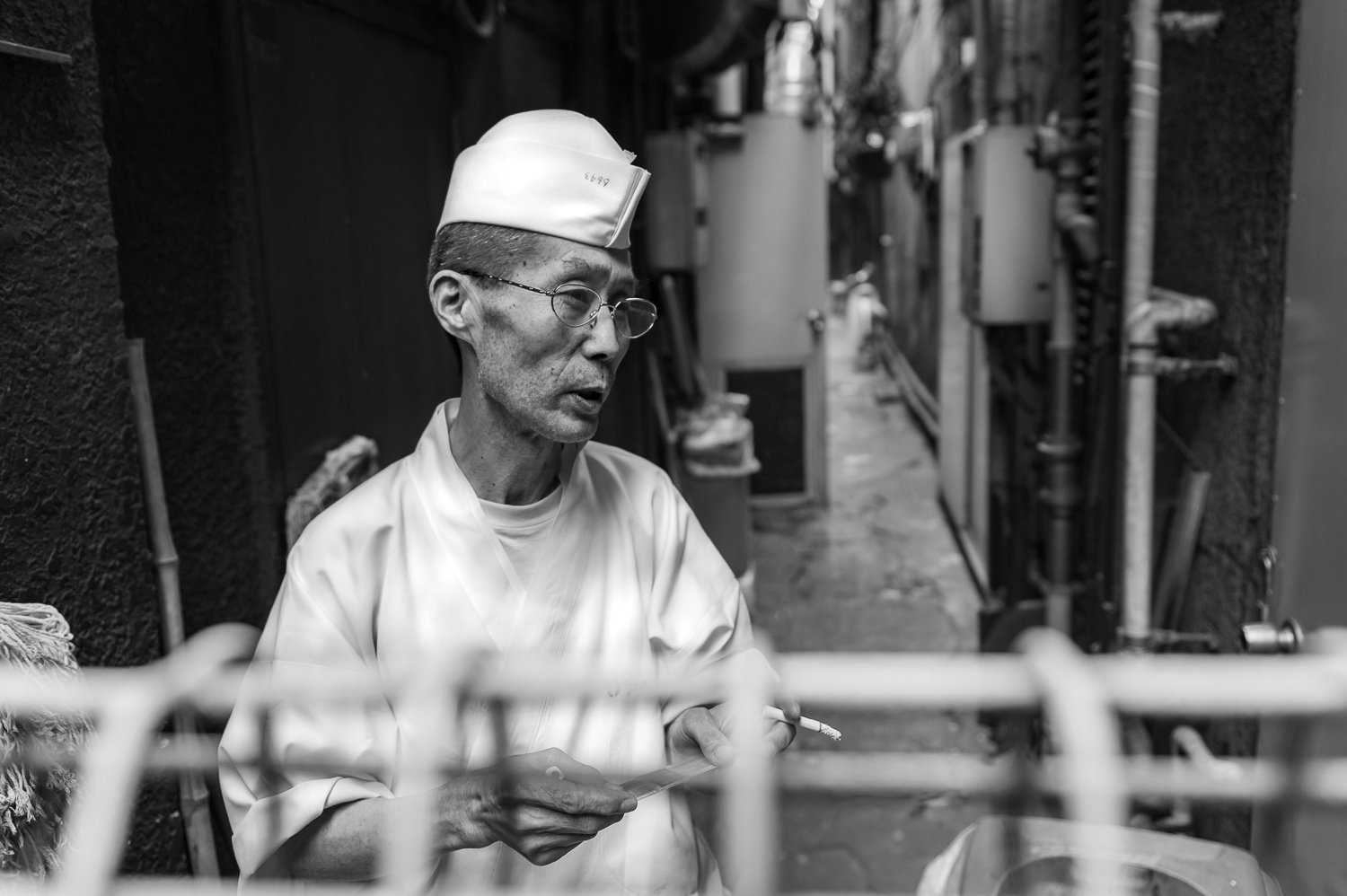
The Return frame.The cook with the longest heater cigarette.
That session mattered for two reasons. The frame was made on a digital camera, and it was the image that proved to me digital was capable of real street photography. And it was the moment I understood I could do this — and that I was ready to prove it. On the streets of Ameyoko.
What it's like to shoot in Ueno Market
There are covered markets, and markets by train stations, and plenty of outdoor markets. There are very few markets that have become part of the railway itself, the way this one has.
That geography is what gives Ueno its light all day long. The stretches under the tracks are covered and go quite dark; others are fully open. What you get between them are veins of light, and they are ideal for putting a subject in. Walking from the back of the market to the front in the morning lays that light across the face of every person coming at you, which makes shooting from the hip less a choice than a certainty.
Closer to the station you start to see the rhythm of it. People move like a heartbeat — a pulse of chaotic busyness, then a few moments of relaxed tension, then the next pulse. That rhythm buys you a certain amount of invisibility from the vendors and the patrons. It also means tight quarters. Very little physical room, and a requirement to shoot quickly and accurately.
The faces here are a mix: fresh, happy-to-be-there tourists, and weathered, ready-for-another-day locals. The signage is well aged and gives you layers for nothing.
I am careful not to stand in one place too long, because that is what causes friction in Ameyoko. A vendor's real estate is limited and me standing in front of it is not good for business. So I have my own rhythm. I move up with the crowd and pulse back down with the crowd, looping the same stretch until I get the frame I want.
And the market is nothing if not reliable. The same vendors selling the same wares from the same stalls, day in and day out. The light behaves the same way almost every day. And the tourists are, well, nothing if not reliably touristy.
That is why I keep coming back. I know the light will be good. I know the vendor will set his stall up the same way he set it up yesterday.
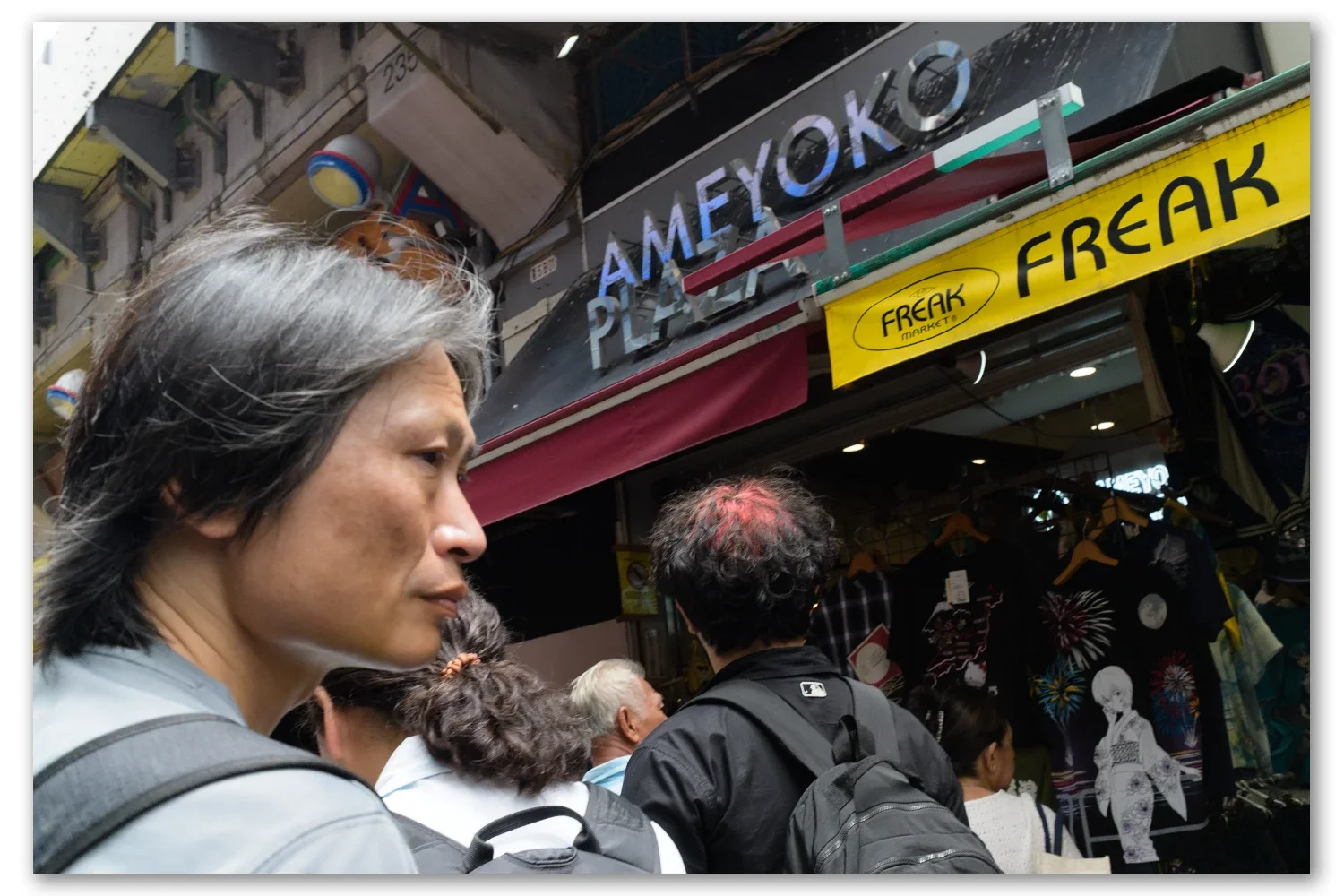
The close quarters street photography action in Ueno's Ameyoko Market
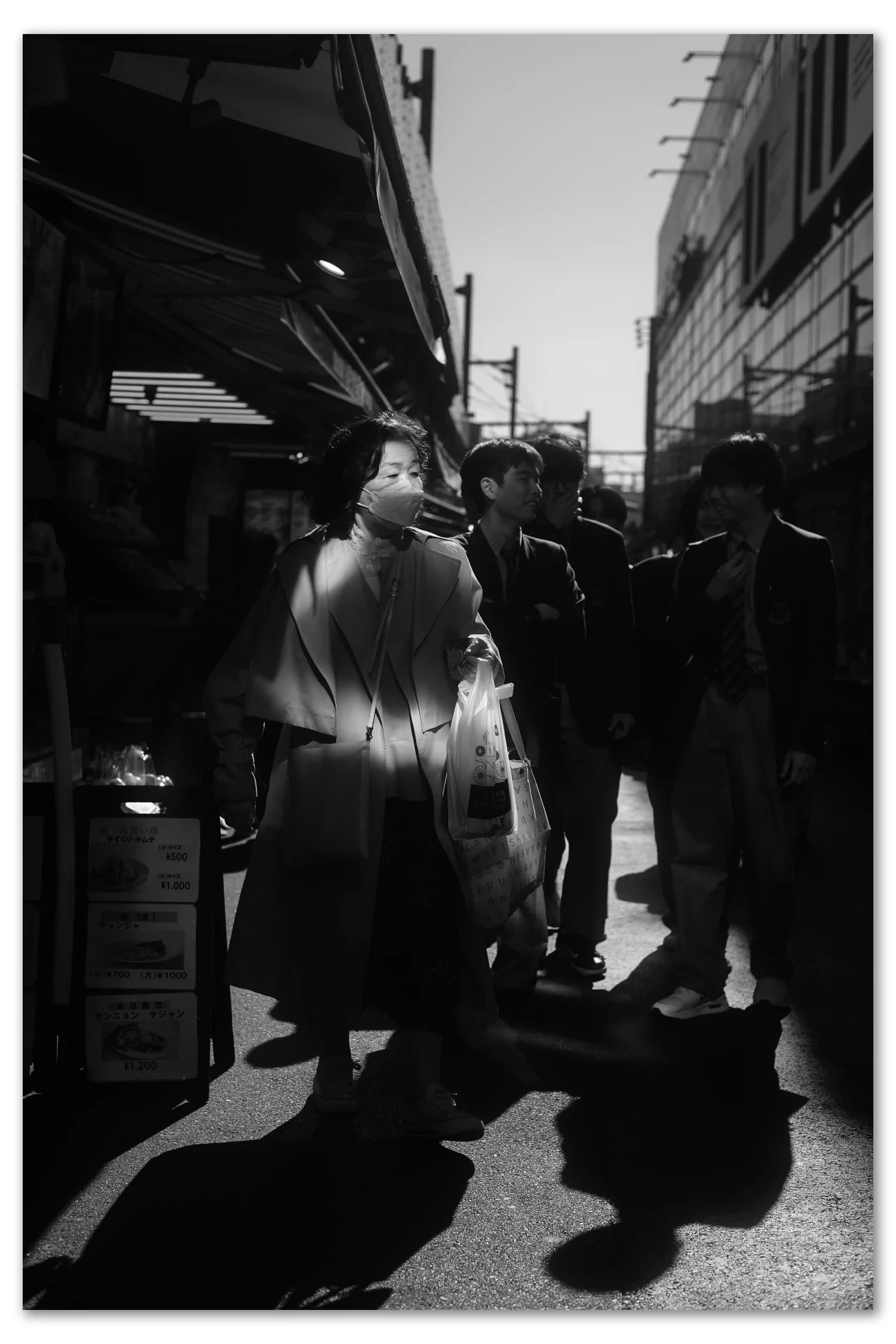
The gorgeous reflected light of Ueno Ameyokocho Market.
Why you should shoot in Ueno Market
Three reasons, and they are the light, the people, and the fact that it is a proving ground.
The light. Ameyoko doesn't need a beautiful day to give you spectacular light. Because the market is threaded through the train lines above it, the quality is there almost every day. Add the fact that the main avenue curves slightly, so light comes off the neighbouring buildings and lands on people buying fruit and fish, and what more do you want?
The people. The cross-section is fascinating on its own — my rough count from a hundred visits says something like two in three are visitors and the rest are local. Then consider that many of the vendors have been standing in the same spot for more than a generation.
The proving ground. This market is overwhelming at the best of times. Getting past the fear of photographing people at close quarters is hard enough; doing it while moving through a crowd is another layer of difficulty entirely. Ameyoko is a good place to find out whether you have what it takes — or whether you need a little more seasoning, as I did.
Where to shoot — Ameyoko's findable corners
The market is not physically large. Three or four blocks. But for a street photographer that is plenty, and it holds enough repeatable positions to work for hours. These are the ones I stop at.
Outside Okachimachi Station. Steps from the exit, at the back end of the market. There is an old 1970s-style Ameyoko sign with zebra stripes, and people moving in and out at the crosswalk. Good for people, and you get the sign as a layer behind them. If a train goes over, you have two or three layers.
The open road, halfway in. About midway through there is a road open to traffic during market hours. It is not busy, but it creates space. In the morning a vein of light comes down between the tracks and lands on a hat maker's sign — an old red façade that reads, Regatte. The area is busy enough that people walk through that light regularly.
The quarter-block near the fishmonger. Further up, in the busier stretch. Not really a corner — call it a quarter of a block — but little pools of light fall onto people's faces where it reflects off the buildings beside the tracks. It is pure magic.

The famous light between the tracks of UenoMarket. Tokyo's best location for street photography.
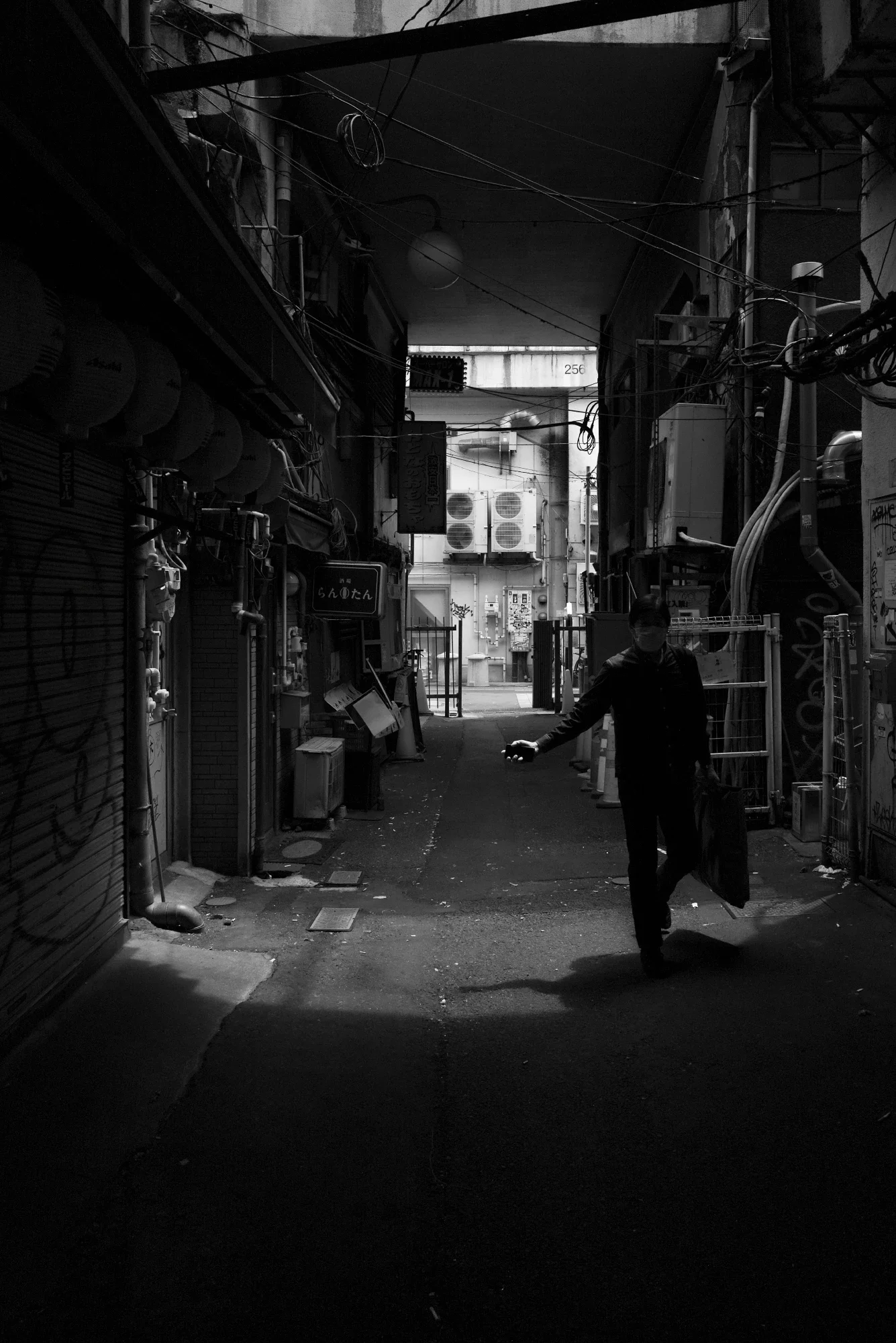
The famous 2-5-6 alley in Ueno Market: Tokyo's best location for street photography
The Ameyoko corners I keep
The ones above I will happily hand to anyone. They are not the ones I come back for.
The moment you map a corner it stops being yours and becomes a checklist — which is exactly what I left the famous wards to get away from. So I will tell you they are here. I will not tell you where.
These are the locations that find you. They take a few temps for the best images to come to fruition, but its worth the time. In them, there's a little piece of what makes Ueno Market the greatest location for street photography in Tokyo.
Ameyoko light, weather and season
I shoot this market all year round. If I had to name months to avoid it would be July and August — the heat and humidity of a Tokyo summer make those close quarters a sweaty mess.
The clear skies of autumn, winter and into spring give the best and most consistent light. Strong pools of reflected light, and dramatic veins pouring through the tracks at different hours.
Late December is special. From Christmas through to New Year you get locals preparing for the holiday, foods you won't see the rest of the year, and a busyness that isn't matched at any other time.
The rainy season — late May, often running through June — is difficult for some, but it gives you umbrellas, reflections, puddles and an overall quality I hate to call cinematic.
And finally: any time of year, in any weather, between five and seven in the evening. The sunset against the market's own lights is undervalued and genuinely wonderful. After seven the place shifts into nightlife, which is fun in its own right but is no longer a market.

Sun umbrella reflection in Ueno Market
Friction and manners in Ameyoko
This is a place of commerce. The vendors are here to sell, and that is the source of nearly all friction here. It isn't that they are rude. It is that someone standing in front of their stall for several minutes is not good for business.
So I move with the flow. If there is a background I want as a layer, I might stop a moment or two to try for it — but if it isn't happening I don't force it. I carry on with the rhythm of the people, go down a few shops, and circle back to try again.
If a shopkeeper scolds me, I smile, I nod, I apologise, and most importantly I move on. In any disturbance here the shopkeeper is almost always right and the street photographer is almost always at fault.
It is also a place of tourism, which cuts two ways. Tourists may not want their picture taken, so be mindful. But tourists also photograph everything, which means cameras and phones are out constantly — and that makes a street photographer far less conspicuous than he would be anywhere else.
My whole operating procedure in Ameyoko is that simple. Smile, nod, and never stay in one place too long.
Gear and approach
You can never go wrong with the classic pair, a 35 and a 50. But I have spent years photographing this market, and my best frames have come from the two ends of the range rather than the middle.
Wide — 28 down to 20 — gives you the layers and the context, and it gives you two subjects at once: a person, and the market itself.
Long — 85 and 135 — gives you something else entirely. A portrait of the market. Not just of a subject, but of the texture and the colour and the reflections, and of how tight and how old this place is.
The market is small enough that either choice is defensible on any given day. What it actually asks for is not glass. It asks you to move at its speed and behave well while you do.
Getting there
Ueno Station's Shinobazu exit puts you straight into the famous end of Ameyoko. If you are here with friends or family, that is fine.
We are here on a mission, so take the train one stop further to Okachimachi and come out the north exit. That is the back of the market, and it is the right way in.
The path through is up to you. I prefer a figure eight: into the market about halfway, cross under the tracks, keep going in the same direction, then circle back to close the loop. The exact shape doesn't matter. By the end of a session I will have run half a dozen of them, crossing under the railway at different points, and that will have covered very nearly all of Ameyoko.
Allow two to three hours if you want to work it properly.
The verdict
Who is Ueno Market for? Almost anyone can come away with good images here. To get the most out of it you want to be an intermediate street photographer — someone who can move comfortably between fast shutter and zone focusing and the high-contrast problem of a vein of light between the tracks.
It is a busy place and it can be overwhelming, which makes it less than ideal for some. If you need time to compose carefully and check your settings, this is not your ground.
And there is a second honest objection. Parts of it are very touristy, and travelling all the way to Japan to photograph other visitors may not be what you came for.
That said: the history, the light, the people. It is one of the best places in Tokyo to make photographs.
The final thought on Ameyoko
Ueno Market is Tokyo's best street photography location. It is a bold statement. It is true.
The market has everything that makes Tokyo street photography exceptional. It is busy, it is local, it is touristy, and it has a history entirely its own. There is great colour, great light, great texture. There is a vibe.
And every single day there is a pile of great moments in there waiting to be made.
— Jeff
Read my Ground Review of Akabane and learn why its the corner not made for Instagram. Check my other articles on Ueno for a more in depth understanding of the area.
The streets never look the same way twice. I’m curious—how does this side of Tokyo hit you? Drop a comment below.
I live on flat whites and shutter clicks. If you’ve found value in these shots, toss a coffee my way to keep the sensor humming.
For those who want to skip the tourist traps and shoot the real Tokyo, my calendar is open for workshops. Explore the Masterclass here or email me at jeff@tokyoforgeries.com.
See you in the shadows.
Tokyo Forgeries is an evolving archive of Tokyo street photography and vintage-lens deep dives. We spend 30 days in every ward, using mid-century brass and glass to capture the city’s soul. This is a roadmap for the active pursuit of craft—documented through the geography of Tokyo and the character of its light.