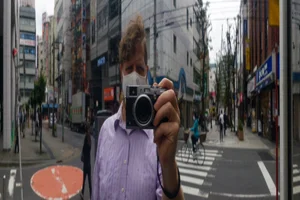
28mm vs 50mm in Shibuya: Two Cameras, One Rainy Day
It doesn't really matter what name is on the camera, Leica or Nikon. You can't control how people react to it.
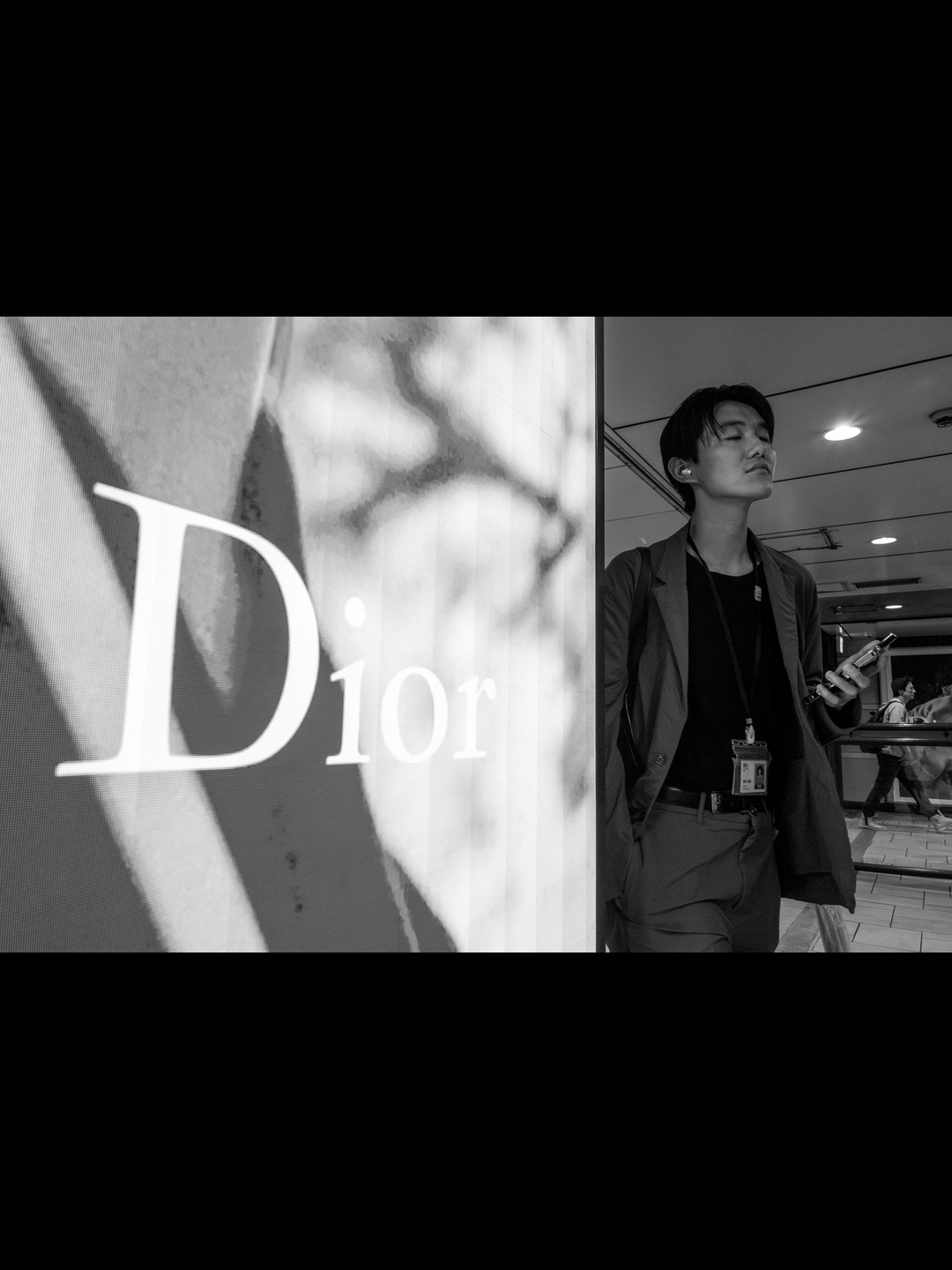
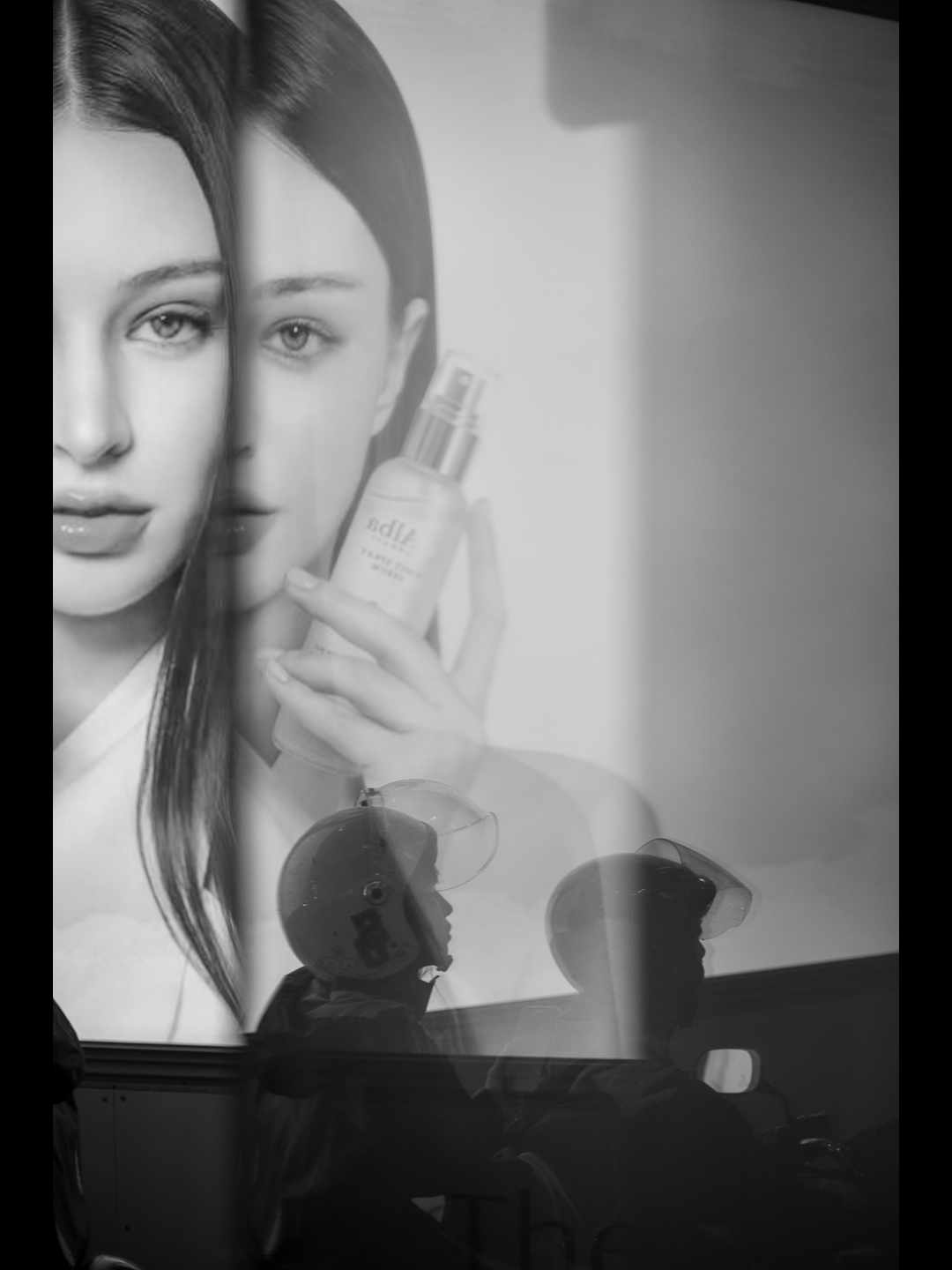
Dior signage and a man Leica Q2
A rainy Shibuya day
This was an odd day, because I took two cameras, two lenses and two completely different ways of thinking. I will often take a single camera body with two focal lengths, just in case my chosen focal length for the day gets stuck. I have a backup. I have another way to go, a different direction. But on this day, I took a Leica Q2 Monochrom with a 28mm lens and a Nikon Z9 with a 50mm lens. Different focal lengths, different camera sizes, but most importantly, a different approach to how you might shoot.
I don't mean this to be a shootout between lenses, or a verdict on which lens is right for a location. This post is a precursor to articles that will come out over the next few months. Not just on focal lengths, one versus another, but on how I see certain parts of the city as ideal for certain focal lengths.
28mm vs 50mm: the two focal lengths
50mm. This is the "goat" lens for street photography. You could probably put the 35mm in that category as well. It's fairly close to the human eye: not exactly, but close enough. Because the optical formulas are reasonably simple, you can get a fast 50mm for a reasonable price these days. That lets you create separation and shoot well into the night.
28mm. The lens that sits right on the edge, on the apex between a normal field of view and a wide one. Depending on the situation, it does a little of both. It is not as common as the 35mm or the 50mm, but it is a spectacular lens for street photography.
The difference shows up the moment you try to zone focus. On full frame, at f/8 and focused at 2 metres, a 28mm keeps everything from about 1.25 to 5 metres sharp. At the same settings, a 50 mm gives you about 1.7 to 2.5 metres: a zone less than a metre deep. (Figures assume a 0.03mm circle of confusion.) That one number explains most of what follows.
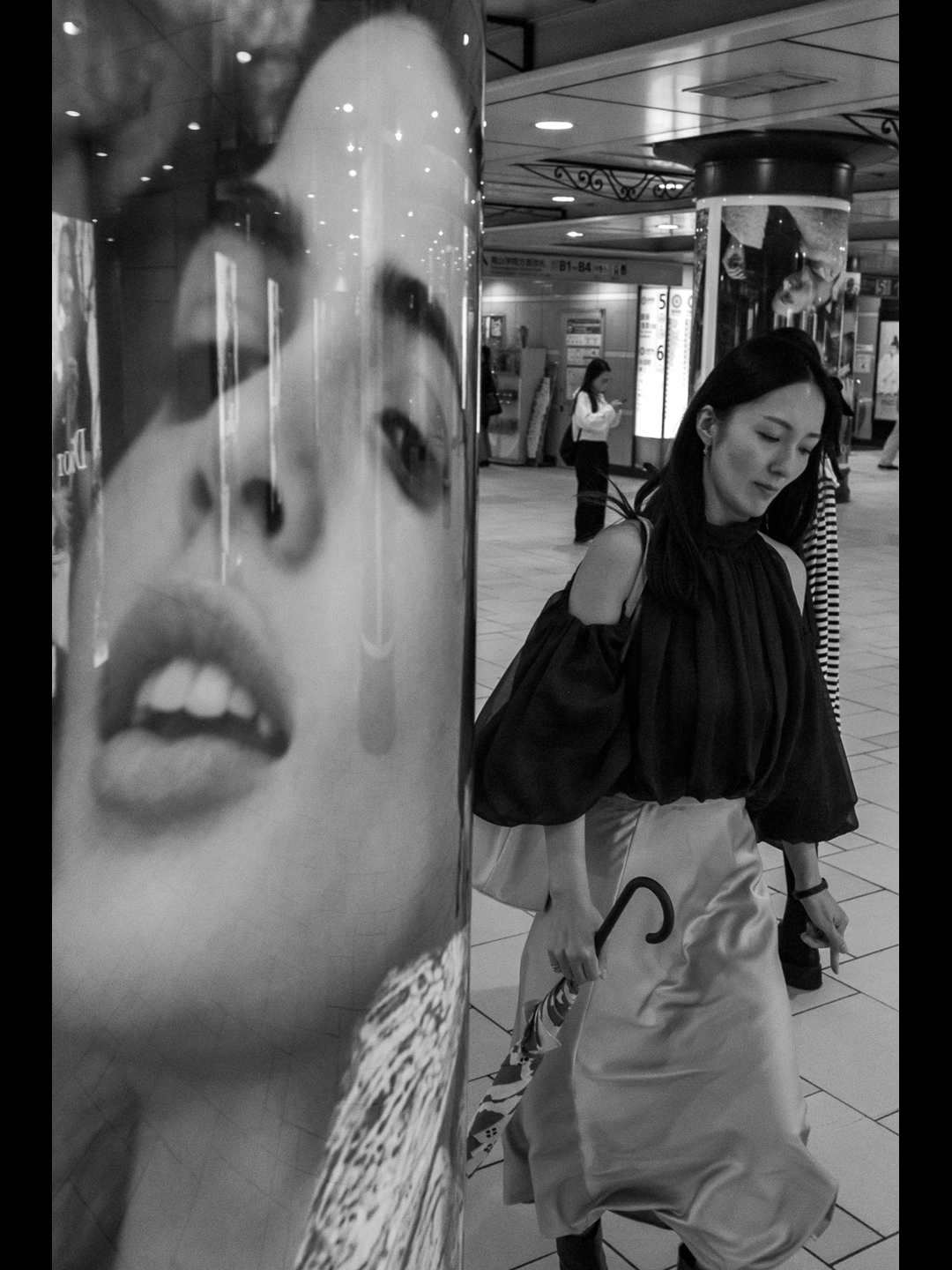
Leica Q2 Monochrom at Omotesando Station near Shibuya
Two cameras: Leica Q2 Monochrom vs Nikon Z9
The Leica Q2 Monochrom. This is a very slight, yet powerful camera. The monochrome sensor is the key factor, of course, but it also comes with an amazing lens: sharp, fast, but not clinically oppressive either. It has a little character to it. As much as I don't want to admit it, this camera draws far less attention, and the attention it does attract is the right kind. This person is an artist. This person needs business. This person is not a tourist. It attracts the attention of trust, which is incredibly useful in street photography. Dare I say, imperative.
The Nikon Z9. This is a beast of a camera. That said, it's the smallest flagship body Nikon has made. I tend to shoot in portrait orientation by default, and having a grip on both sides of the camera is intuitive for me. I originally bought it for other professional work, mostly for its video capabilities. I see it as a hybrid video and street photography setup, and I love it for so many reasons.
The major difference goes back to the last point about the Leica: what kind of attention does it attract? Unfortunately, I feel these kinds of cameras and rigs create a sense of mistrust. Someone isn't there to document or create. Someone is there to take, not make. I do my best to defuse this, but it can come up from time to time.
What the camera says before you do
I really don't change anything between the Nikon and the Leica: how I walk, where I go, what I'm thinking, what I'm trying to forge. That's me. That's my thought. The camera is just an extension, a tool with which to manifest those thoughts. It doesn't really matter what name is on the camera.
But you can't really control how people react. One camera says "street photography master." The other says "sports photographer, photojournalist, professional photographer." It doesn't say "artist." That's unfortunate, because I think people in all of those industries can very much be artists within that work.
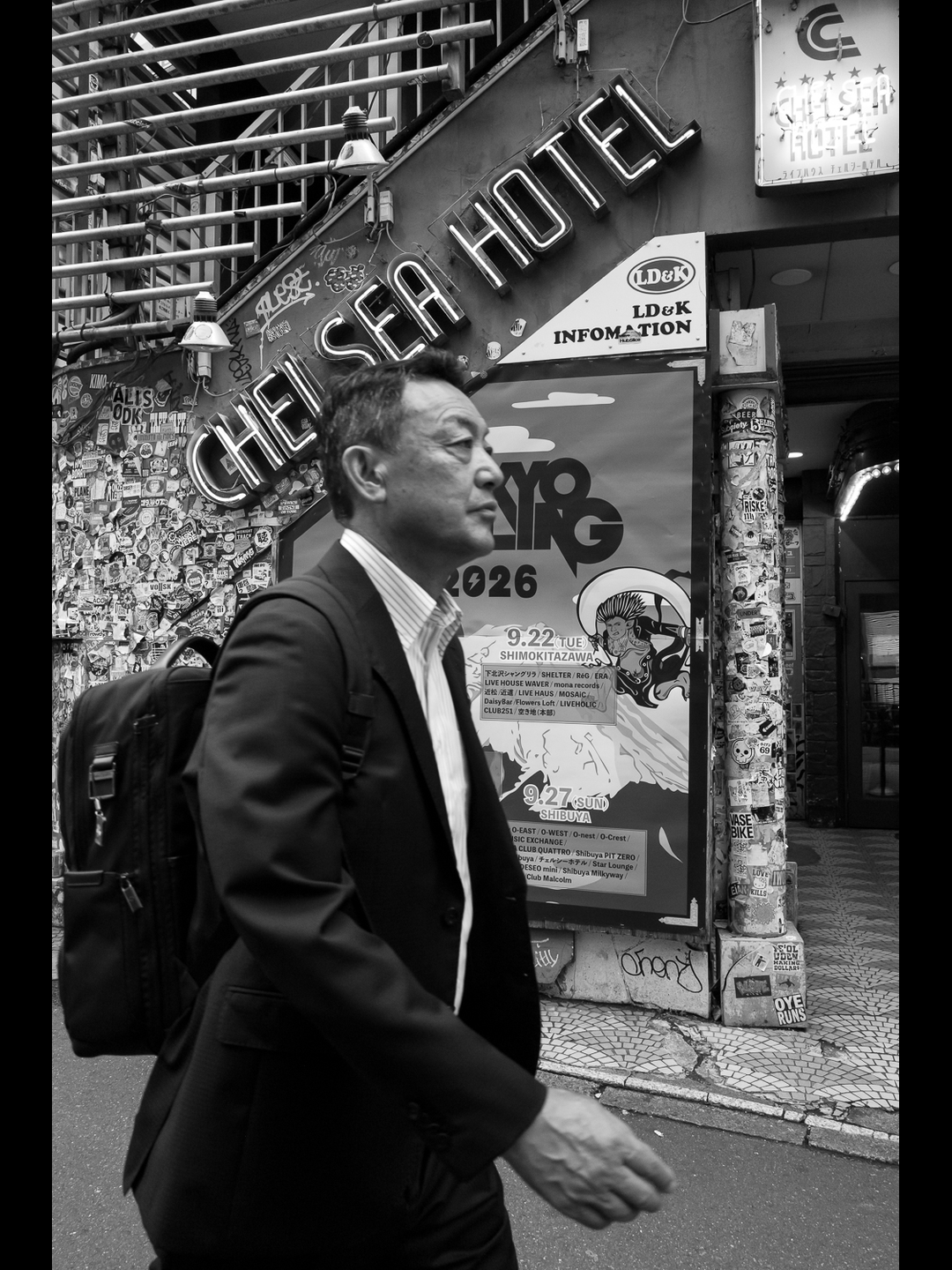
Shibuya Chelsea Hotel
How close each camera lets you stand
The really big difference I find is where I can put one camera over the other. I don't feel there is much limitation with the Leica. I can get as close to somebody as I want, as close as I dare, and they don't really flinch. That works in two ways:
1. The camera is so small, and it has a certain panache, a je ne sais quoi, about it.
2. At 28mm you can zone focus quite easily, and with the sensor being essentially ISO-invariant, you can let auto ISO run and use exposure compensation to brighten or darken the image however you feel it should look.
I'm a little more hesitant to go into certain situations with the Nikon. Not completely. I'll get really close to people, but I need a 35, 28 or 24mm lens on to do that. As soon as I go to 50, you can't zone focus anymore. Your depth of field is just so shallow. And there's the size difference. I'm a big guy, and that's a big camera. Even though the 50mm lens is fairly small, it needs an adapter to fit the Z body. People don't understand that. They just see a big, unwieldy camera. It doesn't feel big and unwieldy to me, but it does to the person I'm photographing, which isn't always to my advantage.
I find myself treading a little more quietly, a little more lightly afoot. With the Nikon, I want to get a few frames off before anybody realises what's happening. Now, many people won't care. Some people will: a smile, a nod of appreciation, a thank you, a conversation. All of those things help, and all of those things can get you some great images.
I've taken some really great images that way with the Nikon, even with focal lengths longer than 50mm. I use a 135 quite often, and I'm very happy with it. Especially when you have a chance to talk with somebody and meet them. That's usually really special.
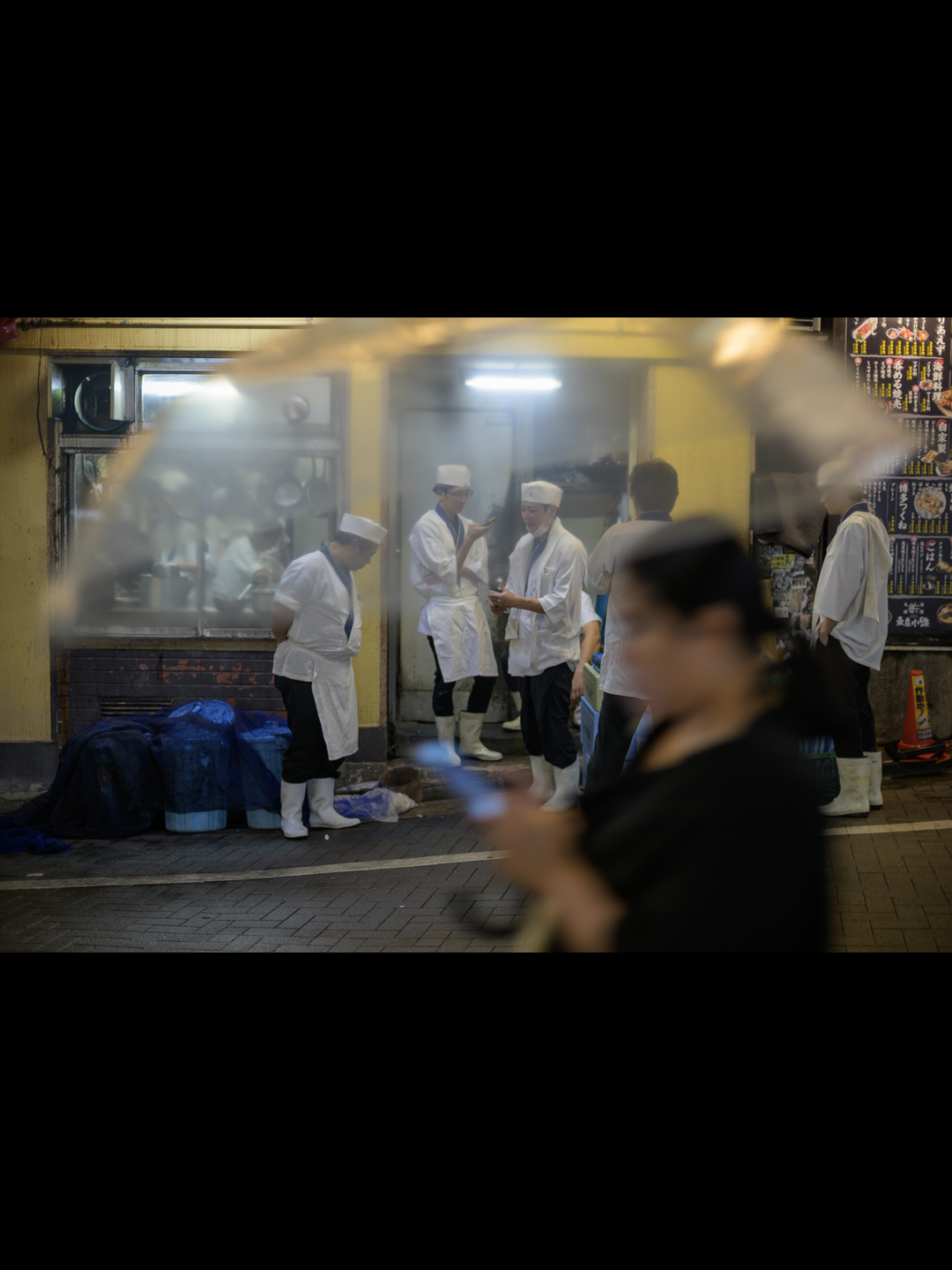
Shibuya Station's famous chicken restaurant on a Nikon Z9 at 50mm
Friction
What I'm driving at is that there's a different level of confidence in what you can do with one camera versus the other. I think a little more about the tool in my hands when I use the Nikon than when I have the Leica. With the Leica, my mind is freer to focus on the frame, on the subject, on the moment, and to be in the moment. Getting to that place with that camera has far less friction than it does with the Nikon Z9.
Now, if I changed to a Nikon Df or Zf, would things change? It's possible. But I don't think it's necessary, for two reasons.
First, the Nikon doesn't make me overthink. I'm just a little aware of it. When there's a moment and you're right in it, that awareness fades really quickly. You're in that moment, and you're getting that thing. You're doing everything you can to get the image you have in your head, the thing you saw in that second.
Second, I like the challenge. I don't think I'm at the level of the industry's best yet. I need to put in that work, and I need to be able to make a camera like the Z9 work. If I go all Leica one day, or move to a smaller Nikon (a Zf, a ZR, or something like it) and shoot that way, everything I learned on the Z9 will make me that much better.
Shibuya Crossing Z9at 50mm
The last day of Seibu
I didn't plan it this way, but the day I walked Shibuya with two cameras was the last day of Seibu Shibuya. The banner on the corner said so plainly: THE LAST, 9.30 WED, and in Japanese, fifty-eight years of thanks, given shape. The department store opened in April 1968. In the seventies and eighties it was where new Japanese designers were found, and it closed without a ceremony.
I stood at the crossing with the 28mm and let a taxi drag through the frame at a fifteenth of a second. The building held still. Everything in front of it didn't.
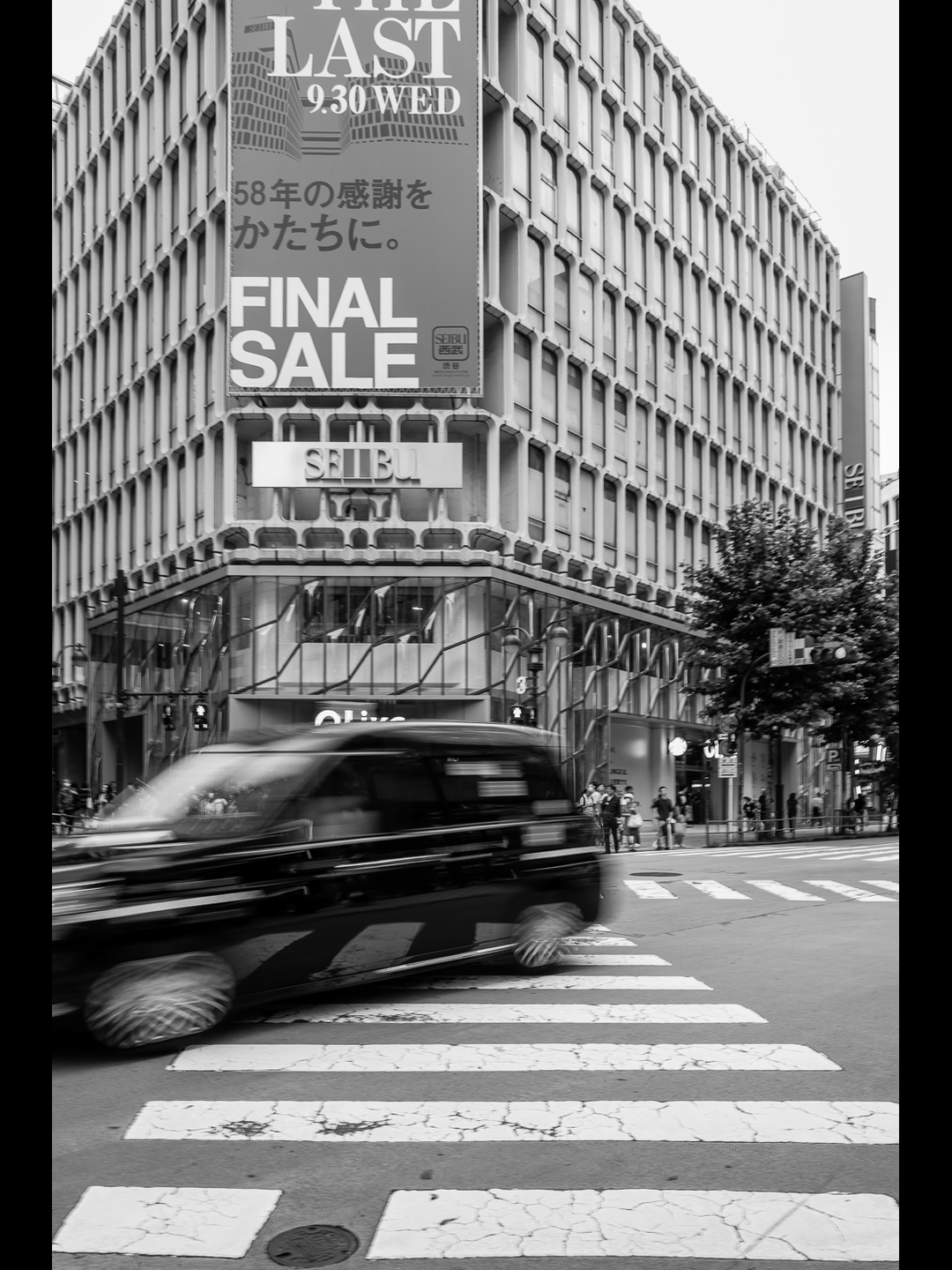
The last day of Seibu Shibuya Leica Q2Monochrom 28mm
Which is better: Leica or Nikon, 28mm or 50mm?
The truth is, I love using both cameras for different reasons. I think it's really difficult, though, to put any other manufacturer's camera body and lens above Leica's for street photography. It matters greatly, almost completely, who is wielding that camera and lens. But in the hands of someone with even a reasonable level of experience and artistry, a Leica will give just that much more.
That said, I can't imagine a day when I don't shoot Nikon. It feels like home to me. If I have to work a little harder to get it to where the Leica is, I'm okay with that.
Most certainly, the 50mm is one of the best focal lengths in street photography, if not the best. But in a place like Shibuya, with its tall buildings, narrow roads and a claustrophobic amount of people, the lens with the least friction is the 28mm. If you could only shoot 50 there, I'm sure you'd find pictures, 100%. It's such a rich location, and the 50 is such a great lens at a wonderful focal length. But for ease of use and for a precise balance between quantity and quality (that is, a higher volume of really, really good images), I really feel the 28mm is the way to go in Shibuya.
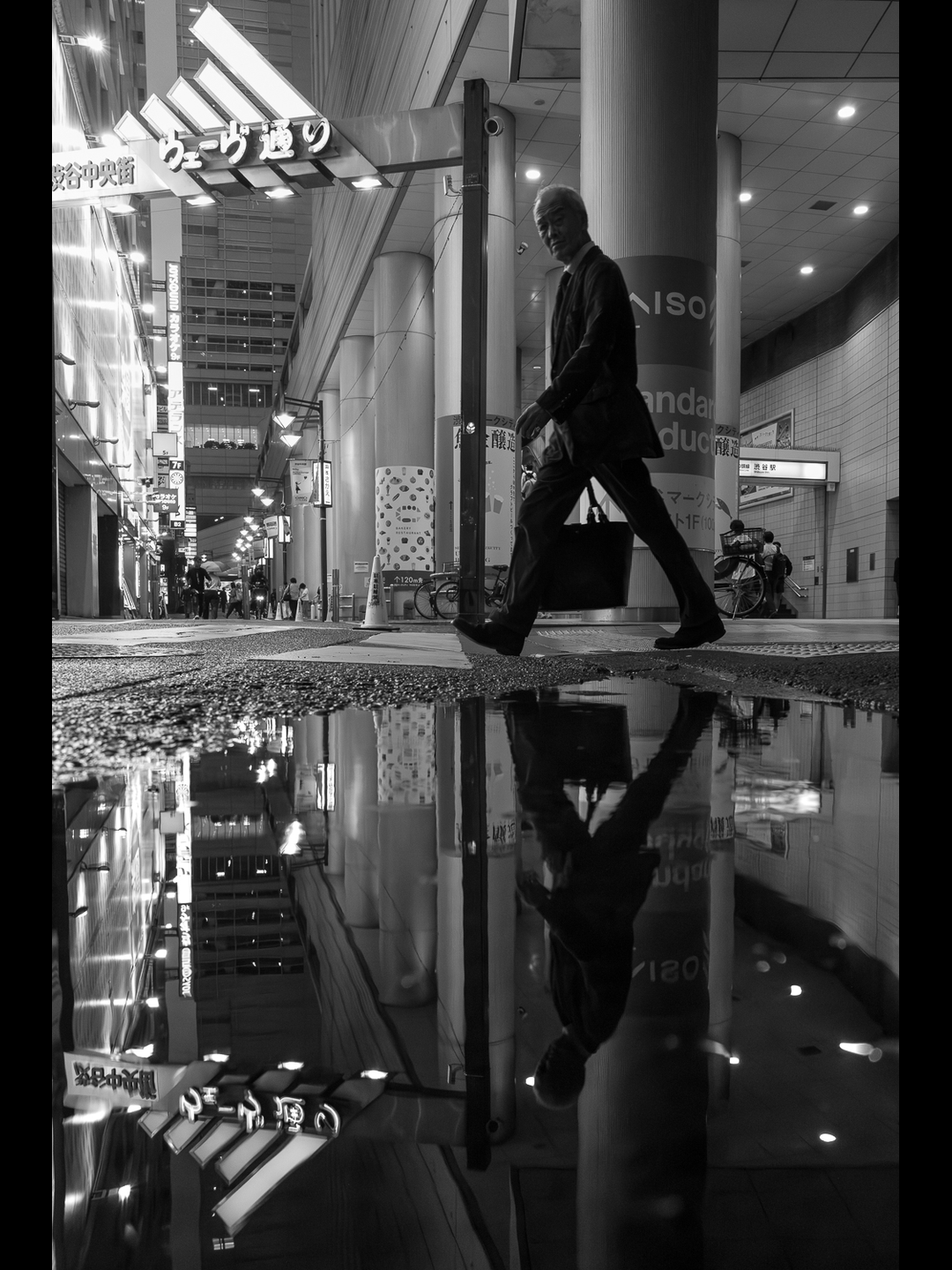
Shibuya Crossing puddle reflection, Leica Q2 Monochrom 28mm
A note on the frames
You'll notice far more 28mm frames than 50mm frames from this day. That isn't an accident. I spent more time with the 28mm and less with the 50mm, and that is the argument in miniature: the 50 is harder to shoot in Shibuya, or rather, the 28 is more accommodating to it.
In closing
Whatever camera and lens you have is likely the right one, and you should push it to its absolute maximum. Squeeze every bit of goodness out of that camera and that lens, then get a new lens and do the exact same thing. At this point in time, there isn't going to be a great evolution in camera technology anytime soon. There's a huge used market, full of wonderful equipment, and even things several years old are incredibly competent. There's no need to go hunting for brands.
What's next: a series on focal length
Over the next six months to a year, I'm going to be writing articles on the theme of focal length. Not just vintage lenses, but focal length itself: why one is better than another, why one might be used in one situation over another, one lens versus another.
There will be deep dives into some of my favourite locations, like:
- Ikebukuro
- Shibuya
- Shinjuku
- Ueno Market
- Shinagawa
- Kōenji
- Nakano
- Sangenjaya
Which focal length works best in each place? Some of the articles are already written, and some of the experiences have already been had. But I'm very much looking forward to making new ones, new images too, exploring and re-exploring Tokyo under the theme of lenses and focal length.
The name on the camera is the least of it. The distance you're willing to stand at is everything.
— Jeff
---
If you'd rather walk these streets than read about them, the corners I keep off the page are on the masterclass. Details are on the Workshops page.