What Makes a Good Street Photograph?
What Makes a Good Street Photograph?
A good street photograph is three things working at once — light, composition, and a moment — held together by a clear subject that makes the viewer pause and ask a question. Get those aligned, and the technical details barely matter. Miss the moment, and no amount of sharpness or perfect exposure will save the frame.
Let's break it down, and then I'll tell you the part that actually separates the good from the forgettable.
The three ingredients
Light. Street photography lives and dies on light. The direction it comes from, the contrast it carves, the way it falls across a face or down an alley — chasing good light is most of the job. Learn the hours your locations turn, and shoot then.
This doesn't mean you need a perfect vein of light and someone walking through it to get a great shot. Light can be terrible and harsh, a mix of fluorescent and incandescent. A little sunlight thrown in for fun. A nightmare to white balance, but that's the light your subject is in. That's the light you need to use to capture your subject.
Understanding how to get the most out of light in any given situation will separate the good street photographers from the great.
Composition. A good frame guides the eye. Use the basics deliberately — leading lines, the rule of thirds, layers, negative space — to point attention exactly where you want it. Composition is what turns a chaotic street into a legible picture.
Take time to understand all of the compositional rules. And then you can use them to express your part in that street scene. You're the witness, you're the observer, you're the documentarian. How you see it is just as important, if not more so, than any rule in any art book.
The moment. The gesture, the glance, the collision of elements that lasts a quarter-second. This is the soul of the genre. Cartier-Bresson called it the decisive moment; I'd just say it's the thing that makes a photograph feel inevitable rather than accidental.
Completely true, but in the best of circumstances, with a great deal of experience. It's not something we all have, and that's not a situation we're always going to find ourselves in. I'm all for happy accidents. They're a great opportunity to learn, to see what you didn't see but accidentally captured. Now that the accident can be applied to future images.
What the moment is really all about is understanding and observation. Observing people, observing locations, and understanding who's going to do what in which moment. Understanding why capturing this moment rather than that one makes a great street photograph.
Combining all three of these things takes a great deal of effort, patience, and experience. My advice is not to stress about any one thing in any one moment. There is always plenty of time to review images, watch YouTube videos, read books, visit museums and galleries, and learn. When you're in the streets, just shoot. If you're feeling overwhelmed, you're probably thinking too much.
Think before you go out. Make a choice about what you're going to work on that day: what technique, what theme, what concept or idea you're trying to learn, and just focus on that one thing. This is exactly when those happy accidents will occur. So focused on the colour yellow. I didn't realize I had made a triangle of yellow objects in my image. Now, you can start looking for triangles of different themes.
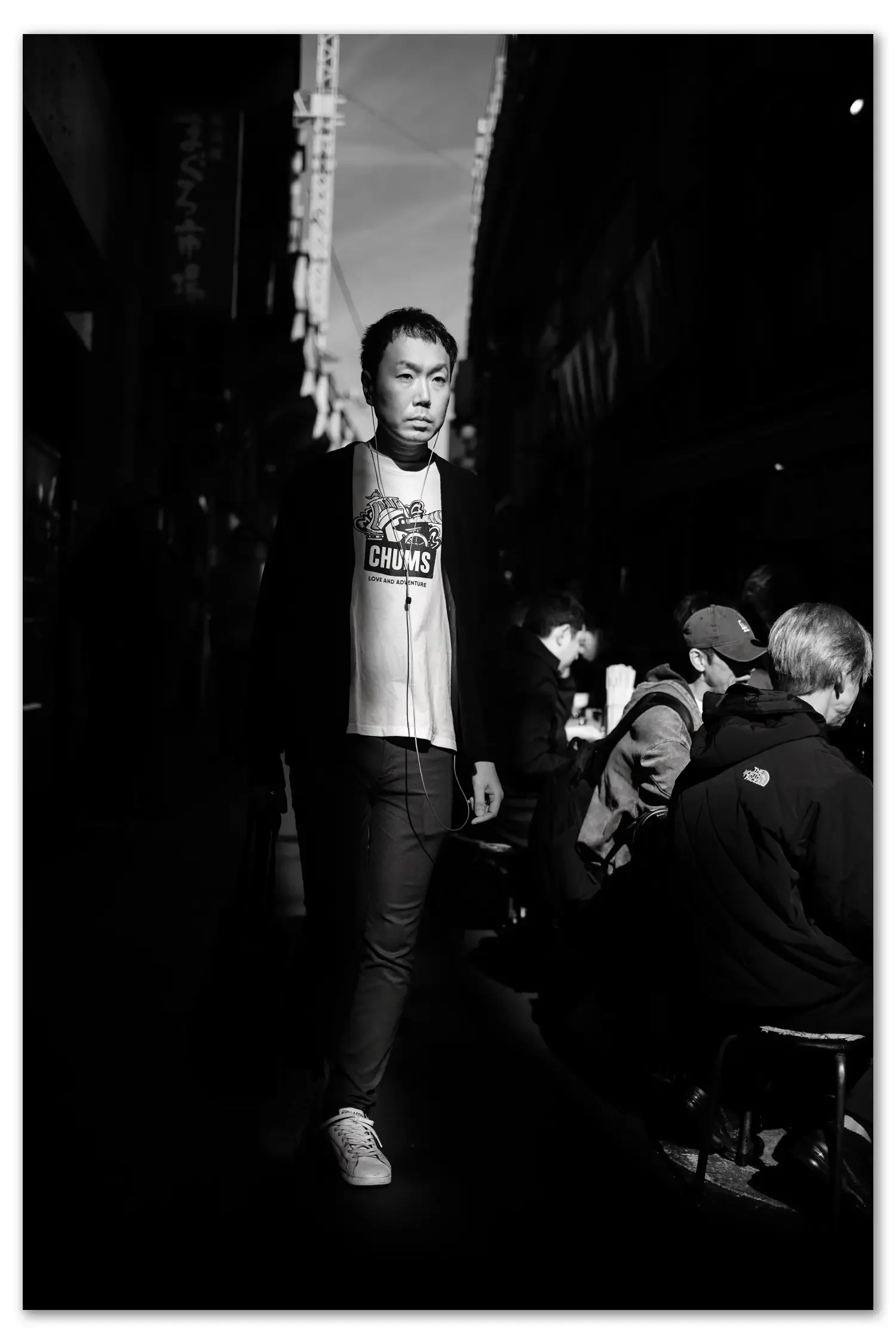
A great subject walking in Uneo’s great light
The non-negotiable: a clear subject
Most weak street photos fail the same way — they're a picture of everything, which means they're a picture of nothing. A strong frame has an unmistakable subject, even amid clutter. The viewer should never have to ask, "What am I looking at?"
To combat this, one of the best techniques I've learned is to find a really compelling background. Wait for things to walk into frame. Don't worry if they're in exactly the right place. Don't worry if they're too close to the camera and out of focus. Just keep shooting. A pattern will emerge, and then it's just a matter of repeating that pattern in a way that creates the best image for you.
Living in Tokyo, there are tons of billboards right on the street. Focusing on the eye of one of the models on the billboard, then letting people walk in, past, and around to see what happens, is a great way to start the day. It's also a fantastic way to get an interesting picture rather than just a picture of everything.
The part that separates good from forgettable
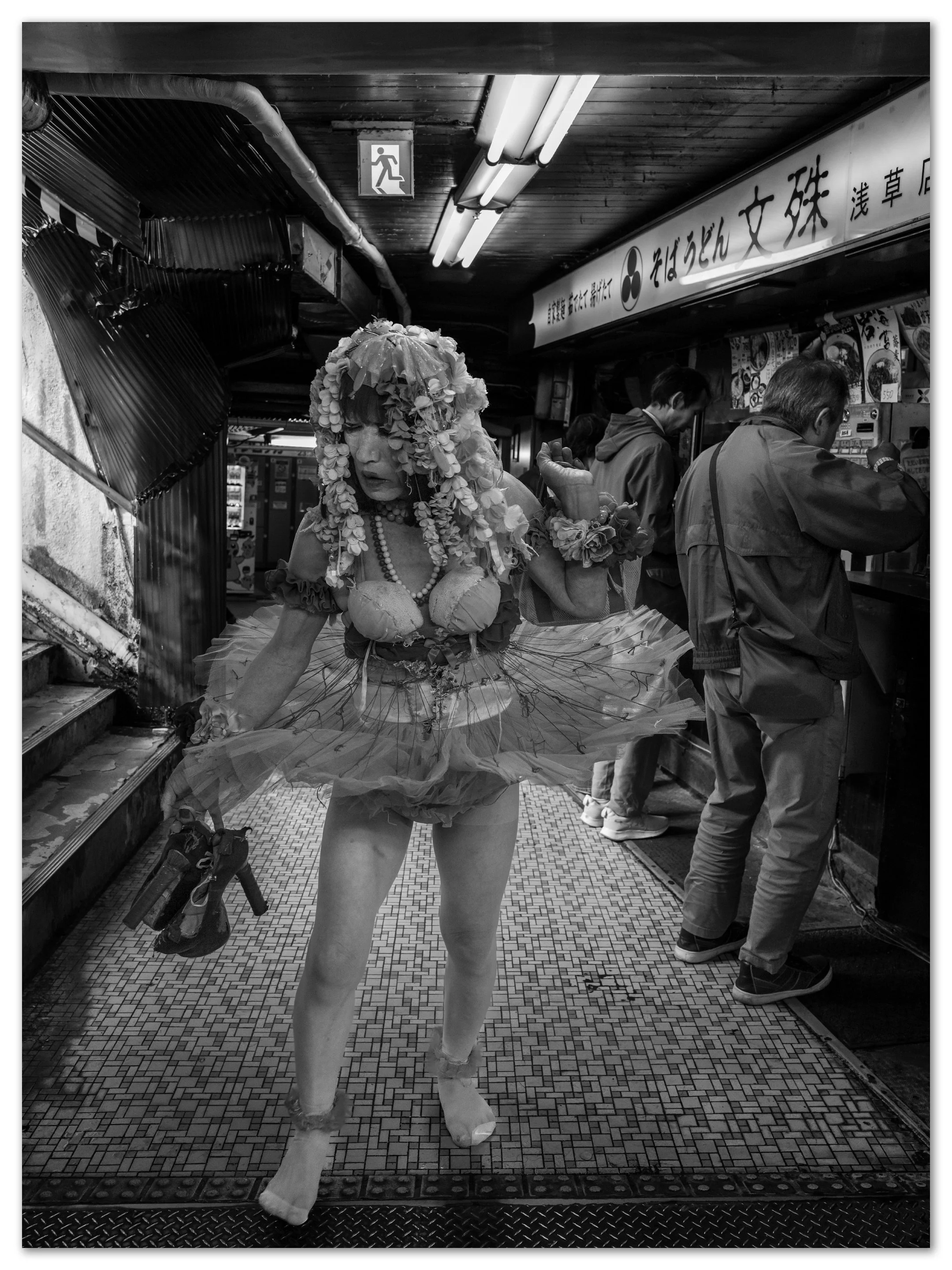
Asakusa Noodle shop candid portrait
Here's my honest opinion, which ties everything I write about together. A photo being real — candid, unposed, authentic — is not the same as it being good. The cult of authenticity has convinced a lot of people that capturing a true moment is enough. It isn't. A true moment with dead light, no subject, and lazy composition is just a snapshot. A good street photograph is real and made — found, then forged through light, frame, and timing into something that holds a stranger's eye. That's the whole idea behind making your own luck: the great frame is earned, not stumbled upon.
It isn't to say there isn't a certain amount of serendipity in street photography. It's all the preparation and the work you did before that allows you to take advantage of that.
There's something that isn't talked about very often, and I see it in the contemporary greats today. They have an idea, they see a moment, and they go after it. I don't mean just walking quickly to get next to somebody that you saw on the street. I mean, they use every amount of gear and technique and experience they have at their disposal in that moment to get the shot that's in their mind.
I've seen this many times with various photographers for whom I handle logistics while they're in Tokyo. I can also see the flip side of the coin in my own work: I see a cool idea or image and go get it. But I don't really go and get it. There is a level of commitment that is sometimes lacking in my own work, and I understand that because I've seen a higher level of commitment in a handful of other people's work.
I don't mean to make it sound as if I'm lazy, that you're lazy, or that they work harder. I really think it's down to building passion through experience. We all love to do it, but how great that love is varies from individual to individual. Conversely, what you're willing to do for that love will also vary.
It is time, and not gear, that is the cost we all must pay to grow our love to the size that will do anything to fulfill it.
Learning to recognize the good frame before you press the shutter — and to walk past the merely real one — is most of what I teach in a one-on-one Tokyo Forgeries Master Class. (New here? Start with what street photography is; ready to push further, see how to get better.)
What makes a good street photograph?
A good street photograph combines light, composition, and a moment, anchored by a clear subject that makes the viewer pause. When those align, technical details matter little; without the moment, technical perfection cannot save the frame.
Why does a street photo need a clear subject?
Without a clear subject, a photo of everything becomes a photo of nothing. A strong frame has an unmistakable subject even amid clutter, so the viewer asks what is happening rather than what they are looking at.
Is a candid or authentic photo automatically a good one?
No. A real, candid moment is not automatically good. A true moment with weak light, no clear subject, and poor composition is just a snapshot. A good street photograph is both real and well made — found, then shaped through light, framing, and timing.
The streets never look the same way twice. I’m curious—how does this side of Tokyo hit you? Drop a comment below.
I live on flat whites and shutter clicks. If you’ve found value in these shots, toss a coffee my way to keep the sensor humming.
For those who want to skip the tourist traps and shoot the real Tokyo, my calendar is open for workshops. Explore the Masterclass here or email me at jeff@tokyoforgeries.com.
See you in the shadows.
Tokyo Forgeries is an evolving archive of Tokyo street photography and vintage-lens deep dives. We spend 30 days in every ward, using mid-century brass and glass to capture the city’s soul. This is a roadmap for the active pursuit of craft—documented through the geography of Tokyo and the character of its light.