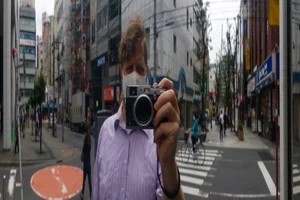
Set the aperture and shutter speed yourself and let auto ISO handle the rest: f/8 or f/11, around 1/500 for people walking, auto ISO with a generous upper limit, and exposure compensation to darken or lighten the scene. Add zone focus at about two meters and shoot RAW. That keeps the two decisions that shape the photograph — depth and motion — in your hands, which aperture priority does not.
Every beginner's guide gives the same answer: shoot aperture priority and let the camera work out the rest. That is sound advice for photographing things that hold still, and street photography is the one genre where nothing does.
Look at what each mode actually surrenders. In aperture priority you keep the aperture and hand the camera your shutter speed — the single setting that decides whether a walking man is a person or a smear. In shutter priority you keep the shutter and hand over the aperture, which is the setting that decides your zone of focus, so your carefully worked-out two metres of sharpness collapses every time a cloud moves.
Both modes give away one of the two things that make the photograph.
So: manual aperture, manual shutter, auto ISO, and exposure compensation under your thumb.
Both decisions that shape the image stay with you. The one that doesn't shape anything floats.
Why auto ISO is not cheating
Because ISO is not a creative decision. Aperture is a decision about depth and zone. Shutter is a decision about motion. ISO is neither — it is the tax you pay on the light you were given, and handing it to the camera surrenders no authorship at all. It surrenders arithmetic, which is the only thing a camera is genuinely better at than you.
Where I start
f/8 or f/11. Shutter fast enough to hold a stride — 1/500 is a sensible floor for people walking, and you drag it deliberately to 1/25 or so when you want a still subject anchored in a river of blur. Auto ISO, with a wide range. [Zone focus at about two metres](/blog/zone-focusing-street-photography). Then I stop touching the camera.
Exposure compensation is the actual skill
The meter averages. You are not photographing an average. Under the tracks, you are photographing a person standing in a shaft of light with a black market behind them, and left to itself, the meter will try to rescue those shadows and blow out the only thing you came for.
Compensation is how you tell the camera the scene really is that dark. Set it for the block you are working on and leave it there — do not chase it frame by frame. On a bright day in a deep alley, I will often sit a stop or more under what the camera wants, and the frames come back with the light intact and the market falling away into charcoal, which is the photograph.
On ISO ceilings — two things nobody tells beginners
First: your ISO ceiling is not a number you can be told. Every sensor makes a different kind of noise, not simply more of it. Some bodies produce a fine, grain-like noise that sits perfectly well in a monochrome conversion and even helps it. Others fall apart into blotchy, colour-mottled patches that no amount of processing will save. Two cameras at the same ISO can be two completely different decisions.
And it is subjective, and it depends on where the picture is going. A print at A3 forgives what a hundred-percent crop never will. A black-and-white conversion forgives what colour does not. What one photographer calls unusable, another calls texture.
So find yours, and find it again every time you change bodies. Photograph a dull scene at every ISO from base to the top, process them exactly how you actually process, and look at them at the size you actually publish. The number where you stop is your ceiling. It will not match the review.
## Second: the ladder does not run smoothly downhill
Most modern sensors change gear somewhere in the middle of their ISO range. Below that point, they are optimized one way; above it, another, and the consequence for you is simply this: the image does not get steadily worse the higher you climb. There is usually a stretch in the middle where the file holds up better than you would expect, and sometimes better than the step just below it.
I keep that in mind two ways. I do not set an auto-ISO ceiling timidly low, because the camera is often perfectly good well past where nervous photographers stop it. And when I choose by hand in a dark alley, I don't crawl up a third of a stop at a time — I go to where I know the camera is comfortable and get on with it.
I am deliberately not giving you numbers. Where the change happens differs from body to body; the benefit depends on getting the exposure right, and a street photograph very rarely arrives with perfect exposure attached. This is a reason to stop being frightened of the middle of your ISO range. It is not a formula, and anyone selling it to you as one is doing arithmetic instead of photographs.
When to break all of this
At night, open up. The zone collapses to nothing, and that is the moment to stop pretending and switch to autofocus. When you want deliberate blur, drag the shutter and accept that the frame is now about motion rather than about a face.
And aperture priority is not forbidden. On a wandering afternoon with the light changing every thirty seconds and nothing moving fast, it is perfectly sensible. I am arguing against it as a first habit, because it teaches you to think about depth and forget motion — and motion is what this whole genre is made of.
Set the camera so it stops asking you questions. The street asks enough of them.

Ueno Salary Man under the tracks in a pool of light.
The image above is my proof of concept. I was in this Ueno alley under the Yamanote Line tracks, recording sound with a boom mic on a pole in one hand and a Leica in the other.
The common counterpoint
This is over-engineering a solved problem. Modern metering is excellent, and auto ISO is excellent; programme mode would land ninety-five per cent of these frames, and the photographer would be looking at the street instead of at a dial. Telling beginners to shoot manual is hazing — a rite of passage dressed up as technique — and it produces people who miss moments while thinking about a third of a stop. And be honest about the arithmetic: manual with auto ISO and exposure compensation is aperture priority with extra steps and a sense of superiority.
My answer
The last line is the real objection, and it is wrong on a specific, checkable point. In aperture priority, the camera chooses the shutter speed, so the moment the light drops, it will happily hand you a walking man at 1/60 and a blurry picture. In manual with auto ISO, both the aperture and the shutter are locked where you put them, and only the ISO moves. That is not a difference of attitude. It is the difference between a frame that holds a stride and one that does not, and it is the whole reason for the arrangement.
On programme mode: largely true, and it would get many of the frames. But notice that the objection and I want the same thing — the photographer looking at the street instead of at a dial. My answer is not to fiddle more. Fiddle once at the curb, then never again for the rest of the afternoon. Nothing in this answer asks you to adjust anything mid-moment except compensation, and compensation is set for a block, not a frame.
The hazing charge is fair against the culture, and I have no interest in manual as a badge. Manual as virtue is nonsense. Manual as a lock is the entire point: I am not doing mental arithmetic out there; I am removing variables so that the only thing left to think about is the person walking into the light.
Part of Street Photography: Twenty Questions, Answered— a series answering the questions people most often ask about street photography.
Frequently asked questions
Should I use aperture priority for street photography?
It works on slow, changeable days, but it is a poor first habit. In aperture priority the camera chooses the shutter speed, so when the light drops it may give you 1/60 and a blurred walking figure. Manual with auto ISO keeps both aperture and shutter where you set them.
What shutter speed should I use for street photography?
Around 1/500 is a sensible floor for people walking. Drag it much slower — around 1/25 — only when you want a still subject set against moving blur.
What ISO limit should I set for street photography?
There is no universal number. Every camera produces a different kind of noise, and what is acceptable depends on how you process and how large you publish. Test your own camera across its ISO range and set the ceiling based on what you see—it is often higher than people expect.
Notes and sources
The settings are my own working practice; the 1/500 floor and the 1/25 drag also appear in my Ueno zine. Many modern sensors switch analogue gain partway up their ISO range. Where that happens differs from camera to camera, which is why no specific number is given here.