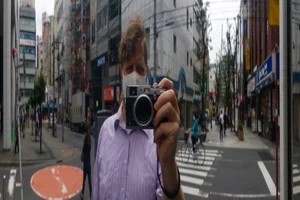
You anticipate a decisive moment by choosing the place first and waiting for the person, rather than chasing people. Find the light and geometry, decide where in the frame the picture will happen, then watch for the tells that come before action: two paths about to cross, someone slowing down, a repeated task, a gap in the crowd. Cartier-Bresson described it as recognition — seeing an event's meaning and its form at once — and recognition can be practised.
The decisive moment is not something that happens to you. It is the name we give to a prediction that came true.
The genre has turned it into a visitation — a mystical flash that either arrives or does not — and that is an extremely convenient thing to believe, because it lets you fire twelve frames at a stranger and call the survivor fate. Luck is not a method. If the moment only ever comes to you, you are not forging anything. You are collecting.
Start with the phrase itself, because almost everyone using it has the story backwards.
Cartier-Bresson's 1952 book was called Images à la Sauvette — roughly, images taken on the sly, on the run. "The Decisive Moment" was the English title, chosen by the American publisher because it sold better. The line underneath came from Cardinal de Retz's memoirs of 1717, suggested by his editor Tériade: il n'y a rien en ce monde qui n'ait un moment décisif — there is nothing in this world that does not have its decisive moment. His own foundation now says plainly that the idea went on to oversimplify how his work was understood.
And his actual definition has no magic in it at all. Photography, he wrote, is la reconnaissance simultanée, dans une fraction de seconde, d'une part de la signification d'un fait, et de l'autre d'une organisation rigoureuse — the simultaneous recognition, in a fraction of a second, of the significance of an event and of a rigorous organisation of form.
Read that again. Recognition. Twice. Both halves are cognitive acts. Nothing in it is given to you.
So here is how you actually get ahead of it.
Set the stage, then wait for the actor. This is the single largest shift, and most photographers never make it. Beginners follow people — they see someone interesting and chase the picture around the street. You cannot predict a person. You can absolutely predict a place. Find the light, find the geometry, decide exactly where in that frame the photograph will occur, and now the only unknown left is who walks into it. The frame is built before anyone arrives. This is also why zone focusing works: you already fixed the distance, so the stage has a marked spot on it.
Learn the rhythm of the place, not the person. Streets have a pulse. Signal cycles. Train arrivals. The surge of a crowd out of a station and the hollow that follows two minutes later. Ameyoko breathes on the timetable above it. Once you know the cycle, you know when the alley will empty enough for one figure to read against it, and you are standing there already when it does.
The tells. These are what actually precede a moment, and they are all visible:
- Convergence. Two trajectories that are going to intersect. Watch feet rather than faces — feet commit to a direction before a face admits to it.
- The pause before action. Slowing down, a hand going to a pocket, a glance upward. Preparation is nearly always visible, and it is the two seconds you need.
- Repetition. A vendor's work is a loop. He will lift that crate again in ninety seconds. Repetition is a free second take, and the only honest form of a retake street photography offers.
- The gap. Bodies move in clumps with holes between them. You are not waiting for a person; you are waiting for the hole that lets a person separate from the crowd.
- Eye lines. People look at what they are about to walk toward. Their attention arrives before their body does.
Be early, because you cannot be fast. Human reaction time is not going to win this. The frame you missed is almost always the one where you were still lifting the camera. Settings locked, distance set, camera at chest or already up. If you have to think, you have already lost the two seconds the tell bought you.
Return is prediction's cheat code. On the fourth visit to a corner, you know what happens there at four in the afternoon. That is not mysticism; it is data, and it is the reason the photographers who look luckiest are the ones who go back the most.
The drill that exposes you. After a miss, say out loud what you were waiting for. If you can name it — "he was going to step into the light and turn his head" — you were anticipating, and you were merely early or late. If you cannot name anything, you were not anticipating. You were hoping with a camera up.
The moment is not a gift. It is a forecast, which means it can be practised, and — this is the part people do not like — it means it can be wrong.

Salaryman reflected on a passing Tokyo train, observable and predictable-perfect image concept to practice with
The common counterpoint
The decisive moment is a myth that has done seventy years of damage. It sanctifies one frozen instant and has produced an entire genre of well-composed nothing — the man leaping the puddle, the umbrella at the perfect angle, technically immaculate and empty. Cartier-Bresson was a formalist whose subject was arguably geometry, and even the term was a publisher's invention, as you concede. The living tradition runs the other way: Winogrand and Frank are full of frames that are awkward, early, late, tilted — and better for it, because the interesting instant is usually the one beside the peak. Training yourself to anticipate is training yourself to shoot what you already expect, which is the definition of a cliché. And practically, a modern camera firing twenty frames a second catches things no human could foresee. Your "prediction" is just a story you tell afterwards about which frame you kept.
My answer
The damage is real, and I have already made the same argument elsewhere: sanctified peak moments have produced a great deal of well-made nothing, and the leaping-man frame is a genre cliché precisely because everyone learned to wait for the same instant.
But look at what that objection actually indicts. It indicts a choice of moment, not the ability to see one coming. Anticipation does not commit you to the tidy peak. It gives you the peak and everything on either side of it, and then you get to decide — and if the truer frame is the awkward one two beats later, you are there for it, still looking, because you knew what was happening. The photographer who cannot read the scene does not get the awkward frame either. He gets whatever the shutter happened to land on.
On the burst: I am not going to pretend a single frame is morally superior, and a fast camera does catch things nobody could have foreseen. I use one. The distinction I care about is whether the burst was fired at a prediction or instead of one. Firing because you knew what was coming and wanted the peak covered is craft. Firing because you did not know what was happening is a lottery ticket, and the tell is what you have afterwards — twelve frames of a thing you still do not understand, and a sorting problem.
And the retroactive-storytelling charge is fair, which is why I gave you a test that can fail. Say what you expect before it happens. Out loud, if you are alone enough. If you can name it in advance, it is prediction. If you can only name it afterwards, it was luck — and luck is welcome, luck is a gift, but luck is not a practice, and it does not improve.
You will never be fast enough to react. You can only ever be early.
Part of Street Photography: Twenty Questions, Answered— a series answering the questions people most often ask about street photography.
Frequently asked questions
Did Cartier-Bresson coin the phrase "the decisive moment"?
Not exactly. His 1952 book was titled Images à la Sauvette; the English title, The Decisive Moment, was chosen by the American publisher. The phrase comes from an epigraph from Cardinal de Retz's memoirs, suggested by his editor Tériade.
How do you predict a moment in street photography?
Learn a place rather than a person. Streets run on rhythms — signal cycles, train arrivals, crowds surging and emptying — and people telegraph what they are about to do through their feet, their pauses and their eye lines.
Is shooting bursts cheating?
No, but it matters whether you fire at a prediction or instead of one. A simple test: say what you expect to happen before it happens. If you can, you were anticipating. If you can only explain it afterwards, it was luck.
Notes and sources
All details about the book are from the [Fondation Henri Cartier-Bresson's document on Images à la Sauvette](https://www.henricartierbresson.org/wp-content/uploads/2016/12/DP-Images-a%CC%80-la-Sauvette-FHCB-1.pdf): the English title was chosen by Simon and Schuster; the epigraph, "Il n'y a rien en ce monde qui n'ait un moment décisif," is from Cardinal de Retz's memoirs of 1717 and was suggested by Tériade; the definition is Cartier-Bresson's own; and the Foundation notes that the idea "a quelque peu simplifié la façon dont l'œuvre d'Henri Cartier-Bresson a été perçue."